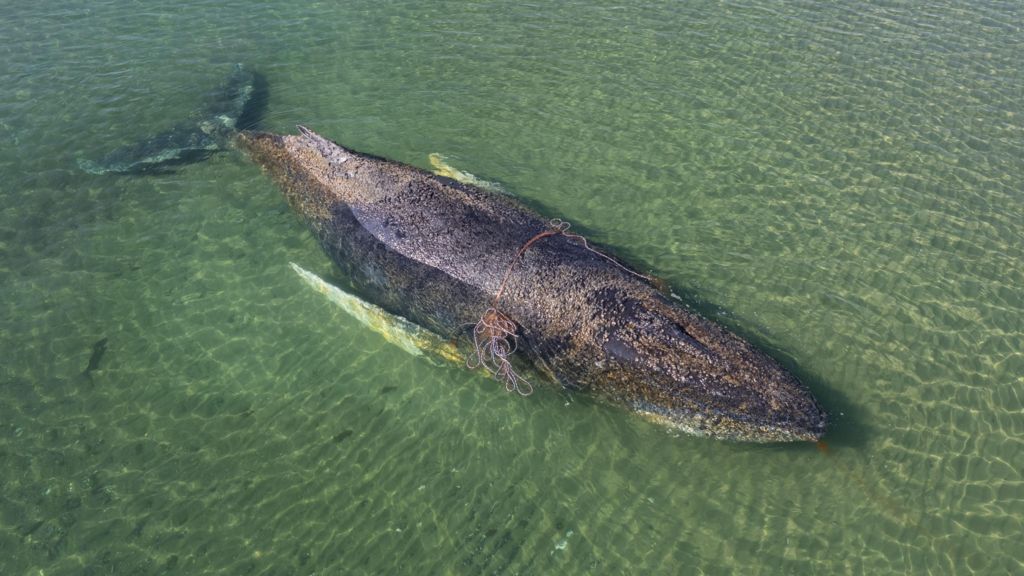
In a conclusion that has reignited debate over large-scale marine wildlife rescue efforts, a humpback whale that captured German public attention after repeated stranding on the Baltic coast has been confirmed dead near the Danish island of Anholt, between Denmark and Sweden.
The story of the 12-meter mammal, nicknamed alternately “Timmy” and “Hope” by rescuers and local media, began on March 23, when it first became stranded on a sandbank off Germany’s Poel Island, before re-stranding multiple times on Timmendorfer Beach in Lübeck Bay after an initial escape. After several unsuccessful rescue attempts by German state authorities, officials ultimately called off the official operation, leaving conservationists and the public divided over the whale’s fate.
The impasse broke when two private German entrepreneurs, Karin Walter-Mommert and Walter Gunz, stepped forward to fully fund an independent rescue mission. The team fit the weak whale with a satellite tracking device, coaxed it into a custom water-filled barge named Fortuna B, and transported it out to the deeper, saltier waters of the North Sea, releasing it in early May. The operation was immediately hailed as a landmark moment by regional officials: Till Backhaus, environment minister for Germany’s northern state of Mecklenburg-Vorpommern, called the mission a success and an inspiring example of what collective action could achieve for animal welfare across the country.
But the private rescue sparked fierce controversy even before the whale was released. Leading wildlife conservation organizations warned from the start that the vulnerable, underweight animal faced very low odds of long-term survival. The German Oceanographic Museum pointed out that the whale’s prolonged stay in the low-salinity Baltic waters had already left it severely weakened, putting it at constant risk of drowning even after relocation. The international NGO Whale and Dolphin Conservation added that the extended stranding had caused permanent skin damage from low salinity, arguing that the stressful translocation would only prolong the animal’s suffering rather than save it.
Weeks after the successful release, a whale carcass was spotted off Anholt Island on Thursday. Confirming the identity took several days, as poor weather conditions initially prevented authorities from accessing the site. On Saturday, the Danish Environmental Protection Agency announced it had verified the carcass was indeed the rescued humpback, and successfully recovered its tracking device.
Currently, Danish officials say there are no immediate plans to remove the carcass from the coastal area or conduct a necropsy to determine the exact cause of death, as the remains do not yet pose a hazard to local navigation or ecosystems. However, authorities have issued a public safety warning: local residents and visitors are urged not to approach the carcass, as decomposing whale remains can carry zoonotic diseases transmissible to humans. Officials also noted that there is a small risk of a natural rupture driven by buildup of decomposition gases inside the mammal’s body, a common hazard with large beached whale carcasses.