LONDON – The British capital is bracing for a high-stakes weekend of public assembly, with Metropolitan Police rolling out one of the largest recent domestic security deployments to manage two massive competing demonstrations and a major soccer championship, all occurring within hours of each other on Saturday. Tens of thousands of protesters were expected to converge on central London, while another crowd of tens of thousands of football fans would gather at Wembley Stadium for England’s FA Cup Final between Chelsea and Manchester City, creating unprecedented coordination challenges for law enforcement.
To prevent violent clashes between opposing groups and maintain public order, authorities have deployed more than 4,000 police officers, supported by a full suite of security resources including armored vehicles, mounted police units, canine teams, surveillance drones, and air support from helicopters. A core priority for police is separating two diametrically opposed protest marches along designated, isolated routes: a rally organized by far-right figure Stephen Yaxley-Lennon, who uses the pseudonym Tommy Robinson, under the “Unite the Kingdom” banner, and an annual demonstration marking Nakba, the 1948 displacement of roughly 700,000 Palestinians from their historic homeland. While main marches are kept apart, law enforcement remains on high alert for unsanctioned contact between smaller splinter groups unaffiliated with either main organizing body.
In a move to pre-empt potential hate crime, the UK’s Crown Prosecution Service (CPS) has instructed prosecutors to evaluate whether protest materials — including placards, banners, and chants documented on social media — cross the line from protected speech into criminal offense of inciting hatred. CPS Director Stephen Parkinson emphasized that the guidance does not target legitimate free expression. “This is not about restricting free speech,” Parkinson stated. “It is about preventing hate crime and protecting the public, particularly at a time of heightened tensions.”
The national government has also taken pre-emptive action, barring 11 foreign far-right figures from entering the country to attend the “Unite the Kingdom” rally. High-profile figures already confirmed as excluded include Polish politician Dominik Tarczynski, Belgian politician Filip Dewinter, anti-Islam commentator Valentina Gomez, and Dutch activist Eva Vlaardingerbroek. Prime Minister Keir Starmer made clear the government’s zero-tolerance stance for incitement of violence and disorder. “We will block those coming into the UK who seek to incite hatred and violence,” Starmer said. “For anyone who sets out to wreak havoc on our streets, to intimidate or threaten anyone, you can expect to face the full force of the law.”
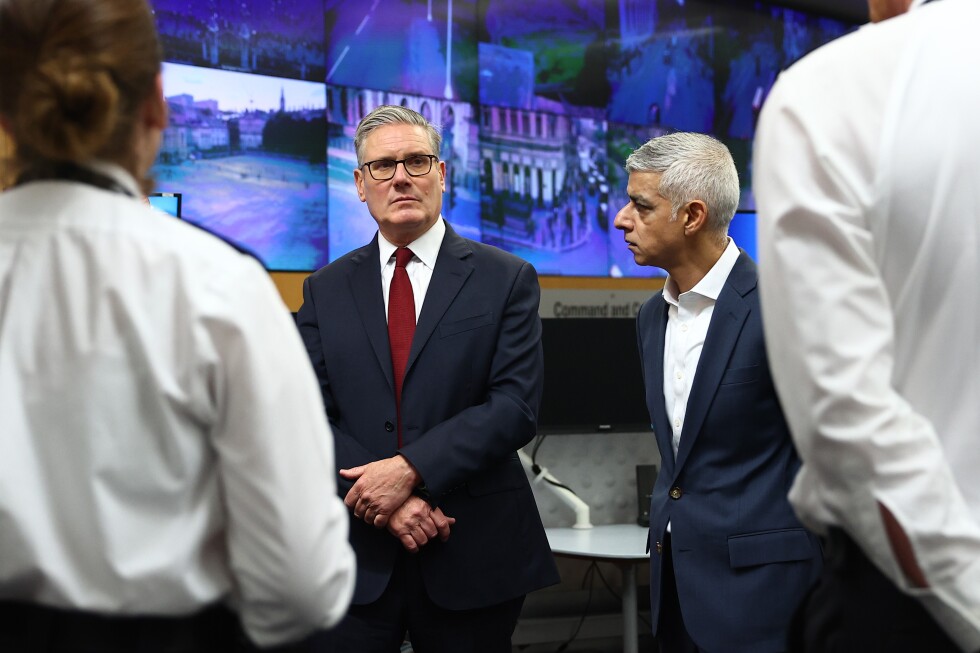
A day ahead of the demonstrations, Starmer visited the Metropolitan Police’s central command center to review security plans alongside Met Commissioner Mark Rowley and London Mayor Sadiq Khan. In a landmark moment for UK protest policing, Saturday’s operation marks the first time live facial recognition technology will be used to monitor a major protest gathering. Security cameras have been installed in the Camden neighborhood of north London, a popular thoroughfare for attendees traveling to the “Unite the Kingdom” rally that falls outside the official march route.
A short distance away at Wembley Stadium, police are working to ensure the FA Cup Final, one of the biggest events on the UK domestic sports calendar, proceeds without disruption. Kickoff for the match between Chelsea and Manchester City is scheduled for 3 p.m. Saturday, with authorities coordinating crowd management across the capital to keep protest routes, fan travel corridors, and the stadium perimeter separate and secure.