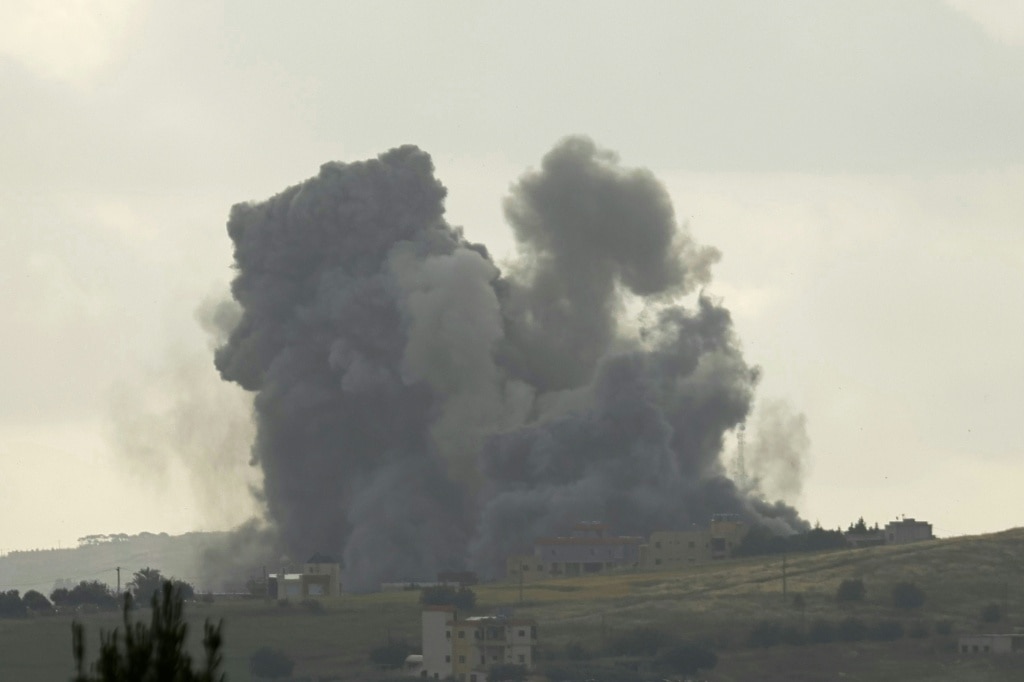
Just one day after the United States broker a 45-day extension of a ceasefire between Israel and Hezbollah, the Israeli military launched a new wave of airstrikes against Hezbollah positions across southern Lebanon, marking an abrupt end to the temporary calm that followed the Friday diplomatic breakthrough. The escalation has triggered mass displacement of local residents, with hundreds of civilians fleeing five targeted southern villages toward the coastal city of Sidon and Beirut, Lebanon’s capital, according to the country’s official National News Agency.
The violence was not confined to rural border areas: State media confirmed that an Israeli airstrike hit a multi-story residential building in the southern Lebanese port city of Tyre, carried out hours after the Israeli military issued evacuation warnings for the structure. AFP correspondents on the ground confirmed the strike. Separately, Lebanon’s health ministry announced that an Israeli strike in the southern town of Haruf killed three paramedics affiliated with the Hezbollah-linked Islamic Health Committee. The Israeli military reported that over the past seven days, its operations in southern Lebanon killed more than 220 Hezbollah militants and struck over 440 militant targets across the region.
The ceasefire extension, announced Friday by the US State Department following two days of Washington-mediated talks, was intended to create space for negotiations toward a permanent, long-term political settlement between the two neighboring states. “The April 16 cessation of hostilities will be extended by 45 days to enable further progress,” State Department spokesperson Tommy Pigott confirmed in a statement. He added that US officials will host new negotiations for a permanent agreement on June 2 and 3, while the Pentagon will convene military delegations from both sides for security talks on May 29.
Lebanon’s official delegation described the deal as a critical step toward long-term regional security, noting in a statement released by the Lebanese presidency that the truce extension and US-facilitated security negotiating track “pave the way for lasting stability” and provide “critical breathing space for our citizens.” Lebanese Prime Minister Nawaf Salam echoed that sentiment, adding in remarks at an NGO gathering Friday that his country has been exhausted by decades of “reckless” foreign-backed conflicts and called on Arab and international stakeholders to back Beirut’s position in upcoming negotiations with Israel.
The conflict in the broader Middle East has already rippled through global energy markets, after Iran’s blockade of the Strait of Hormuz — the world’s busiest chokepoint for crude oil shipments — has gutted oil exports from OPEC founding member Iraq. Iraq’s new oil minister announced Friday that the country exported just 10 million barrels of crude through the strait in April, a stark drop from the typical monthly volume of 93 million barrels. Like most Persian Gulf oil producers, Iraq routes the vast majority of its crude exports through the strategic waterway, and has struggled to reorient its supply chain to alternate routes after the Iranian blockade took effect.
The disruption to global oil supplies has shaken financial markets: Global equity indexes slumped Friday after high-level US-China summit talks failed to produce any breakthrough agreement to reopen the strait, stoking renewed fears that sustained energy price increases will fuel persistent global inflation and slow economic growth. Energy markets moved sharply in the opposite direction: International benchmark Brent crude rose 3% to trade near $109 per barrel following the news.
In another development tied to regional tensions, the United Arab Emirates issued a firm rejection of Iranian accusations that the Gulf state has played an active offensive role in the ongoing conflict. “The UAE affirms its categorical rejection of Iranian claims and attempts to justify Iranian terrorist attacks targeting the UAE” and other regional countries, Minister of State Khalifa bin Shaheen Al Marar said in an official statement.
Separately, in the occupied West Bank, Palestinian health officials reported that Israeli forces shot and killed 34-year-old Nour al-Din Kamal Hassan Fayyad on the outskirts of the Jenin refugee camp in the northern portion of the territory. The Ramallah-based Palestinian Ministry of Health confirmed Fayyad’s identity, saying he was “killed by occupation forces’ fire in the Jenin camp.” The Israeli military had not issued an immediate response to requests for comment on the killing as of Friday.