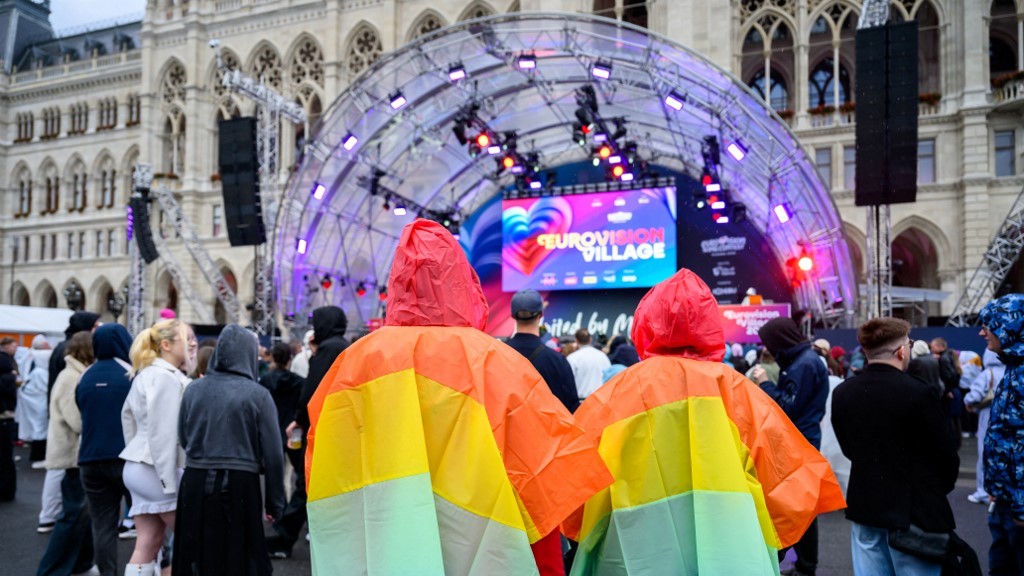
As the 2026 Eurovision Song Contest prepares to crown its winner in Saturday’s grand final in Vienna, the long-running European music spectacle has been plunged into unprecedented controversy, with queer activists leading global calls to boycott the event over what they label deliberate “pinkwashing” of Israeli state violence against Palestinians.
The controversy traces back to December 2024, when the European Broadcasting Union (EBU), Eurovision’s governing body, voted to allow Israel to compete in this year’s contest. That decision has sparked sustained protests across Europe, from mass demonstrations on the streets of host city Vienna to the expulsions of pro-Palestine campaigners who disrupted live shows, and loud public booing and chants of “stop the genocide” during Israel’s qualifying performance. Five countries — Spain, Ireland, Iceland, Slovenia and the Netherlands — have already withdrawn from the contest entirely in protest, and multiple national public broadcasters have refused to air Saturday’s final.
A flashpoint for queer criticism came in Thursday’s live semi-final broadcast, which included a pre-taped segment celebrating the contest’s long history of inclusivity for the LGBTQ+ community, a demographic that has long formed one of Eurovision’s core global audiences. For activists, the segment laid bare what they call the EBU and Israel’s coordinated campaign of reputation laundering: using the language of queer inclusivity to distract from ongoing military violence against Palestinians.
Omar Khatib, a queer Palestinian writer and organiser based in Jerusalem, framed the moment as a clear moral test for global audiences. “Either you are against genocide and against the mass killing of Palestinians, or you are willing to normalise and coexist with it,” Khatib told Middle East Eye. He argued that the myth of Eurovision’s political neutrality no longer holds up, noting that the event has become a stage where “liberalism, nationalism and colonialism intersect under the language of diversity and inclusion.” For queer Palestinian organizers, Khatib added, Israel’s participation is not just a minor entry in a music contest: it is part of a broader state propaganda push that weaponizes queer identity to legitimize state violence against Palestinian people.
In response to the EBU’s decision, thousands of LGBTQ+ viewers who have watched Eurovision for decades are now breaking that long-held habit and boycotting Saturday’s final. Queers for Palestine, a UK-based activist group that held a pro-Palestine symposium in London last month, is urging queer viewers to skip the broadcast and instead join the queer contingent at London’s annual Nakba Day demonstration, which commemorates the forced displacement of hundreds of thousands of Palestinians during the 1948 creation of the State of Israel. For those who stay home, group member Tara suggests organizing local actions: asking local queer venues to cancel their Eurovision screenings, or distributing educational leaflets to attendees explaining how the event enables what activists call Israeli settler-colonialism and genocide.
“Find those around you who want more from their queerness than annual shows of opulence dripping with blood, and set your sights again on what queerness is really all about: liberation,” Tara said. Addressing claims of hypocrisy from pro-Israel commentators, who often point to anti-LGBTQ+ policies from Palestinian political groups like Hamas, Tara pushed back on the false binary. “As queer activists, we love freedom and dignity for everyone and we want to contribute to the end of this oppression,” she said. “We, of course, also support our queer Palestinian friends and siblings when they struggle against the violence of patriarchy in their own society, as all queer people do everywhere in the world… there is quite obviously nothing hypocritical about this.”
Mainstream reporting has backed up activists’ pinkwashing claims: The New York Times revealed earlier this week that Israel has spent more than $1 million on its Eurovision participation, framing the contest as a key soft power tool to repair the country’s damaged international reputation and rally global support amid widespread condemnation of its military operations in occupied Palestinian territories. Records show Israel launched this formal promotional campaign back in 2018, as criticism of its participation grew alongside its ongoing settlement expansion and military operations.
For decades, Israel has positioned itself as a regional LGBTQ+ haven compared to neighboring countries: same-sex relations and same-sex adoption are legal in the country, and Tel Aviv has cultivated a global reputation as a leading queer travel and culture hub. But that reputation has long been challenged by critics, who note that same-sex marriage remains unlegalized in Israel, that powerful Jewish fundamentalist groups routinely push back against LGBTQ+ rights advances, and that a 2025 Pew Research Center survey found 47 percent of Israelis view homosexuality as morally unacceptable. Most notably, queer Palestinians have documented being targeted by Israeli intelligence, who routinely blackmail queer Palestinians into collaborating with Israeli occupation forces.
The boycott campaign has drawn widespread support from artists across the globe, with more than 2,000 musicians signing the “No Music For Genocide” petition calling for a full boycott of the 2026 contest. UK feminist punk band Big Joanie, which centers the experiences of Black and queer women in its work, was one of those signatories. Lead singer Stephanie Phillips said the desire to enjoy a beloved cultural event cannot override the reality of violence facing Palestinians. “I think there is definitely merit for an accusation of pinkwashing,” she said. “While I fully understand that Eurovision means a lot to the LGBTQ+ community, I also think it does not cancel out the reality that many Palestinians are living right now – there are LGBTQ+ Palestinians as well and I doubt they feel represented or seen by the choices of Eurovision.” Phillips noted that the band’s audience has been overwhelmingly supportive of their pro-Palestine stance, with only one negative incident after a show in Cologne, Germany, where an attendee aggressively confronted her for dedicating a song to the Palestinian people.
The controversy has already had a measurable impact on the contest’s global reach. Typically, Eurovision’s 25-country grand final draws more than 150 million viewers worldwide, but this year’s final is on track to be the least-watched in the event’s history. Alongside the five withdrawing countries, Spanish public television has already confirmed it will not air the final, and Slovenian and Irish public broadcasters have also pulled their broadcasts. Semi-final viewership in countries still airing the contest has already slumped sharply from previous years. As final rehearsals wrapped up in Vienna on Friday, a parallel pro-Palestine event featuring speeches and a concert was held in the city center, drawing hundreds of attendees.
Even former contest winners have sounded the alarm over the long-term damage the controversy has done to Eurovision’s reputation as a unifying cultural event. Emmelie de Forest, the Danish singer who won the 2013 contest, told Middle East Eye that the EBU’s decision has left her heartbroken. “I think it has already done a lot of damage to Eurovision, and that makes me genuinely sad to say because the contest has been such a meaningful part of my life,” she said. “I sadly think the contest is creating more division than unity. The controversy surrounding Israel’s participation, the backlash from fans and artists, the countries withdrawing and the growing distrust toward the EBU have all fundamentally changed the atmosphere around Eurovision.”