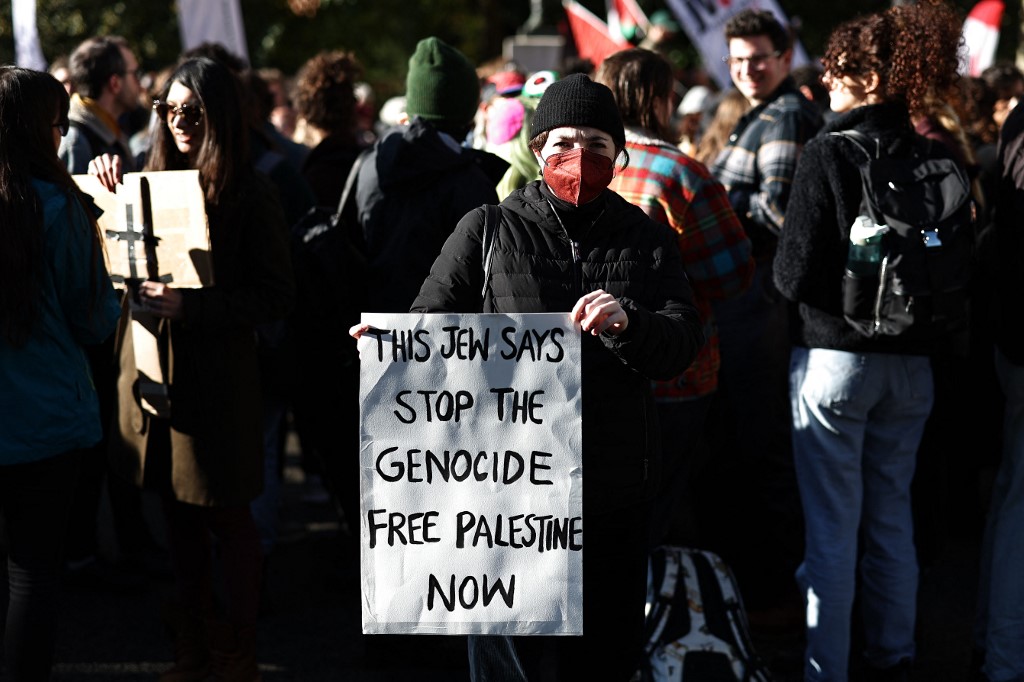
On Saturday, thousands of demonstrators are set to gather in central London for two competing marches carrying starkly clashing ideological messages, as tensions over the Israel-Gaza conflict continue to roil British public life. The first, organized to mark the 76th anniversary of the Nakba — the 1948 displacement and ethnic cleansing of Palestinians that accompanied the founding of Israel — also demands an end to more than two and a half years of Israeli military action in Gaza that organizers describe as genocide. Leading the march will be 80-year-old Haim Bresheeth-Zabner, a British-Israeli author, filmmaker, and child of Holocaust survivors who has spent decades as a prominent pro-Palestine activist.
Near the pro-Palestine rally, far-right figure Tommy Robinson will lead his “Unite the Kingdom” march, a gathering defined by its pro-Israel and anti-Muslim rhetoric. Public safety observers have warned of a heightened risk of violent clashes between the two opposing groups, adding a layer of urgency to policing plans across the capital.
For Bresheeth, participation in this weekend’s march is a continuation of years of consistent advocacy. He is among a large, visible contingent of Jewish activists who have joined every major pro-Palestine protest in London since the escalation of conflict in Gaza, a presence that has been openly embraced by other demonstrators. “I have never felt more welcome,” Bresheeth told Middle East Eye in an interview. “Ask any Jews who took part in the marches, we are never more accepted, or more part of British public life than at those demonstrations, at which there is no violence whatsoever.”
A former Israeli soldier who served in three wars before renouncing Zionism in the 1970s, Bresheeth brings unique personal context to his criticism of the Israeli state and Western policy toward the conflict. Born and raised in Israel, he is co-founder of the Jewish Network for Palestine, author of multiple acclaimed books including *Introduction to the Holocaust* (1997) and *An Army Like No Other: How the Israel Defence Forces Made a Nation* (2020), and director of the 1989 BBC documentary *State of Danger* covering the first Palestinian Intifada. Seventeen members of his mother’s family were murdered in the Holocaust, and his father survived imprisonment in Auschwitz, giving Bresheeth direct, intimate knowledge of the impact of systemic antisemitism.
Against a backdrop of rising hate crime across the UK — where both antisemitic and Islamophobic attacks have spiked since the Gaza conflict escalated — Bresheeth has emerged as a vocal critic of the way discourse around antisemitism has been reshaped in Western politics. He argues that the International Holocaust Remembrance Alliance (IHRA) definition of antisemitism, adopted by the UK and most Western governments, incorrectly conflates legitimate criticism of the Israeli state with hatred of Jewish people, marking a dangerous break from earlier, clearer definitions.
Bresheeth contextualizes modern antisemitism by contrasting it with the systemic, state-sanctioned persecution his family experienced in 1930s and 1940s Europe. “Antisemitism meant Jews were banned from any part of society, including sitting on a park bench or in a first-class train carriage,” he explained. “If you killed a Jew, you didn’t actually do anything wrong, because their life was not protected by the law. In a sense, it was allowed to kill them. This is the situation now of course in Israel towards Palestinians.”
He accuses British political and media elites of weaponizing historic Jewish trauma for political gain, pointing to the response to the April stabbing of two Jewish men in London’s predominantly Jewish Golders Green neighborhood. The attack, in which a 45-year-old suspect with a history of psychiatric illness was charged with attempted murder (and also the stabbing of a Somali man earlier that day), was immediately designated a terrorist incident, prompting Prime Minister Keir Starmer to convene an emergency COBRA meeting and a high-profile government summit on antisemitism.
Two years ago, Bresheeth predicted that unwavering support for Israel from mainstream British Jewish leadership groups and the country’s political elite would fuel a rise in antisemitism across the UK. He notes that most people critical of Israeli actions in Gaza distinguish the Israeli state from Jewish people globally. “The history and tradition of Judaism is obviously the best proof that there is little which is Jewish about Israel, and nothing in Judaism is supporting the genocide,” he said. But he warns that less informed members of the public, swayed by mainstream Jewish organizations’ denial of atrocities in Gaza, are more likely to connect the state’s actions to Jewish communities as a whole, driving anti-Jewish sentiment.
Bresheeth also highlights a profound double standard in how attacks on different communities are covered and addressed by British institutions. He points to a stabbing at an anti-war protest outside Downing Street in April, where an Iranian protester was injured by pro-monarchist counter-protesters. Unlike the Golders Green attack, the stabbing received almost no mainstream media coverage, and Bresheeth claims police failed to intervene even after protesters warned of threats before the incident. “A member of the public had to stop him [the knifeman] because the police had not moved to stop him,” he said.
A Metropolitan Police spokesperson told Middle East Eye that the force is aware of the impact of global conflict on London communities and takes all threats of violence seriously. But Bresheeth says the contrast in responses exposes a systemic bias that prioritizes the safety and concerns of pro-Israel groups over those of pro-Palestine and Muslim communities.
Bresheeth has been a consistent presence at all but one of the major pro-Palestine marches held in London over the past two years, and he forcefully rejects claims that the demonstrations are inherently antisemitic or intentionally disruptive. He refutes Metropolitan Police Commissioner Mark Rowley’s unsubstantiated claim that march organizers intentionally route protests past synagogues to intimidate Jewish Londoners. “We never came near a synagogue, we never attacked anyone, everyone is peaceful… This is a very ugly and disgusting lie in order to stop our marches against the genocide,” he said.
The veteran activist has himself been targeted in the UK government’s crackdown on pro-Gaza protests. In November 2024, he was arrested near the Israeli embassy after giving a speech quoting an Israeli former general who said Israel could not win its war against regional armed groups. Police detained him on suspicion of supporting a proscribed organization, a charge that was ultimately dropped with no further action. Bresheeth, who lives with cancer and heart disease, alleges police held him outside a police station for three hours without access to his medication, a violation of his medical needs that he says put his life at risk. A Met spokesperson says officers followed protocol, arranged for medication to be retrieved from his home, and provided access to healthcare after he was taken into custody. Bresheeth, who was questioned by counter-terrorism officers for more than two hours, calls the incident an example of the disproportionate targeting of peaceful pro-Palestine activists.
He points to broader systemic inequities in policing of the conflict: more than 3,200 people have been arrested across the UK for protesting Gaza and supporting the proscribed activist group Palestine Action, while hundreds of young British Jewish men who have traveled to Israel to fight in Gaza face no official action from British authorities, despite widespread documentation of war crimes committed by Israeli forces. “What kind of democracy are we living in?” he asked.
Bresheeth’s journey to anti-Zionist activism began during his own military service, which began with the 1967 Six-Day War, when he served as a 21-year-old communications officer. “I believed in the claim we were a moral army,” he recalled. He served again in the 1973 Yom Kippur War, an experience that confirmed his disillusionment: “I went there like an idiot and realised the minute I arrived it was a mistake. That war made me an anti-Zionist. I realised that Zionism cannot exist without war, cannot exist without chaos.”
That disillusionment deepened as he witnessed firsthand the conduct of Israeli forces during his service. He recounts an incident during the 1967 war where he overheard a battalion commander report holding 200 Syrian prisoners of war, only for the brigade command to refuse to respond, implying the commander should kill the captives. While Middle East Eye cannot independently verify the incident, multiple documented cases of Israeli forces executing captured Arab troops during this period are part of the historical record. “It became clear to me that we are not a moral army, we are not keeping to international law,” Bresheeth said. “Each of those wars had numerous examples of immorality, illegality, the level of brutality is legend.”
That brutality, he says, has reached an unprecedented peak in Gaza over the past two years. He points to a recent New York Times investigation confirming widespread sexual abuse of Palestinian detainees by Israeli forces, including reports that commanders allowed Palestinian prisoners to be raped by military dogs. “When an army is using torture daily, they are not even POWs – they are doctors, university professors – [who] are being raped by dogs under army commanders. I don’t remember in any other genocide reading about this,” he said.
Bresheeth argues that the denial of the Gaza genocide by the British political and media establishment represents a growing crisis across the Western world, one that signals a broader erosion of commitment to international law and objective truth. “If you want to avoid reality you can hold your hand very close to your eyes and say there is no sun,” he said, referencing the British government’s refusal to label Israeli actions in Gaza as genocide. “We are in an upside down world, it’s an inversion of reality; our elite – the media – is supporting the breaking of international law, refusing to admit this genocide is taking place. This marks a new kind of political crisis in Britain and across the West,” he warns, “What we see are signs of social collapse, losing connection with reality, which is the same as what is happening in Israel – blaming the whole world as antisemitic.”
As London prepares for Saturday’s demonstrations, Bresheeth remains committed to his advocacy, standing in solidarity with Palestinians alongside thousands of other Britons united in their call for an end to the violence.