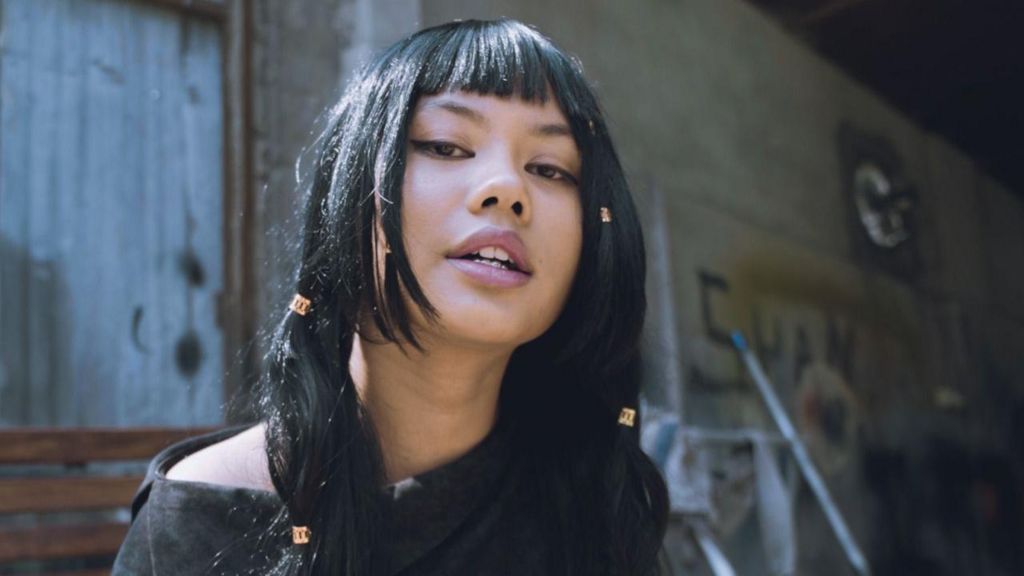
At just 24 years old, Reble — born Daiaphi Lamare — has carved out an unprecedented space as one of the most distinct and captivating new voices in India’s rapidly evolving hip-hop scene. Hailing from the mist-shrouded hills of Meghalaya, a northeastern Indian state wedged between Bangladesh, China, and Myanmar, her art draws deeply from the cultural complexity of a region long sidelined as a cultural outsider within mainland India, and infuses that perspective into a sound wholly her own.
Reble’s journey to mainstream recognition began far from the glitz of Mumbai’s entertainment industry. Growing up feeling like an outsider through years of boarding school, she recalled a childhood spent on the social margins: “Young Reble was always by herself. No friends. Sitting in one corner. Everybody was like, who’s that weird girl?” This early alienation shaped her stubborn, unapologetic artistic identity. She briefly pursued an engineering degree in Bengaluru’s tech hub, but always knew a conventional nine-to-five career would never fit. “I don’t like anybody telling me what to do,” she told the BBC, a mantra that has defined her career from its earliest days.
Her stage name is more than a performance alias — it is a deliberate, personal rebellion. Rap became the perfect outlet for the tangled emotions of a lifelong misfit, she explains, turning her sense of disconnect into raw, intentional art. Unlike many of India’s high-energy, bombastic hip-hop artists, Reble’s style is defined by deliberate emotional restraint: she weaves verses thematically centered on distance, reinvention, and survival across three languages — English, Khasi, and her native Jaintia, the indigenous tongue that she calls her “emotional anchor.” This duality of being simultaneously local and global, rooted yet detached, sits at the core of her creative identity. A quirky irony defines her process: despite being lauded for her sharp lyricism, she openly admits she dislikes writing, leaving most of her verses as scattered, unfinished scribbles that take shape in performance.
For years, Reble built her following within Shillong’s tight-knit local music community, a city far better known for its iconic rock bands, church choirs, and folk guitar traditions than hip-hop. Her breakout arrived unexpectedly through the soundtrack of the Bollywood action film *Dhurandhar*, where her cool, clipped verses cut through the movie’s chaotic, high-energy production to win over millions of new fans across the country. Her newly released single *Praying Mantis*, a dark, hypnotic track, has once again sparked widespread discussion, with fans dissecting every line across social media.
Her rapid rise has not come without backlash. After her Bollywood breakthrough, some long-time fans accused her of “selling out” for pursuing mainstream commercial work. Others in her deeply religious home state, where Christian church culture dominates public life, have attacked her work as anti-Christian or even satanic over lyrical references to demons. Reble dismisses the outrage with characteristic cool: “When you get commercial success, people think you sold your soul.” For her, working on film projects is not compromise, but experimentation — and she remains selective about the work she takes on.
Reble’s success is more than an individual success story: it reflects a sweeping shift underway in Indian popular culture, where regional artists from once-fringe regions are gaining national and global traction, breaking the long-held monopoly of big mainland cities over cultural relevance. Growing up in Shillong’s rich music ecosystem, where church choirs blend with teenage metal bands and blues bars, she absorbed both local tradition and global hip-hop influences. Early on, she connected deeply with Eminem’s work, particularly his ability to turn alienation into art — a theme that echoes through her own tracks. Yet her work remains unapologetically rooted in her identity: on *Opening Act*, she raps “I’m a Jaintia making moves/ I’m a tribal,” a proud declaration of heritage shaped by the village and the resilient women who raised her.
Like many Indigenous northeastern Indians who have lived outside the region, Reble has faced systemic racism and concedes that artists from her part of India have never had the same opportunities as their mainland counterparts. But she frames her journey through pride, not resentment: “Coming out from a region like that, I feel very proud.” Back home, even when audiences do not always fully grasp every layer of her hip-hop sound, the reception has been deeply emotional. “They’re happy that someone is doing something. Like — that’s our girl,” she says.
For those watching from the outside, Reble’s rise can feel sudden, but she frames it as the simple result of deliberate consistency. “The biggest lesson so far is that consistency is key,” she says. “More than talent, I believe in the discipline of getting better over time. If you’re not good at something, you need to get better. Be realistic enough to know how bad you are.” That grounded, unromantic approach to struggle is what makes her story stand out: even as she turns lifelong alienation and marginalization into art, she refuses to sensationalize hardship, letting the quiet power of her work speak for itself. As Indian culture continues to decentralize, with the most exciting creative energy emerging from once-overlooked regions, Reble got there first — and she’s only just getting started.