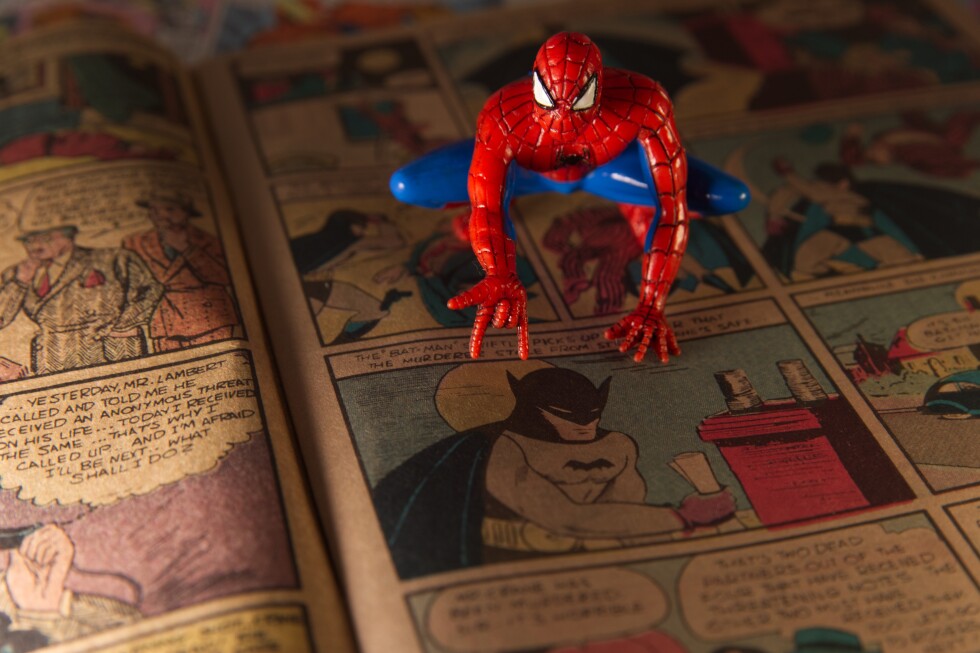
BARCELONA, Spain — From their glossy eye-catching covers to depictions of impossibly muscular heroes clad in skintight costumes, American superhero comics draw readers in instantly with the promise of high-stakes battles, triumph over villains and thrilling adventure. For decades, these slim, serialized publications have carved out a one-of-a-kind space in global pop culture, often contrasted sharply with other regional sequential art forms.
Against Europe’s more literary, substantive graphic novels, traditional American superhero comics are often dismissed as flimsy, juvenile entertainment. When stacked against Japanese manga’s sprawling, genre-spanning narratives with complex thematic layers, American superhero stories read as earnest and uncomplicated, rooted in a bygone era of American cultural identity. Once sold for mere nickels and dimes before climbing to quarter price points, today single issues typically cost as much as a coffee shop latte — a clear marker of their place as a product of American consumer capitalism, widely labeled as junk-food literature: eye candy for casual readers, light entertainment that requires little deep engagement. But this surface reading overlooks the deeply American identity that has been baked into these 32-page monthly stories for generations.
The turning point for modern American superhero comics came in 1961, when Stan Lee and Jack Kirby launched the Fantastic Four. In the team’s origin story, a fateful unplanned space journey exposes four explorers to cosmic radiation, leaving them with extraordinary abilities they never asked for. This origin rewrote the rules of superhero storytelling: for the first time, all-powerful heroes were also reluctant, relatable figures, shaped by the unintended consequences of scientific progress and random chance — flawed, modern people first, heroes second.
This blueprint shaped countless iconic characters that followed. Spider-Man, the Hulk, Wolverine, and dozens more were marked by their otherness: their incredible powers turned them into outcasts, casting them as imperfect, burdened messiahs rather than perfect, unflappable paragons. Tied to a core thread of the American cultural psyche, nearly all of these characters abide by Peter Parker’s iconic moral mandate: “With great power comes great responsibility.” Like a distinctly American reimagining of the Greek myth of Sisyphus, they are bound to an endless cycle of sacrifice, repeatedly stepping forward to save the world even when victory offers them no personal reward.
What could be more fundamentally American than this core belief: that when raw power is anchored to a commitment to justice, it will ultimately prevail? It is a worldview that is simultaneously deeply honorable and unapologetically naïve, a reflection of the national identity that has shaped the country for centuries.
Today, even as storytelling has grown grittier and more complex, the two giants of the American comic industry — Marvel and DC — continue to reimagine what American character looks like for new eras. Long sidelined as supporting players to white male lead characters, female fan-favorites including Gwen Stacy, Jean Grey, and Susan Storm have emerged as central leaders in recent years, breathing new life into iconic sagas for Spider-Man, the X-Men, and the Fantastic Four. DC’s *Absolute Wonder Woman* has pushed creative boundaries with groundbreaking, cinematic artwork, while half-Latino, half-Black Miles Morales has become the Spider-Man for a new, more diverse generation of readers.
Even with these evolutions, the core tensions that have long defined American superhero stories remain unchanged. Bruce Wayne, the Batman, is unable to form deep meaningful connections with anyone beyond his longtime butler Alfred — a perfect portrait of the isolated individual in modern, atomized American society. Steve Rogers, Captain America, carries the weight of representing the World War II “Greatest Generation,” forever an outsider out of time even in his own country. And Lex Luthor, Superman’s villainous megalomaniacal nemesis, stands as one of the most iconic depictions of a power-hungry tech tycoon meddling with humanity’s future for his own gain — a trope that feels just as relevant today as it was decades ago, leaving readers to joke that the modern world could use a mild-mannered Clark Kent keeping watch on powerful elites, just in case.
This feature is part of the recurring series “American Objects,” created to celebrate the 250th anniversary of the United States, exploring the everyday and cultural items that have shaped the nation’s identity over its history.