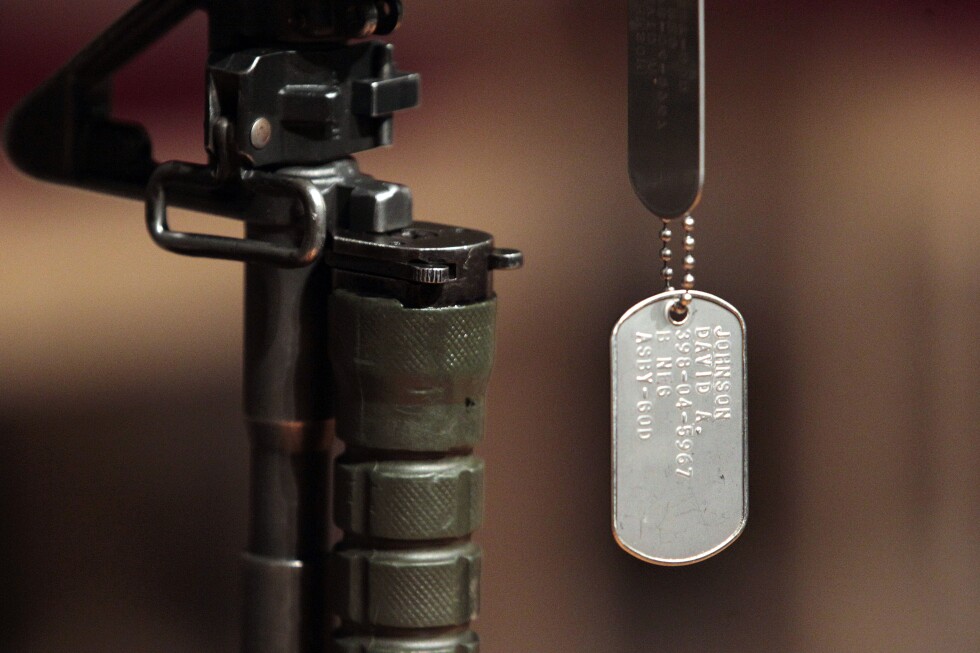
For grieving military families across the United States, a small pair of worn metal rectangles often holds more weight than any memorial. Many survivors clench these items in their palms, as if they can still feel the hand of the service member they lost gripping back. Even battle-hardened fellow troops have broken down in tears reading the engraved names and details etched into their surfaces.
More than a century after an Army chaplain first advocated to make these identification tokens – universally known as dog tags – standard issue for all American service members, they have evolved far beyond a practical tool for battlefield identification to become one of the most sacred and tangible links between fallen troops and their loved ones left behind.
Stationed at Dover Air Force Base, the facility where the remains of U.S. service members killed overseas are repatriated to American soil from conflicts ranging from Afghanistan to recent tensions in the Middle East, Air Force Major and Chaplain Benjamin Quintanilla Jr. has witnessed this connection firsthand. “What families are searching for when they hold these tags is a connection to the person they lost,” Quintanilla explained. “That is what makes these dog tags such a sacred symbol for them.”
From the brutal trenches of the World Wars to the jungles of Vietnam and decades of ongoing conflict across the Middle East, military dog tags have also stood as a quiet, enduring emblem of the sacrifice American service members have made in global engagements. Even so, Pentagon historians note that the origin of the common term “dog tags” for these identification tokens remains unconfirmed to this day.
The urgent need for standardized battlefield identification first emerged into public consciousness during the American Civil War, when tens of thousands of troops were buried in unmarked graves as “unknown” soldiers. National Park Service data underscores this gap: at Vicksburg National Cemetery alone, 75% of the 17,000 Union troops interred there are recorded as unknown.
It was not until the end of the Spanish-American War, the 1898 conflict that cemented the United States’ status as a rising global power, that a formal push for standard issue identification tags began. Serving as morgue director in the Philippines following the conflict, Army Chaplain Charles C. Pierce became the first official to formally request that all Army service members be issued individual identification tags.
By the time the United States entered World War I, mandatory dog tag wear was required for all combat troops. The small metal tokens were officially integrated as a required part of the standard military uniform by World War II, a policy that remains in place today.
In the modern era, dramatic advances in forensic science and biometric identification have reduced the historical reliance on dog tags for confirming the identity of fallen service members. Even so, the small tokens still hold critical practical value for military chaplains deployed to combat zones: the standard listing of religious affiliation allows chaplains to deliver appropriate, respectful end-of-life care and funeral rites for dying and fallen troops, according to Quintanilla.
It is the deep symbolic meaning of connection, however, that makes dog tags irreplaceable for military communities. Surviving family members treasure the dog tags their loved ones wore during their service, as well as the honorary tags placed on fallen troops’ caskets during formal dignified transfer ceremonies. So profound is this attachment that many survivors choose to wear their loved one’s tags daily, or even get permanent tattoos replicating the engraved text.
For currently serving troops, dog tags also act as the simplest, most immediate marker of shared belonging. Quintanilla, who originally joined the Air Force as a dental technician before becoming a chaplain, explained this bond: “I can trust somebody who is wearing the same identification as me. It’s a reminder that I was part of something bigger than myself.”
This story is part of *American Objects*, a recurring series marking the 250th anniversary of the founding of the United States that explores the stories of ordinary objects that shaped the nation’s history.