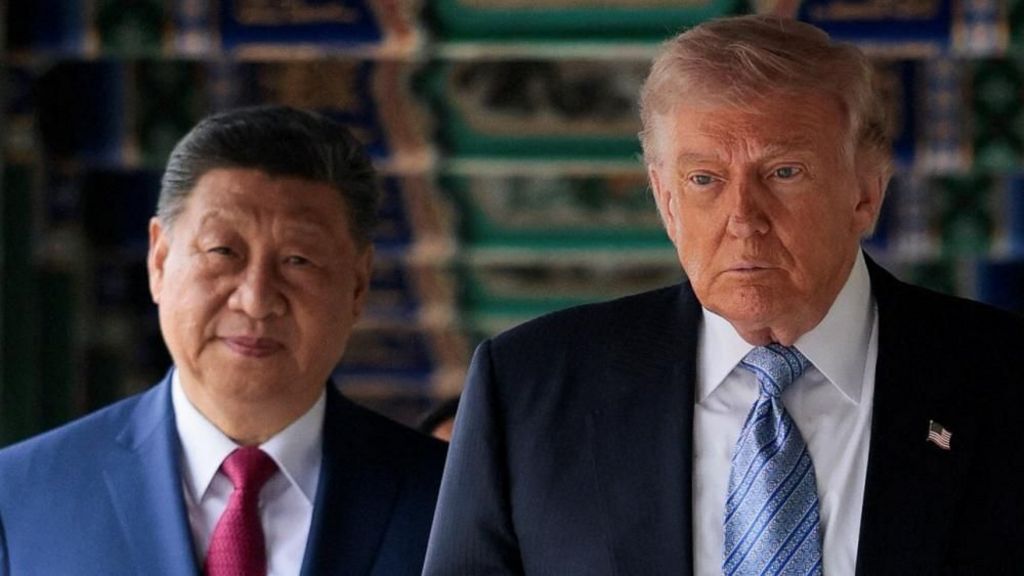
Following two days of high-stakes bilateral talks in Beijing between U.S. President Donald Trump and Chinese President Xi Jinping, the long-simmering Taiwan issue has once again taken center stage in U.S.-China relations, with Trump emerging with an intentionally ambiguous position that leaves key questions about Washington’s policy unanswered.
Traveling back to Washington aboard Air Force One, Trump confirmed to reporters that the topic of Taiwan dominated a large portion of his discussions with Xi. For decades, China has claimed the self-governing island of Taiwan as an inalienable part of its sovereign territory, and Beijing has repeatedly declined to rule out the use of military force to assert its control. Trump told reporters that Xi directly raised the question of whether the United States would come to Taiwan’s defense in the event of a conflict, a core query that cuts to the heart of cross-strait and U.S.-China tensions. In response, Trump said he avoided taking a clear position, telling Xi: “I don’t talk about that.”
The biggest immediate uncertainty created by the talks centers on a previously approved U.S. arms sales package to Taiwan, a deal that drew fierce condemnation from Beijing when it was announced late last year. The $8 billion package includes cutting-edge military hardware, from advanced rocket systems to a range of offensive and defensive missiles. Trump confirmed that he and Xi debated the proposed sale at length during the summit, and announced that he has not yet made a final decision on moving forward with the transfer. “I will make a determination over a fairly short period,” the U.S. president said, noting he plans to hold a conversation with Taiwanese President Lai Ching-te before finalizing his choice.
Washington’s long-standing approach to the Taiwan question has long required a delicate diplomatic balancing act. U.S. law formally mandates that the United States provide Taiwan with the necessary capabilities to defend itself, and the island has been an unofficial U.S. ally in the Indo-Pacific for decades. At the same time, successive U.S. administrations have worked to nurture diplomatic and economic ties with Beijing, avoiding explicit moves that would trigger full diplomatic rupture with China. This fragile balance has come under growing strain in recent years, as China has significantly expanded large-scale military exercises around Taiwan, stepping up pressure on the island’s government and stoking regional anxiety that has caught Washington’s attention.
According to Chinese state media coverage of the closed-door talks, Xi framed the Taiwan issue as the single most consequential matter shaping the future of U.S.-China ties. Xi warned that if the question is mismanaged, it could lead to direct confrontation and even open conflict between the two global powers. When asked by reporters whether he believed a conflict over Taiwan could break out between the United States and China, Trump downplayed the risk. “No, I don’t think so. I think we’ll be fine,” he said, adding that “[Xi] doesn’t want to see a war.” Trump also emphasized that Xi holds firm views on the issue, saying Xi “feels very strongly” about the island and does not support any move toward formal Taiwanese independence. Repeating his ambiguous position, Trump stated: “I made no commitment either way” on the core policy questions around Taiwan.
When pressed directly by reporters on whether the United States would defend Taiwan if it came under military attack, Trump again refused to give a clear answer. “I don’t want to say that. I’m not going to say that,” he said. “There’s only one person that knows that. You know who it is? Me.” He reiterated that Xi had directly asked him about the defense question during their bilateral meeting, and he had once again declined to outline a clear position.
For its part, Taiwan’s foreign ministry moved quickly to respond to the outcomes of the summit. Taiwanese Foreign Minister Lin Chia-lung stated that the island’s diplomatic team had been closely monitoring all discussions between Trump and Xi throughout the summit, and that Taiwan has maintained open, steady lines of communication with the United States and other international partners. Lin said Taiwan’s priority is to ensure that its long-standing relationship with the United States continues to deepen in a stable manner, and that all of Taiwan’s core national interests are protected. He reaffirmed that Taiwan has consistently positioned itself as a defender of peace and regional stability in the Indo-Pacific, and placed blame for rising cross-strait tensions on Beijing, accusing China of escalating regional risk through what he called “aggressive military actions and authoritarian oppression.”
The summit’s outcomes leave the future of U.S. policy toward Taiwan unclear, with observers across the globe waiting for Trump’s upcoming decision on the arms sales package to signal which direction Washington will lean on the issue in the coming months.