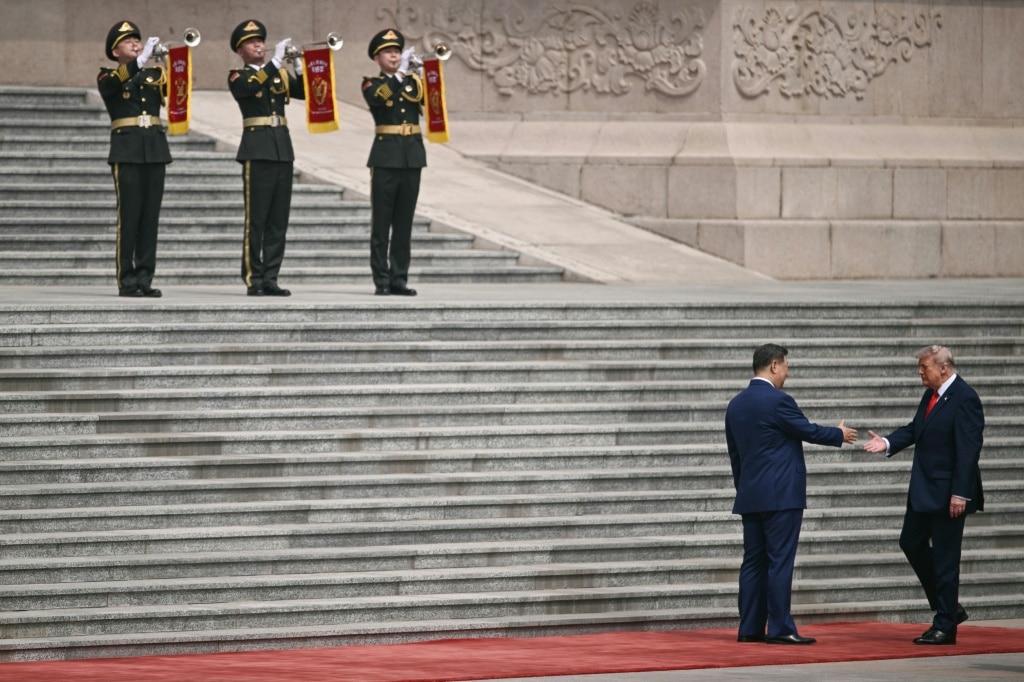
When U.S. President Donald Trump arrived in Beijing for his landmark summit with Chinese leader Xi Jinping — the first visit by a sitting American president in nearly a decade — high expectations for breakthrough progress on trade and bilateral relations hung over the meetings. But after a day of ceremonial handshakes and official banquets, a blunt warning from Xi over the sensitive issue of Taiwan overshadowed the proceedings, as the U.S. delegation heads into the final day of talks on Friday focused on securing tangible trade and geopolitical wins.
On the trade front, Trump is seeking to lock in major commercial agreements across key sectors ranging from agriculture and commercial aviation to cutting-edge artificial intelligence. He is joined on the trip by a roster of top American business leaders, including Tesla CEO Elon Musk and Nvidia chief Jensen Huang, highlighting the private sector’s stake in improved bilateral commercial ties. Ahead of Friday’s trade-focused discussions, Trump previewed one high-profile deal in an interview with Fox News, confirming that China has agreed to purchase 200 Boeing commercial jets. Markets reacted cautiously to the announcement, however: shares of Boeing dipped immediately after the reveal, as investors had anticipated a larger, more substantial purchase agreement.
Beyond commercial deals, the Trump administration is also pushing for progress on geopolitical flashpoints, most notably the ongoing Middle East conflict and its impact on global energy supplies. In his Fox News interview, Trump said that Xi gave him clear reassurance that China will not provide military aid to Iran amid the ongoing war, a key win for the U.S. administration. “He said he’s not going to give military equipment… he said that strongly,” Trump told reporters, adding that Xi shares the U.S. goal of keeping the Strait of Hormuz — the critical maritime chokepoint through which 20% of the world’s oil supplies pass — open to global shipping. The White House later confirmed in a brief official readout that both leaders “agreed that the Strait of Hormuz must remain open to support the free flow of energy.” This issue has already upended the summit schedule: Trump was originally scheduled to travel to Beijing in late March, but postponed the trip over tensions linked to the Hormuz closure.
Talks between the two global powers are also set to address the emerging framework for AI governance, with U.S. Treasury Secretary Scott Bessent telling CNBC that the world’s two leading AI powers are negotiating to establish “guardrails” for responsible development and deployment of the technology. Despite this opening for dialogue, longstanding frictions remain: U.S. export controls on advanced AI semiconductors and related technology to China remain one of the most contentious issues in bilateral trade relations.
Diplomatic undercurrents have shaped the tone of the summit from the start. While Trump has repeatedly praised Xi, calling him a “great leader” and a “friend,” the Chinese side has responded with relatively muted diplomatic overtures. That dynamic shifted sharply on Thursday, when Xi delivered an uncharacteristically blunt warning that any missteps on the Taiwan issue could push the two nuclear-armed superpowers into open conflict. Trump declined to address Xi’s Taiwan warning when questioned by reporters Thursday, but Bessent said the president would share more details of his position “in the coming days.”
The two leaders also touched on long-term great power dynamics during their first day of talks, with Xi referencing the so-called Thucydides Trap — the theory that a rising power will inevitably clash with an existing dominant power. Xi emphasized that Beijing and Washington have the ability to transcend this historical risk, avoiding conflict despite their growing competition. In a post on his Truth Social platform early Friday, Trump framed Xi’s reference to great power shifts through a domestic political lens, noting that Xi “very elegantly referred to the United States as perhaps being a declining nation.” Trump claimed that Xi’s observation was not aimed at his own administration, which he says has overseen an “incredible rise” for the U.S., but rather at the tenure of his predecessor Joe Biden. “Two years ago, we were, in fact, a Nation in decline,” Trump wrote. “Now, the United States is the hottest Nation anywhere in the world, and hopefully our relationship with China will be stronger and better than ever before!” He added that Xi “congratulated me on so many tremendous successes.”
As the two leaders enter the final day of negotiations, observers are watching to see whether the summit will deliver on Trump’s promises of tangible wins, or whether lingering disputes over Taiwan, AI trade controls, and the Middle East will overshadow any potential progress.