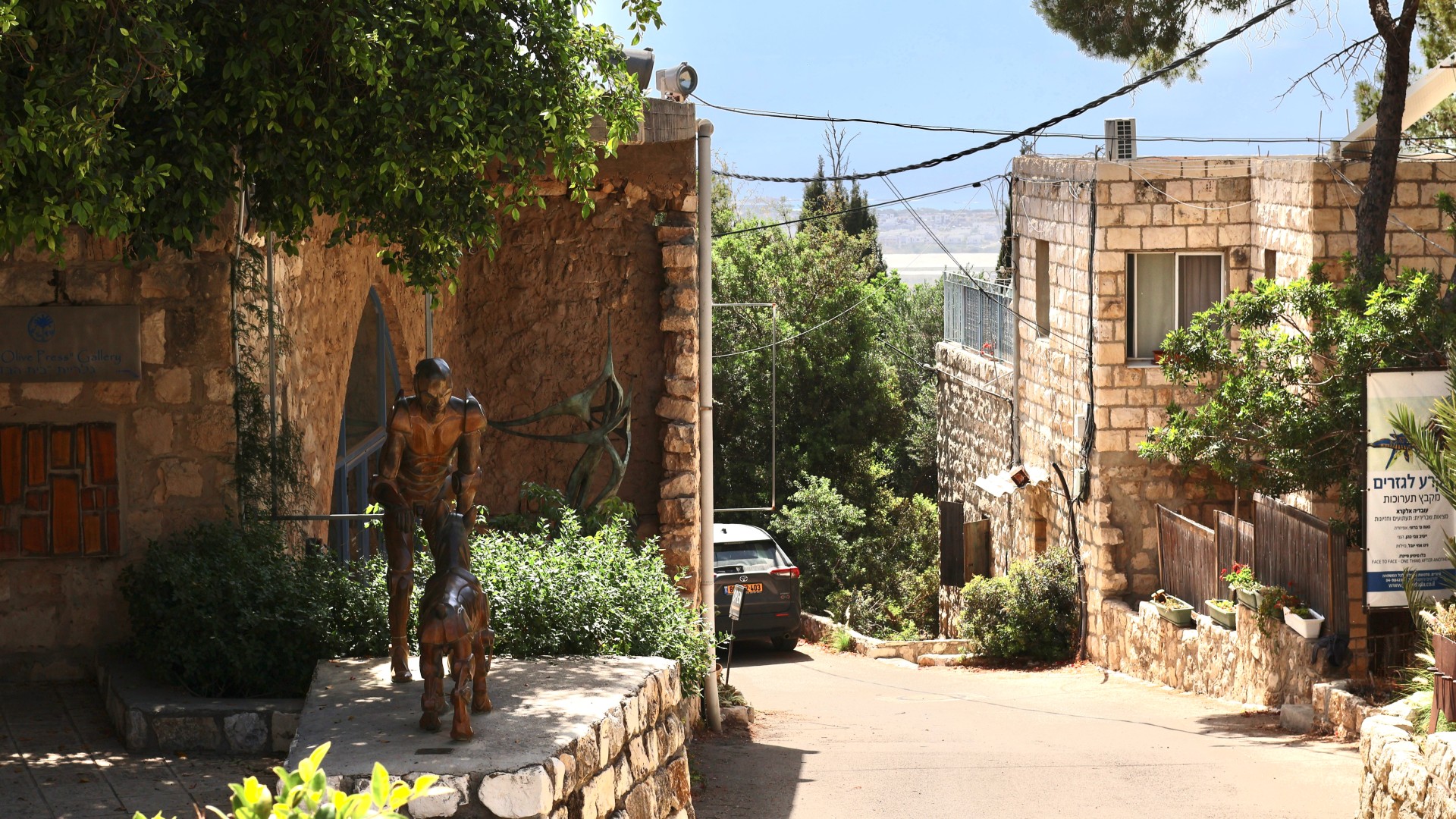
Nestled along the sun-dappled slopes of Mount Carmel, with sweeping views of the blue Mediterranean stretching out below, the quiet Israeli artists’ village of Ein Hod draws visitors with its winding cobblestone paths, weathered cactus hedges, and dozens of sunlit art galleries tucked into centuries-old stone structures. But for Palestinian artist Yara Mahajneh, the picturesque facade of this community hid a jarring, unspoken reality when she arrived one evening to set up her graduate exhibition at the village’s Janco Dada Museum: gated entrances, uniformed guards, and restricted access that cut off the original inhabitants of this land from the homes their ancestors built.
“What kind of protection does a peaceful, liberal artists’ village need?” Mahajneh asked in reflection on that night. For Mahajneh, the question cut deeper than just unexpected security. It opened up a long-buried history that she had never been taught during her four years studying fine art at the University of Haifa: Ein Hod was once Ein Hawd, a thriving Palestinian village that was emptied of its residents during the 1948 Nakba, then repurposed as a cultural hub for Israeli artists. Throughout her degree, she learned European and Israeli art history, but the story of the village just kilometers from campus, and the legacy of Palestinian art itself, was never part of the curriculum.
The documented history of Ein Hawd stretches back more than 800 years, tied to the Abu al-Hija clan, whose ancestral roots in the area trace back to fighters who arrived with Salah al-Din al-Ayyubi during the Crusader period. By 1948, the village was home to roughly 800 to 850 residents, who built a livelihood around Mediterranean agriculture: growing wheat, barley, olives, and carob, raising sheep, and producing charcoal for trade, according to Sameer Abu al-Hija, a Palestinian historian and direct descendant of the village’s displaced population.
That self-sufficient community came to an abrupt end in July 1948, weeks after Israeli forces seized the northern port city of Haifa and a string of nearby Palestinian villages. Palestinian historian Mustafa Kabha explains that the fall of Haifa shattered morale across the southern Haifa district, triggering a wave of displacement that swept through Ein Hawd. For residents, reports of massacres at Tantura and Deir Yassin stoked urgent fear for the safety of women, children, and elderly residents. After two fierce battles against heavily armed Zionist forces, the village fell, and its population was forced into exile.
Some families fled to Wadi Ara and Jenin, while others sheltered in nearby Daliyat al-Karmel. A small number of residents later attempted to return, but were blocked from reoccupying their original village lands. They built makeshift homes first from brush, then from tin and mud, and eventually from concrete, on a small plot of hillside land adjacent to the original village — a makeshift community that exists to this day. Unlike hundreds of other Palestinian villages destroyed during the Nakba, Ein Hawd’s stone structures were left standing; they were just emptied of their people.
In the early 1950s, after a short period housing North African Jewish immigrants, the abandoned village was spotted by iconic Israeli artist Marcel Janco, who recognized its preserved stone homes and dramatic coastal landscape as an ideal setting for an artists’ retreat. The site was rebranded as Ein Hod, and slowly transformed into the arts colony that exists today. Over decades, former family bedrooms were converted into exhibition spaces, living rooms became performance venues, and the village’s original mosque was repurposed into a restaurant and bar. Today, tourists wander the same narrow lanes that once echoed with the voices of Abu al-Hija villagers, browsing galleries and cafes built inside the stolen homes.
For Kabha, this transformation lays bare a profound injustice at the heart of the site: “They are using one of the highest forms of human expression and documentation on the remains of other people.”
That layered contradiction came into sharp focus for Mahajneh when she was invited to exhibit her graduation project, *Katibet Mheileh*, an exploration of intergenerational trauma among Palestinian women, inside the Janco Dada Museum located in the heart of the former village. At first, she saw the invitation as a career-making opportunity for a young emerging artist. But as she began installing her work, the setting forced her to confront an unignorable question: why exhibit this exploration of Palestinian memory in a space that was built on the erasure of Palestinian memory?
In her performance, participating women stood silent with personal objects bound to their bodies, while recorded fragments of memory echoed through the gallery: “The house was demolished. Iron my shirt.” For Mahajneh, the irony became unavoidable: her exploration of Palestinian displacement was being hosted in a displaced Palestinian village, where the descendants of the original inhabitants still lived uphill, barred from entering the land their families built. “At some point, I felt that we also became objects in the gallery,” she said. “We were serving a purpose inside this space.”
For Sameer Abu al-Hija, the injustice is not an abstract political question — it is a daily, personal reality. “There are people here who pass their father’s house every morning on the way to work,” he said. “But they still cannot enter it.”
The story of Ein Hawd raises far broader questions about who controls the narrative of Palestinian history, Kabha argues. The erasure of the village is not just physical: after 1948, hundreds of destroyed and depopulated Palestinian villages were written out of official Israeli curricula, public memory, and mainstream narratives. Even in spaces that frame themselves as progressive and inclusive, like Haifa University’s art department, that erasure persists, says Mahajneh. For Palestinians living inside Israel, this systemic erasure leaves generations disconnected from the land and history that is rightfully theirs.
Today, Ein Hawd’s physical legacy remains intact: the stone houses, the old mosque, the cactus fences, and the village paths all still stand. But they exist within an official narrative that erases the people who built them. For older generations of displaced residents, there has long been a fear that the narrative of erasure will succeed — that as the elders pass, the young will forget their connection to the land. But for Abu al-Hija, a recent moment put those fears to rest: when his seven-year-old grandson asked him to take a trip to the original village, to see the home his family built, it proved that the memory of Ein Hawd cannot be erased. That, he says, is his answer to the old prediction that the young would forget: “The young did not forget.”