Towering over the Paris skyline, the gilded dome of Les Invalides is recognized worldwide as the final resting place of French emperor Napoleon Bonaparte, drawing more than 1.4 million tourists to its historic museums and mausoleum every year. But few visitors understand that beneath the landmark’s iconic facade, a quiet, centuries-old core mission endures: for more than 350 years, this complex has served as a permanent home and specialized hospital for wounded veterans and civilian victims of war and terror attacks.
First commissioned in the 17th century by King Louis XIV, the National Institution of Invalides welcomed its first group of retired and injured soldiers in 1670, marking the first time a European state took formal, long-term responsibility for caring for its war-wounded — a duty previously left entirely to religious orders. Today, the institution houses 64 residents, ranging from young combat veterans injured in overseas deployments to 90-plus-year-old Holocaust survivors who count themselves among the last living witnesses of Nazi atrocities.
As the original facilities have aged, the French government has launched a major 100 million euro ($108 million) renovation project, with public funding covering core infrastructure and private donors invited to sponsor upgrades to individual residential rooms. This month, the institution granted exclusive access to Associated Press reporters, opening up the residential wings that sit just steps from Napoleon’s grand central sarcophagus — a rare look at the living community that shares space with one of Paris’ top tourist landmarks.
“Les Invalides is a unique place — a magical, incredible and grand site,” explained General Christophe de Saint Chamas, the military officer who serves as the institution’s governor. He noted that from its inception, the project carried dual meaning: it demonstrated Louis XIV’s commitment to his soldiers, and it stood as one of the first formal acts of state-sponsored social care in modern history. “Before that, religious communities were taking in the wounded by obligation. Here, the state said: we’re taking care of them, over the long term, until their death,” de Saint Chamas said.
Across its 350-year history, Les Invalides has tracked every turning point in French history: it was stormed by revolutionaries seeking weapons during the 1789 French Revolution, expanded to house thousands of veterans under Napoleon’s rule, and opened its doors to civilian war victims for the first time in the 20th century. Today, two of its most prominent residents are 101-year-old Ginette Kolinka and 98-year-old Esther Senot, both Auschwitz-Birkenau death camp survivors who have dedicated decades to educating young people about the Holocaust to ensure its atrocities are never forgotten.
Senot, born to Polish Jewish parents in Paris, was just 15 when she was arrested by French police and deported to Auschwitz in 1943. Of the 1,000 people packed into her cattle car transport, only she and one other person survived. She spent 17 months in Nazi camps, returning to France after liberation weighing just 70 pounds, having lost 17 family members including her parents and six siblings. For decades after the war, she faced widespread indifference to the stories of deportees — it was only during a 1985 visit to Auschwitz that she began speaking publicly, after challenging a tour guide’s inaccurate account that erased the majority-Jewish identity of most camp victims.
“When people asked me to share my story, I could not say no,” Senot recalled, showing the identification number the Nazis tattooed on her left arm. She moved to Les Invalides after her husband’s death and as her own medical needs grew, a choice shaped by her connection to the institution: her brother, a soldier in the French 2nd Armored Division that helped liberate France from Nazi occupation, lived at Les Invalides for 10 years in the 2000s. “I used to come visit him regularly, and I already knew the community here. When I found myself alone in old age, coming here felt natural,” she said.
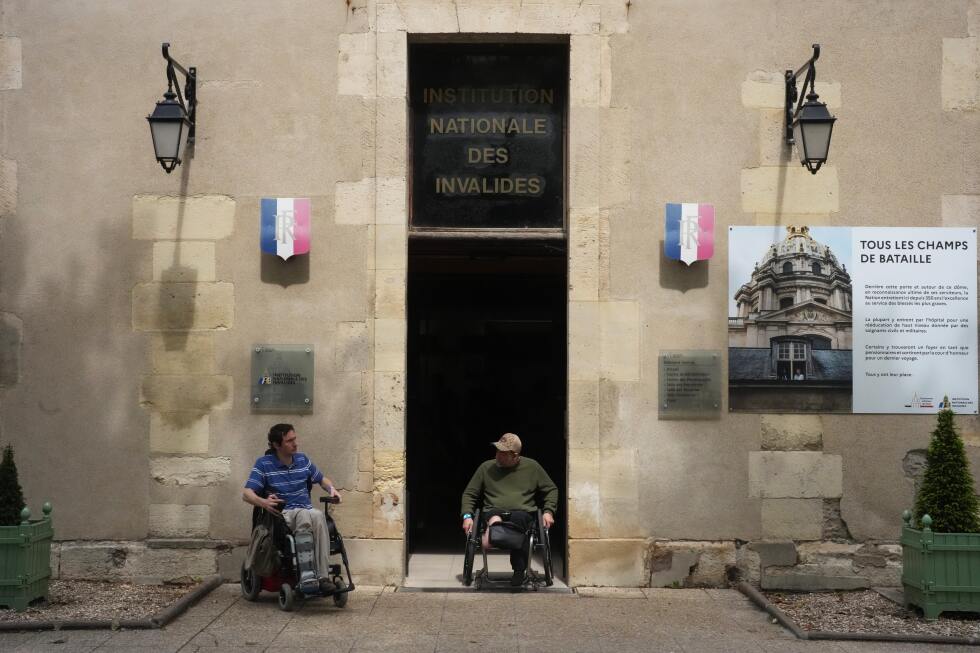
For younger wounded veterans, Les Invalides offers more than just medical care — it provides a ready-made community bound by shared experience of combat and injury. Master Corporal Mikaele Iva, who was left disabled after a parachute accident during a deployment to Gabon in 2021, has lived at the institution since his injury. He uses a wheelchair, but still competes in adaptive sports including fencing, archery and golf through the facility’s sports club, and represents Les Invalides at national ceremonies.
“Over time, we become a second family here,” Iva explained. Residents gather to chat in the common coffee room, attend football matches and concerts together, and support one another through the challenges of living with disability. “We share both joyful moments and hard days. That’s the same as military life: we get back on our feet after injury, and we never leave each other behind, no matter what,” he said. Iva added that he finds deep meaning in the care France provides through Les Invalides: his former comrade, whom he pulled to safety after a severe injury during a deployment to Afghanistan, also lives at the institution, a tangible reminder of the nation’s promise to stand by those who serve.
Caregivers share that same sense of national purpose. “We devote ourselves to them body and soul,” said Mustapha Nachet, a nurse coordinator who has worked at the residential center since 2014. “This is the nation’s way of giving back for everything they have given for our country.” Nachet noted that care at Les Invalides is deeply personalized, as the needs of a 30-year-old wounded combat veteran are vastly different from those of a 99-year-old civilian Holocaust survivor.
Beyond residential care, Les Invalides operates a world-leading specialized hospital for people with severe war-related disabilities, with cutting-edge expertise in prosthetics and rehabilitation. Its medical teams conduct ongoing research to improve mobility for amputees and wheelchair users, and they have treated dozens of survivors of the 2015 terror attacks across Paris, including victims of the Bataclan concert hall massacre.
General Sylvain Ausset, the institution’s medical director, notes that across centuries, the facility has documented how the nature of war injury has evolved with each new conflict. “Each conflict leaves its own mark, and none ever erases a previous one,” he explained. “In World War I, we saw severe facial injuries on a mass scale that people rarely survived before. In World War II, more soldiers with spinal cord injuries that caused paraplegia and quadriplegia began to survive. In more recent conflicts in Iraq and Afghanistan, we saw multiple amputations on a scale never seen before. Today, the defining injury we treat is psychological trauma.”
For de Saint Chamas, the institution’s centuries-long mission remains as vital today as it was when Louis XIV broke ground in the 1600s. It is a tangible promise to active-duty troops: “It allows active-duty troops to deploy knowing that if something happens to them, France will be there.”