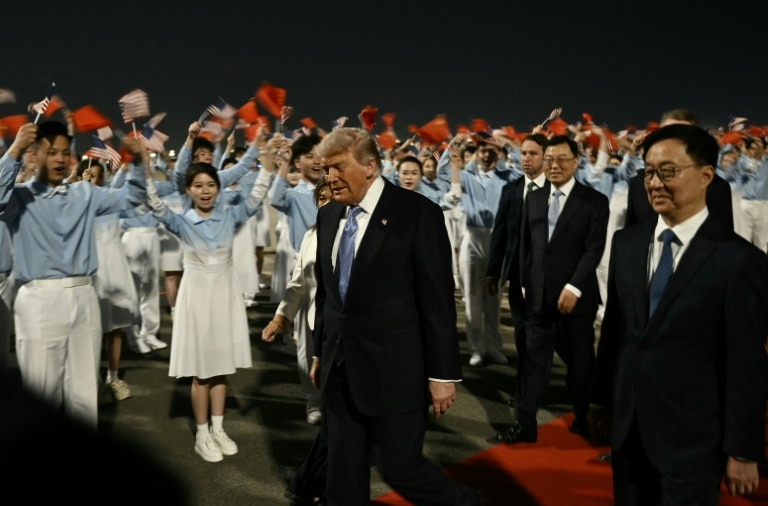
Eight years after his last visit to China, U.S. President Donald Trump touched down in Beijing Wednesday evening for a two-day high-stakes leadership summit, marking the first trip by a sitting U.S. president to the Chinese capital since 2017. Welcomed with traditional ceremonial fanfare, including a red carpet greeting and 300 uniformed Chinese youth chanting welcome and waving both national flags as the U.S. leader pumped his fist descending from Air Force One, the lavish opening sets the stage for discussions on a host of thorny issues that have split the world’s two largest economies and nuclear powers.
Trump’s traveling delegation includes some of America’s most high-profile business leaders, headlined by Nvidia CEO Jensen Huang and Tesla CEO Elon Musk — names the president has highlighted as symbols of the commercial breakthroughs he aims to secure during the meetings. On Thursday morning, Chinese leader Xi Jinping will formally greet Trump at Beijing’s opulent Great Hall of the People, followed by an official state banquet that evening. After the summit, Trump is scheduled to tour the Temple of Heaven, a centuries-old UNESCO World Heritage Site that once served as the ceremonial worship site for Chinese imperial dynasties, before holding informal talks, a tea gathering and working lunch with Xi on Friday ahead of his departure back to Washington.
This summit was originally scheduled for March, but was delayed by the escalating conflict around Iran, a sticking point that will still top the bilateral agenda. Most of Iran’s oil exports, which are sanctioned by the United States, currently flow to China, and Trump has confirmed the two leaders will hold a lengthy discussion on the issue, even as he downplays the need for Chinese cooperation on Washington’s policy toward Tehran.
Trade tensions, the longest-running source of friction between the two nations, will also be a core focus of the talks. Following Trump’s 2017 visit, the U.S. rolled out sweeping tariffs on hundreds of billions of dollars worth of Chinese goods, triggering a tit-for-tat trade war that saw retaliatory levies push combined duties to over 100% on many cross-border goods. The two leaders reached a one-year truce on tariffs during an October meeting in South Korea, and this week they are expected to negotiate an extension of that pause — though negotiators on both sides have cautioned a final agreement is far from guaranteed.
Trump has pinned his approach to the talks on his self-described close personal rapport with Xi, telling reporters ahead of the trip he expects a “great big hug” from the Chinese leader, who he has long praised for his firm governing style. Top on the president’s commercial priority list are new trade deals covering U.S. agricultural exports, aircraft sales and wider market access for American companies. Aboard Air Force One en route to Beijing, Trump wrote on social media that he would press Xi to “open up” China’s markets to U.S. firms, saying “these brilliant people can work their magic” given fair access.
For its part, the Chinese foreign ministry struck a constructive tone ahead of the summit, releasing a statement Wednesday saying Beijing “welcomes” Trump’s visit and stands ready to work with Washington to expand bilateral cooperation and productively manage differences. But analysts note China’s global position has shifted significantly since Trump’s last visit in 2017, with Beijing now far more assertive on geopolitical and trade issues, leaving multiple core disputes unresolved.
One of the most sensitive issues on the agenda is Taiwan, the self-governing democracy that Beijing claims as its sovereign territory. Trump confirmed ahead of the trip that he will raise the topic of ongoing U.S. arms sales to Taipei during his talks with Xi — a break from decades of U.S. policy that has refused to consult Beijing on arms sales to the island, a shift that is being closely watched by Taipei and U.S. regional allies.
Other topics slated for discussion include China’s export controls on rare earth minerals, the growing global rivalry in artificial intelligence development, and broader restructuring of the bilateral trade relationship. Both sides enter the summit seeking to secure tangible wins while preventing a further escalation of tensions, a delicate balance that carries major implications for the global economy and international security. Trump is also pushing to lock in a firm date for a reciprocal visit by Xi to the U.S. later in 2026, a move that would serve as a high-profile proof of his claim to have built a strong working relationship with his Chinese counterpart.