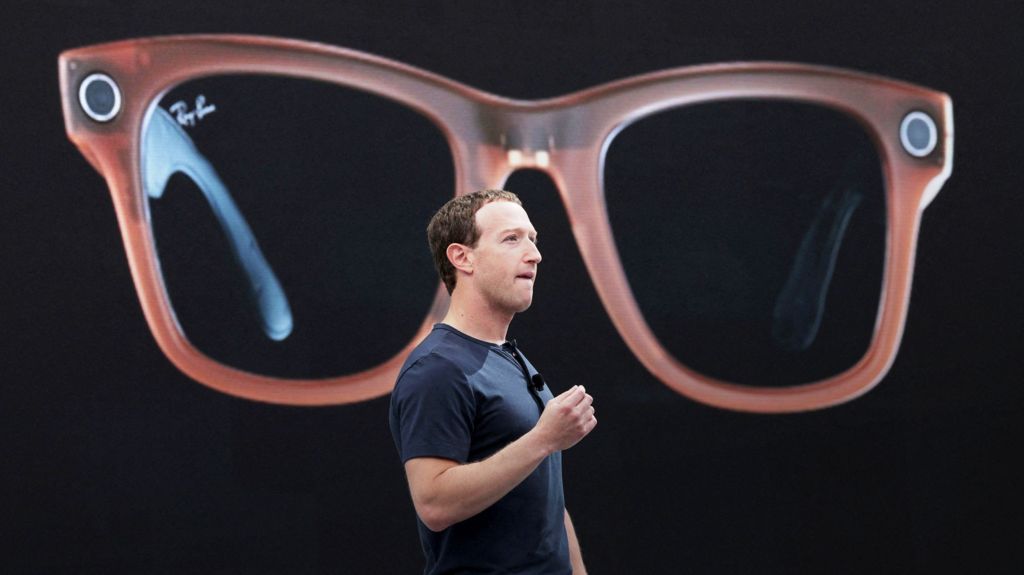
The emerging market for AI-powered smart glasses is facing growing scrutiny over deep-seated privacy risks, even as some of the world’s largest technology corporations prepare to scale up sales of the wearable devices in the coming years, with projections pointing to hundreds of millions of units sold globally by the end of the decade.
Currently, Meta dominates the fast-growing segment, holding an estimated 80% of all global smart glasses sales thanks to its early entry into the mainstream market with the Meta Ray-Ban smart glasses, produced in partnership with eyewear giant EssilorLuxottica. The product blends the iconic, understated design of classic Ray-Ban frames with cutting-edge tech: a nearly undetectable built-in camera, integrated small speakers, and lightweight lenses that display contextual information for wearers. Recording can be activated with a simple tap on the frame, making it extraordinarily easy to capture photos and video without drawing attention to the act.
This discreet recording capability has already spawned widespread misuse, most notably a growing trend where male wearers of Meta’s smart glasses secretly record unsuspecting women in public spaces — from beaches to retail stores — for online content. Many women only discover they have been filmed after the videos, which often include harassment and abusive commentary, go viral on social media. Legal options for affected people remain limited, as photography in public spaces is widely protected under law in most jurisdictions. One woman who spoke to the BBC reported that when she requested the removal of a non-consensual recording of her, the creator demanded payment to take it down.
Beyond non-consensual public recording, the devices have faced legal pushback over the processing of user content. Two class-action lawsuits were filed against Meta after contract workers in Kenya, hired to review smart glasses recordings to train Meta’s AI models, revealed they were forced to view deeply graphic content including sexual activity and private bathroom use. Many plaintiffs said they had no idea their recordings were being reviewed by human staff, despite Meta’s assertion that the possibility of human review is clearly disclosed in its terms of service.
Even with these mounting controversies, sales have surged to more than 7 million units sold to date, with Meta CEO Mark Zuckerberg calling the product line “some of the fastest-growing consumer electronics in history” in a recent statement. Meta spokesperson Tracy Clayton defended the company’s position, noting that the firm has dedicated teams working to mitigate misuse, but argued that “the onus is ultimately on individual people to not actively exploit” any technology.
The market’s growth is attracting new entrants, with a wave of major tech companies preparing to launch their own smart glasses offerings in the next 18 months. Apple is reportedly developing its own AI and AR-enabled smart glasses, expected to launch as early as 2025. Snap has confirmed it will release a new iteration of its Specs smart glasses later this year, and Google is preparing for a second attempt at consumer smart glasses more than a decade after the high-profile failure of Google Glass, which was pulled from the market over identical privacy concerns just two years after launch. All upcoming models are expected to follow Meta’s blueprint, combining AI features with augmented reality that relies on built-in cameras to function.
Not all user experiences are negative, however. Mark Smith, a tech-savvy early adopter and enterprise software advisor at ISH, wears his Meta Ray-Bans daily. He praised the device’s practical perks: listening to music and podcasts while doing household chores without blocking out ambient noise the way over-ear headphones do, seamless hands-free phone calls, and quick, convenient photo captures while traveling that eliminate the need to pull out a smartphone. Even so, Smith acknowledged that obvious privacy risks remain, noting that the small indicator light that activates during recording is nearly invisible in bright daylight, leaving most bystanders unaware they are being filmed.
Industry projections indicate that if current growth trends hold, as many as 100 million consumers could own a pair of AI smart glasses within the next few years. That scale of adoption would create unprecedented challenges for regulators and public institutions that restrict recording in sensitive spaces including courthouses, hospitals, movie theaters, museums, and bathrooms. David Kessler, head of U.S. privacy practice at global law firm Norton Rose Fulbright, said corporate clients are already scrambling to adapt to the new reality. “There are some pretty dark places we could go here,” Kessler said. “I’m not anti-technology in any sense, but as a societal matter…will I need to think [of being recorded] anytime I go out in public?”
Risks could grow even more acute: Meta is reportedly planning to add facial recognition technology to a future update of its smart glasses, which would give wearers the ability to not only secretly record passersby, but also instantly identify them by name. Meta markets its current glasses under the tagline “Designed for privacy, controlled by you,” and advises users to avoid recording people who object and to turn off devices entirely in sensitive spaces. But these voluntary guidelines are widely ignored, with a rising trend of prank content that targets unsuspecting members of the public for online clout.
Public backlash is already starting to build. When a man posted a video complaining that a woman on the New York City Subway broke his Meta glasses after he secretly recorded her, social media users widely celebrated the woman’s actions, calling her a hero. Meta CTO Andrew Bosworth argued earlier this month that strong sales indicate broad public acceptance of the devices, but former Meta AI researcher David Harris, now a professor at UC Berkeley and AI policy advisor to the U.S. and EU, said the current generation of smart glasses faces the same fate that doomed Google Glass over a decade ago. “Technology like this is fundamentally an invasion of privacy and it’s really going to face more and more backlash,” he said.