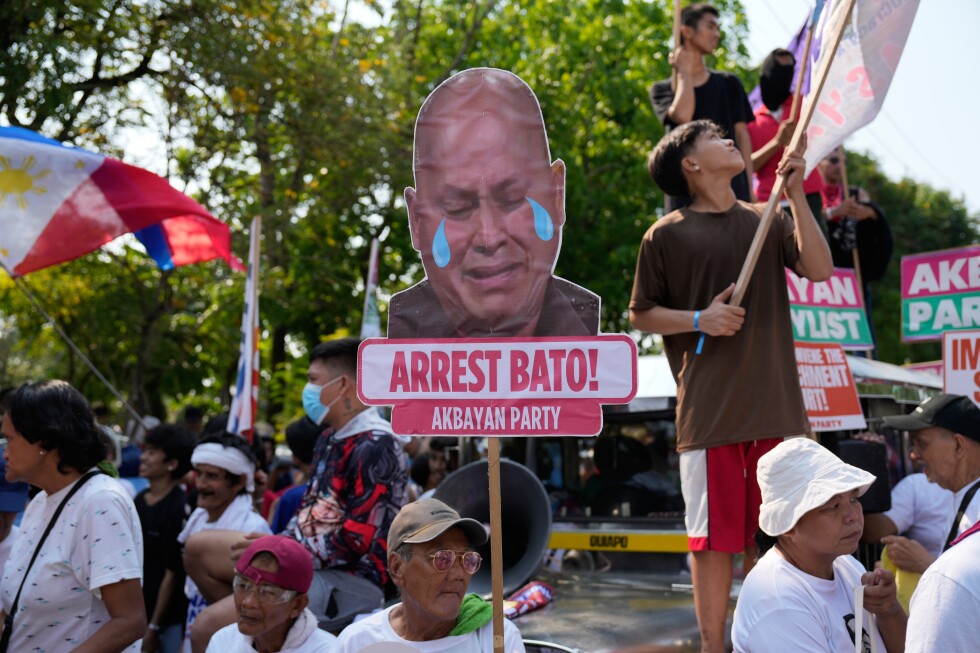
A tense confrontation broke out Wednesday inside the Philippine Senate building in Manila after law enforcement attempted to execute an arrest warrant for a sitting Philippine senator, who faces a murder charge classified as a crime against humanity from the International Criminal Court (ICC). Shots were fired during the operation, leaving the complex locked down in an extended standoff as of Wednesday’s initial reports.
The clash unfolded just 48 hours after the Netherlands-based global tribunal unsealed an arrest warrant first issued in November for Ronald Marapon dela Rosa, 64, who served as chief of the Philippine national police during the tenure of former president Rodrigo Duterte. Dela Rosa was one of the primary architects of Duterte’s nationwide anti-drug crackdown, a campaign that resulted in the deaths of thousands of mostly low-level drug suspects between 2016 and the present. The warrant accuses dela Rosa of direct responsibility for the murder of at least 32 people between July 2016 and April 2018, the period when he oversaw the national police force.
In public comments following the unsealing of the warrant, dela Rosa has stated he will vigorously challenge the ICC’s authority and pursue all available legal channels to avoid extradition. The ICC has not yet released an official statement in response to the violent standoff in the Philippine capital.
This latest development builds on years of legal tension between the Philippines and the ICC. In 2019, the country formally withdrew from the court’s Rome Statute, a move that came after then-ICC prosecutor Fatou Bensouda announced a preliminary investigation into widespread extrajudicial killings tied to the anti-drug campaign. Current President Ferdinand Marcos Jr., who took office in 2022, has not reversed the withdrawal, but his administration has previously stated it would honor Interpol red notices — global requests to locate and temporarily arrest suspects — if the ICC issued one for former officials linked to the drug war. It remains unclear whether a red notice has been officially issued for dela Rosa as of Wednesday.
Duterte himself was taken into custody last year and transferred to The Hague to face his own charges of crimes against humanity connected to the deadly crackdown, and he remains in detention awaiting trial. Last year, ICC judges rejected a bid from Duterte’s legal team to dismiss the case over the Philippines’ 2019 withdrawal. In their ruling, the judges noted that nations cannot misuse their right to leave the Rome Statute to shield individuals from prosecution for crimes already under active investigation by the court.
Established in 2002, the ICC was created to hold national leaders and senior public officials accountable for genocide, war crimes, and crimes against humanity, acting as a court of last resort that only intervenes when a domestic legal system is unable or unwilling to prosecute alleged perpetrators. The court currently counts 125 member states, but three major global powers — the United States, Russia, and China — have never joined. Ukraine became the newest member of the court in January 2025. The institution employs more than 900 people and operates on a 2025 budget of just over 196 million euros, equal to roughly $229 million.
Both the U.S. and Russia have openly opposed the ICC’s authority in recent years. During his second term, former U.S. President Donald Trump imposed economic sanctions on ICC chief prosecutor Karim Khan, several sitting ICC judges, and Khan’s two deputy prosecutors. Trump has repeatedly accused the court of carrying out “illegitimate and baseless actions” that unfairly target U.S. and Israeli officials. During his first term, Trump also sanctioned Khan’s predecessor, Fatou Bensouda, a move that was later reversed by the Biden administration. For its part, Russia has rejected the court’s jurisdiction and issued its own arrest warrant for Khan and the judge who signed the 2023 warrant for Russian President Vladimir Putin over allegations of war crimes in Ukraine. Since the warrant was issued, Putin has traveled to multiple non-member states including China and North Korea, as well as Mongolia, an ICC member state, without facing arrest.