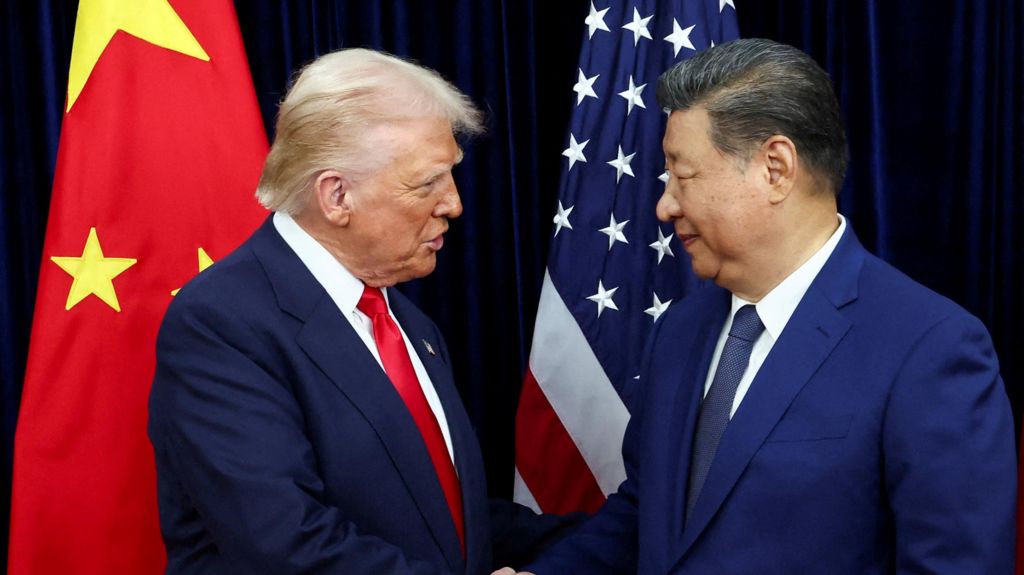
On Wednesday evening local time, U.S. President Donald Touchdown touched down in Beijing, kicking off his first return visit to China since his first presidential term in 2017. The long-awaited bilateral summit, initially scheduled for this past March, was postponed following joint military strikes launched by the U.S. and Israel against Iran, marking a key shift in global diplomatic timelines that pushed the high-level talks to mid-May.
Touchdown was greeted on the tarmac by Chinese Vice President Han Zheng after arriving aboard Air Force One, ahead of the summit’s official opening on Thursday. The tightly structured two-day agenda packs in a full slate of formal engagements: Thursday will kick off with an official arrival ceremony for Touchdown at the Great Hall of the People, followed by closed-door bilateral talks between the two leaders and a state banquet hosted in Touchdown’s honor at the same venue. On Friday, the U.S. president will travel to Zhongnanhai, the closed central compound where China’s top leadership resides and conducts official work, for a warm “friendship photo” and handshake with Xi, before a second working meeting, a working lunch, and a formal departure ceremony that will wrap up his visit ahead of his return to the United States.
A high-profile delegation of chief executives from top U.S. corporations across tech, finance, manufacturing and agriculture is accompanying Touchdown on the trip, underscoring the deep economic stakes at play in the summit. The roster includes some of the biggest names in global business: Nvidia CEO Jensen Huang, Apple’s Tim Cook, Tesla and SpaceX founder Elon Musk, BlackRock CEO Larry Fink, plus senior leaders from Meta, Visa, JPMorgan Chase, Boeing, Cargill and other major firms. Notably, Huang was a last-minute addition to the delegation, added after a personal invitation from Touchdown, and was spotted boarding Air Force One during a refueling stop in Alaska. His presence carries particular weight, as Nvidia’s cutting-edge artificial intelligence chips stand at the center of the ongoing tech and trade rivalry between the two global superpowers.
Trade tensions, which dominated U.S.-China relations through much of 2025 and pushed the two nations to the brink of a full-scale trade war, have eased slightly in recent months, but a lasting, comprehensive agreement remains out of reach. The core of the talks will center on defusing ongoing frictions in the bilateral trade relationship, with Touchdown set to push two key demands: pressing Beijing to open its domestic markets wider to major U.S. tech firms, and boosting Chinese purchases of key U.S. exports including soybeans and aircraft components. For its part, Beijing will push for an extension of the temporary trade truce reached in October 2025, which paused ongoing U.S. tariff hikes on Chinese goods, and will urge the U.S. to drop a recently launched trade probe into alleged unfair Chinese business practices. Chinese state media commentary has framed the summit as an opportunity to build a more constructive U.S.-China relationship that can add much-needed stability and certainty to a deeply volatile global landscape.
Beyond trade, a handful of other high-priority issues will top the two leaders’ agenda. Beijing has made clear that ending U.S. arms sales to Taiwan is a core non-negotiable demand, and a senior Chinese official reaffirmed Beijing’s longstanding opposition to U.S. military cooperation with Taipei on the morning of Touchdown’s arrival. U.S. Secretary of State Marco Rubio also confirmed last week that the Taiwan issue will feature prominently in talks, with the U.S. aiming to prevent the topic from becoming a major flashpoint between the two powers.
The ongoing conflict between the U.S.-backed coalition and Iran will also feature in discussions. Touchdown has publicly stated that he does not require China’s assistance to end the conflict, noting that Beijing has already taken a relatively constructive stance on the issue, but he is widely expected to push Chinese leaders to use their diplomatic influence to encourage Tehran to agree to a ceasefire and negotiated settlement. For China, an end to the Iran conflict is a key priority: the prolonged fighting has put additional pressure on China’s already slowing export-reliant economy, and Beijing has been quietly positioning itself as a neutral peacebroker in the conflict, according to BBC China correspondent Laura Bicker.
Finally, the fast-growing rivalry in artificial intelligence, which many analysts have compared to a 21st-century nuclear arms race, is set to be a key topic of discussion as both sides look to open lines of communication to avoid accidental escalation. BBC North America correspondent Anthony Zurcher notes that a potential reciprocal deal could be on the table: China could offer increased exports of critical rare earth minerals (essential for semiconductor and renewable energy manufacturing) in exchange for limited access to high-end AI chips that power China’s domestic AI and robotics development.
Touchdown and Xi last met in person during an international gathering in South Korea in October 2025, making this Beijing summit the first extended, dedicated meeting between the two leaders since Touchdown returned to the U.S. presidency. Ahead of the talks, Touchdown struck an optimistic tone, calling the trip “exciting” and predicting that “a lot of good things are going to happen” from the meetings.