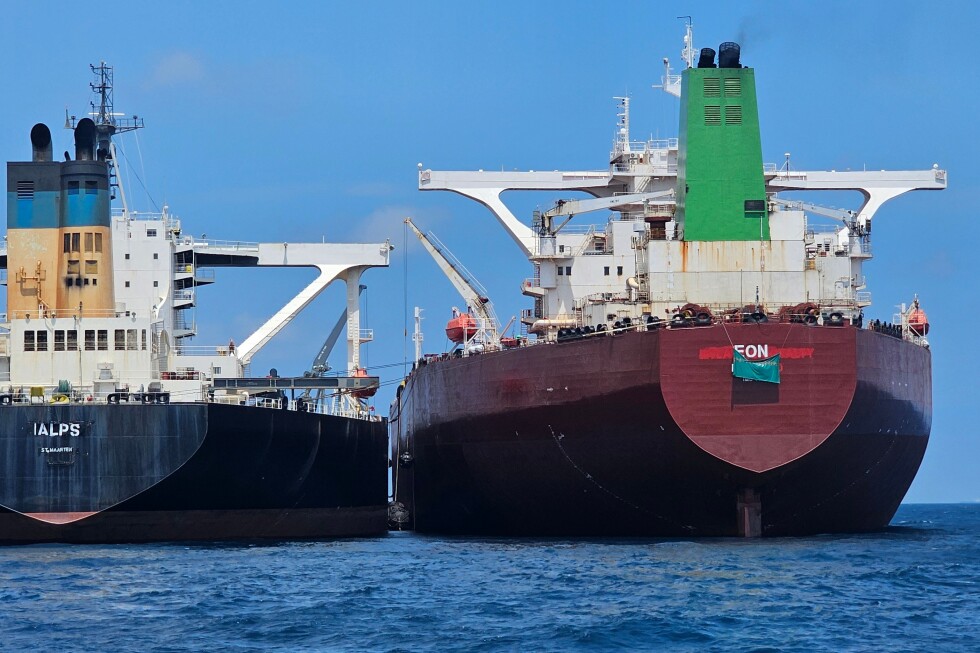
In the busy waters of the South China Sea, roughly 45 miles off Malaysia’s southern Johor state, a persistent pattern of covert ship-to-ship oil transfers linked to Iran has reignited international tensions over Tehran’s efforts to evade U.S.-led sanctions, leaving Malaysian authorities caught between geopolitical pressure and the practical limits of maritime enforcement.
Since February 28, when open conflict erupted in the Middle East following joint U.S.-Israeli strikes on Iran, U.S.-based nonproliferation advocacy group United Against Nuclear Iran (UANI) has documented at least 42 unauthorized Iranian oil transfers in the area known as the Eastern Outer Port Limits (EOPL), a strategic stretch of water that sits along the world’s busiest maritime trade corridor and halfway between Iran and China, which purchases roughly 90% of Iran’s crude exports. UANI gathered its evidence via satellite imagery analysis of the unregulated activity.
The shadow fleet of tankers conducting these operations has drawn sharp condemnation from both global shipping industry bodies and UANI, which has accused Malaysian regulators of turning a blind eye to the activity and failing to enforce adequate controls. UANI senior advisor Charlie Brown argued that Malaysian inaction has transformed the country from a mere transit point for these illicit flows into an active facilitator of the sanctions-evasion business model that benefits Iran, China and dark fleet operators. Brown noted that even after the U.S. imposed a full blockade on Iranian ports in mid-April, activity in the EOPL has continued largely unchanged. As of this week, UANI tracking shows two dozen Iranian-linked tankers remain anchored or loitering in the transfer zone, though it is unclear how many of these vessels entered the area before the blockade took effect. “It’s business as usual,” Brown told the Associated Press.
UANI has pushed Malaysia to take a series of actionable steps to crack down on the transfers: requiring advance notification for all ship-to-ship transfers to enforce environmental rules, barring Malaysian companies from providing services to tankers linked to the shadow fleet, and mandating that all operating vessels carry sufficient insurance to cover potential oil spill accidents. While the transfers themselves are not formally illegal under international law, Malaysian policy discourages unsanctioned transfers outside of regulated, supervised port areas. Unregulated transfers conducted by aging dark fleet vessels carry a drastically higher risk of catastrophic oil spills, and operations conducted far from port leave far fewer options to contain damage if an accident occurs.
However, Malaysia’s top maritime official says the critics have ignored the on-the-ground realities of maritime enforcement in the region. Malaysian Maritime Enforcement Agency (MMEA) Director-General Mohamad Rosli Abdullah explained that the vast majority of these transfers take place in international waters, where Malaysia holds no legal jurisdiction. Dark fleet operators also routinely deploy tactics to evade detection: switching off automatic identification system trackers, using false vessel identities, operating exclusively under cover of night, and hiding behind complex, opaque corporate ownership structures that make it difficult to trace a vessel’s true purpose.
“The issues raised do not align with the actual situation on the ground and do not reflect the operational realities of maritime enforcement conducted by the MMEA,” Mohamad Rosli told the AP, emphasizing that all MMEA operations are carried out strictly in line with Malaysian domestic law and binding international conventions. “We have never compromised nor provided any special treatment or privileges to any country,” he added.
Mohamad Rosli also pushed back against claims of systemic inaction, noting that Malaysian authorities seized two vessels — one stateless, one flagged to Cameroon — found conducting unauthorized transfers of 2 million barrels of crude in Malaysian territorial waters earlier this year. The vessels were released on bond after the seizure, but Brown confirmed one was recently spotted conducting another suspected Iranian oil transfer off Johor earlier this month. Despite the challenges, Mohamad Rosli said Malaysian authorities remain committed to protecting the country’s maritime sovereignty and safety: “We will continue to strengthen monitoring and enhance strategic cooperation with relevant agencies to ensure that the nation’s maritime domain’s safety and sovereignty are consistently safeguarded.”
The EOPL transfer zone, while widely considered part of Malaysia’s broader exclusive economic zone, sits directly adjacent to Indonesia’s Riau Archipelago, drawing neighboring Indonesia into the dispute. Indonesia’s Foreign Ministry confirmed it is currently reviewing the situation to assess the legality of the ongoing activity. “Indonesia does not permit its territory or maritime zones to be used for unlawful activities,” said Foreign Ministry spokesperson Yvonne Mewengkang. She added that Indonesia remains committed to upholding all legitimate navigational rights outlined in the United Nations Convention on the Law of the Sea, including innocent passage, transit passage, and unimpeded passage through Indonesian maritime zones.
As of Tuesday, neither the Iranian Embassy in Kuala Lumpur nor the U.S. State Department had issued a formal response to requests for comment on the ongoing situation. Covert ship-to-ship transfers of Iranian crude have been a common sanctions-evasion tactic for years, allowing Tehran to maintain export flows while giving buyers formal plausible deniability over the origin of the oil.