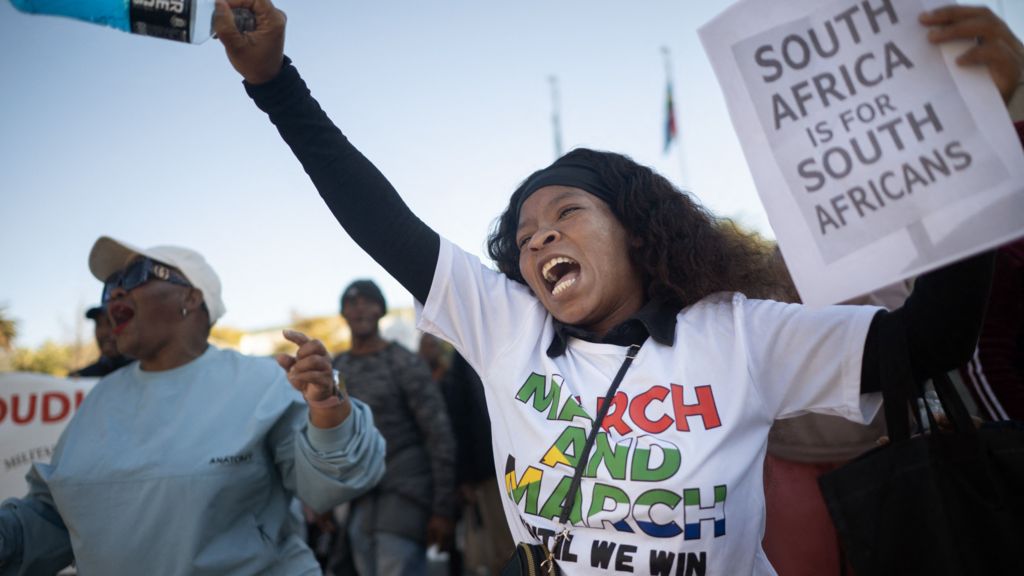
A spreading wave of anti-foreign-national protests across major South African cities has triggered a regional diplomatic crisis, with Ghana launching an emergency evacuation plan for hundreds of its citizens trapped in the unrest.
Ghana’s Foreign Minister Samuel Okudzeto Ablakwa announced via a post on X Tuesday that the country’s president has formally signed off on the immediate evacuation of 300 at-risk Ghanaians. All the affected, described as “distressed” by the foreign ministry, have already registered with Ghana’s Pretoria embassy to arrange for safe passage back to their home country. The evacuation follows a formal travel advisory Ghana issued last week after the latest round of xenophobic violence targeting foreign residents.
Thousands of South African demonstrators have joined the recent protests, rallying against unregulated illegal immigration. Protesters argue that undocumented migrants have strained local access to employment, affordable housing, and contributed to rising community crime rates, amplifying long-simmering public frustration and pushing demands for mass deportations of people without legal residency.
In response to escalating tensions, the Ghanaian embassy in Pretoria issued an updated safety warning Tuesday, urging all Ghanaian citizens in South Africa to exercise extreme caution, avoid all large public gatherings, and close all businesses in the coastal city of Durban ahead of a planned anti-immigration protest scheduled for Wednesday.
South African officials have pushed back against widespread claims of targeted attacks, denying that any xenophobic violence has occurred in recent weeks and asserting that viral videos circulated online showing purported attacks are fabricated. In a public address Monday, South African President Cyril Ramaphosa acknowledged that recent “protests and criminal acts directed at foreign nationals” do not align with the country’s official government policy, framing the unrest as isolated criminal activity rather than coordinated, systemic hostility. Ramaphosa also reaffirmed the government’s commitment to migration regulation, border security, and consistent enforcement of national immigration laws. The South African government added that it has “nothing to hide” and condemned the spread of disinformation via fake visual content.
The diplomatic fallout has already spread across the continent. Both Ghana and Nigeria have summoned South African diplomatic envoys in their capitals to formally protest the mistreatment and harassment of their citizens living in South Africa. Ghana has also taken the extra step of formally requesting the African Union place the issue on its agenda for discussion, arguing that the ongoing unrest poses an unacceptable “serious risk to the safety and wellbeing” of African residents in South Africa.
Ghana is not alone in issuing warnings: Kenya, Malawi, Lesotho, and Zimbabwe have all followed suit, urging their citizens residing in South Africa to take extra safety precautions amid the unrest.
Official demographic data puts the total foreign-born population in South Africa at more than 3 million, accounting for roughly 5% of the country’s total population. However, analysts estimate that a far larger number of undocumented migrants currently reside within South Africa’s borders, a reality that has kept anti-immigration sentiment a persistent flashpoint in national politics. Xenophobic hostility has a long history in the country, with sporadic deadly attacks on foreign nationals recorded over the past several decades.