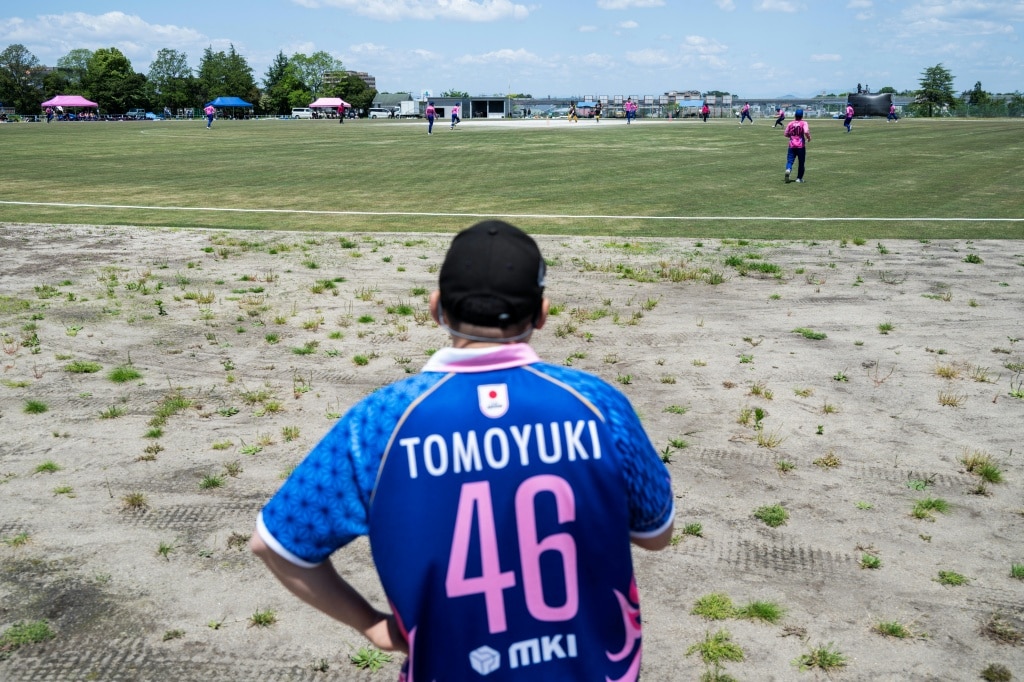
Four months before the Asian Games kick off in Nagoya, a quiet but energetic buzz is growing around a converted baseball field turned brand-new cricket ground, where a sport largely unfamiliar to most Japanese is starting to win over casual spectators.
When the continental multi-sport event runs from September 19 to October 4, most competitions on the program will feel familiar to Japanese sports fans. Cricket, however, remains a complete mystery to the majority of the population – but that has not stopped locals from leaning into curiosity and showing up to watch the action.
Located 40 minutes by train from central Nagoya, Korogi Sports Park retains faint traces of its former life as a baseball diamond, with an old pitcher’s mound still sitting just beyond the playing boundary. Right now, the venue is cutting its teeth ahead of the Asian Games by hosting the first major international cricket event ever held at the site: the East Asia-Pacific qualifiers for the 2028 Men’s T20 World Cup. The tournament brings together eight emerging cricket nations alongside host Japan: Vanuatu, Fiji, Samoa, Indonesia, the Philippines, Papua New Guinea, the Cook Islands and South Korea.
For many local attendees, the match is their first ever live experience with the sport. Yuya Okimasu, a 34-year-old local resident who brought his wife and two children to watch Japan face off against Vanuatu, said his family only first encountered cricket through his daughter’s favorite Australian children’s cartoon *Bluey*. “I’m looking at the rules as I’m watching the game because I don’t understand it, but it looks fun,” Okimasu told reporters, echoing the sentiment of many first-time spectators.
On a windy opening weekend, roughly 300 fans turned out for Japan’s first qualifying match. Most relaxed on deck chairs, listening to a commentator walk through the basic rules of play to help new fans follow along. Temporary stands will be installed before the Asian Games to boost capacity to around 2,000 spectators. While top-ranked international teams are accustomed to far larger, more lavish venues, the quality of the venue’s playing pitch is not expected to disappoint.
The pitch is overseen by Asitha Wijayasinghe, the same curator who manages the playing surface at Sri Lanka’s 35,000-seat Pallekele International Cricket Stadium. Adam Birss, operations manager for the Asian Games at Korogi Sports Park, noted the pitch is expected to play with extra bounce, even with the approach of Japan’s annual September typhoon season. “I would say that it should act like the pitches in Pakistan, which are bouncy but also take spin,” Birss explained. “It’s got a grippy surface, so if you put spin on the ball, it will spin off.”
This new venue is a key piece of an ambitious long-term plan to grow cricket in Japan, a nation where baseball has long reigned as the dominant bat-and-ball sport. The International Cricket Council (ICC) has identified Japan as one of its global priority markets for expansion, and grassroots participation numbers have slowly climbed in recent years. The Japan Cricket Association (JCA) has already built a small but stable foothold for the sport in the Tokyo area.
Cricket’s inclusion in the 2026 Nagoya Asian Games was only confirmed in April 2024, leaving organizers with just 15 months of preparation time. The JCA had previously pushed unsuccessfully to host matches in Sano, a city north of Tokyo that is already a domestic cricket hotbed. JCA CEO Naoki Alex Miyaji acknowledged that Nagoya remains “a huge vacuum area for cricket”, and he has raised concerns that the tight timeline leaves too little time to build widespread public interest ahead of the tournament. “Creating something here with the Asian Games is an ideal situation, but not when you’re talking with 15 months’ preparation,” Miyaji said.
Long-term questions about the venue also remain unresolved. After the Asian Games conclude, the park will be shared between cricket and local baseball teams, and it is still unclear which governing body will take responsibility for maintaining the specialized cricket pitch. Even so, Miyaji says he holds out hope that the venue will become “one of the key ingredients of the growth of cricket in Japan”.
Local leadership has already gotten behind the project, with Nagoya’s mayor emerging as an enthusiastic early supporter. That early public curiosity among attendees who turned out for the qualifying match suggests there is potential for broader interest. In the opening qualifier, the Japanese men’s team picked up a confidence-boosting 30-run win over Vanuatu, adding to the growing momentum.
With just four months remaining until the Asian Games begin, Japanese players say they are ready to embrace the moment and help grow the sport they love. “The ground looks in incredible condition given that they only started building it a few months ago,” said Japan captain Kendel Kadowaki-Fleming. “Excitement is the overwhelming emotion that we’re feeling about it.”