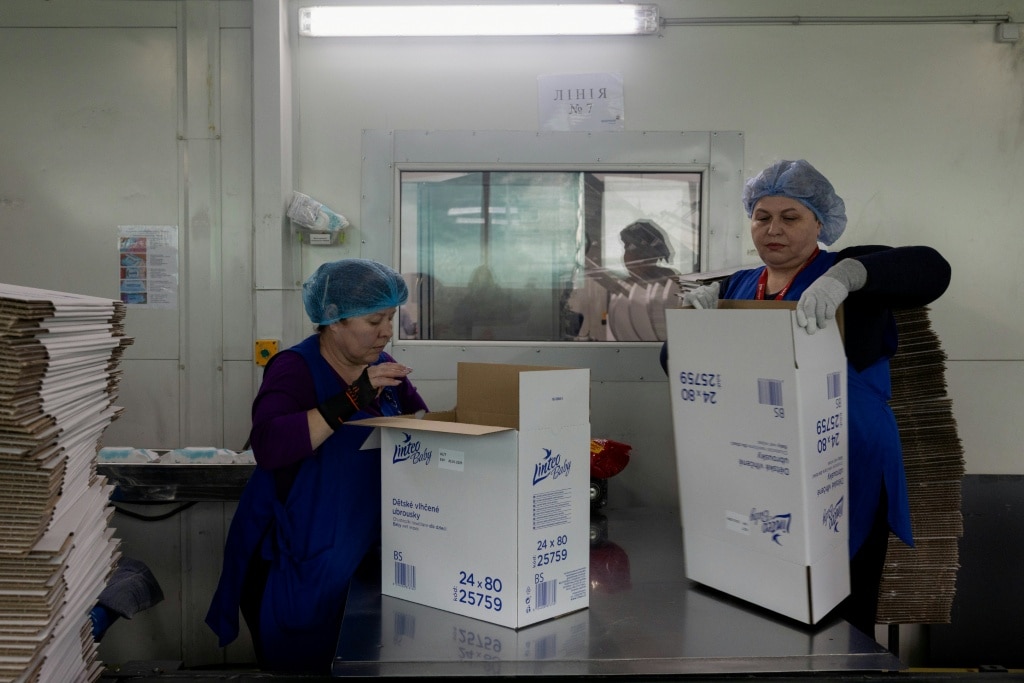
When Anatoliy Synkov fled Russian advancing forces from the ruined city of Bakhmut and resettled in the central industrial hub of Dnipro, he encountered a rare opportunity in a war-battered economy: immediate job offers poured in from local employers desperate for staff. The 55-year-old former forester landed a position on a household goods production line at Biosphere Corporation within seven days, an unusually quick hiring process that underscores a growing, existential crisis for Ukraine’s wartime economy: severe, widespread labor shortages that have left hundreds of businesses struggling to operate.
Even months after starting his new role, Synkov says he still receives frequent unsolicited job offers from other Ukrainian companies, even as employers have hiked wages to attract scarce candidates. The scale of Ukraine’s labor crisis is rooted in the massive population displacement and human cost of the full-scale Russian invasion, which began in 2022. Before the war, Ukraine had a population of roughly 40 million. Today, hundreds of thousands of working-age men have been drafted into military service, with tens of thousands killed or wounded in combat, while the United Nations estimates that around 5.7 million Ukrainians still remain refugees in European and other countries outside of Ukraine.
Biosphere, one of Ukraine’s largest household goods manufacturers, has felt the labor crunch acutely — even after surviving a direct Russian missile strike on one of its Dnipro warehouses in April 2025 that killed one worker and injured 11 others, leaving a gutted, blackened structure still standing at the site. Today, the Dnipro plant employs just 500 workers, down from 800 before the 2022 invasion, according to Olena Shpitz, the facility’s human resources director. Around 100 of Biosphere’s former employees have joined the Ukrainian armed forces, and recruitment has become a constant, uphill battle.
“The number of candidates has dropped significantly,” Shpitz explained. Positions that once took just seven days to fill now take six times that long, and the company has even rolled out employee referral bonuses, offering cash rewards to current workers who help recruit relatives to fill open roles.
The labor shortage is not limited to civilian manufacturing. It has also hit Ukraine’s rapidly expanding military production sector, which is critical to supporting frontline forces against Russia. Kvertus, a leading Ukrainian manufacturer of anti-drone jamming systems, told AFP that critical skilled specialists are often impossible to find in sufficient quantities to meet growing military demand.
New data from the European Business Association (EBA) underscores the scope of the crisis: at the start of 2026, 78 percent of EBA member companies operating in Ukraine reported widespread shortages of skilled workers. Economist Lyubov Yatsenko, a researcher at Ukraine’s National Institute for Strategic Studies, told AFP the war has compounded long-term demographic and structural challenges that predated the invasion, including steady population decline dating back to the collapse of the Soviet Union and a persistent mismatch between the skills taught by Ukraine’s education system and the needs of modern employers.
The most acute gaps are for blue-collar manual labor roles, alongside public sector positions including doctors, teachers and agricultural administrators. These roles have long suffered from low pay and low social prestige, Yatsenko noted, making them even less attractive amid the upheaval of war.
Paradoxically, crippling labor shortages coexist with double-digit unemployment in Ukraine. Official employment data is not published during wartime, but polling firm Info Sapiens estimated the national unemployment rate hit 15.5 percent in March 2026. The disconnect stems from a major skills mismatch: the market has a surplus of accountants, corporate economists and lower-level managers, but far too few trained manual workers. To bridge this gap, Yatsenko has called for expanded retraining programs and targeted policies to draw underutilized groups — including young people, refugees, war veterans and older workers — into understaffed sectors.
Biosphere already employs 19 war veterans at its Dnipro plant, but company leaders say they need additional government support to hire more former soldiers and civilians living with war-related disabilities. Compounding the problem, tens of thousands of draft-eligible men avoid formal work entirely, either staying unemployed or working in the informal shadow economy to evade mobilization rules.
Resolving the crisis will require sweeping reforms to Ukraine’s mobilization system, exemption policies and efforts to bring informal workers into the formal economy, a senior unnamed Ukrainian foreign economic official told AFP. “The main direction must be a more transparent and structured way to change between war service, being at the front fighting, and working in the economy very normally,” the official said. “There must be better rules to go back and forth.” Ukrainian President Volodymyr Zelensky has recently announced plans to allow limited demobilization of long-serving troops in the coming months, though no concrete details of the plan have been released to the public.
Few Ukrainian companies are open to hiring foreign workers to fill gaps: an October 2025 poll found that only one in eight businesses consider bringing in workers from abroad, with most citing concerns over language barriers and cultural or religious differences. Instead, Ukrainian businesses are increasingly turning to women to fill empty roles, after the Kyiv government lifted restrictions on women working in a range of previously banned professions including mining. At Biosphere’s Dnipro plant, women now make up roughly half of the workforce, up from a much lower share before 2022.
“Women are the one thing that they rely on most right now to make it more long-term and sustainable,” the senior economic official said. Even with this shift, challenges remain: of the 3.7 million internally displaced people across Ukraine, many are unable to join the workforce due to war-related trauma or skills that do not match the needs of local labor markets in their new host regions.
For Synkov, the transition from life in Bakhmut to work in Dnipro was not easy. He says it took two full years to process the trauma of being forced to flee his home. But today, he remains pragmatic about his future in wartime Ukraine: “You have to live.”