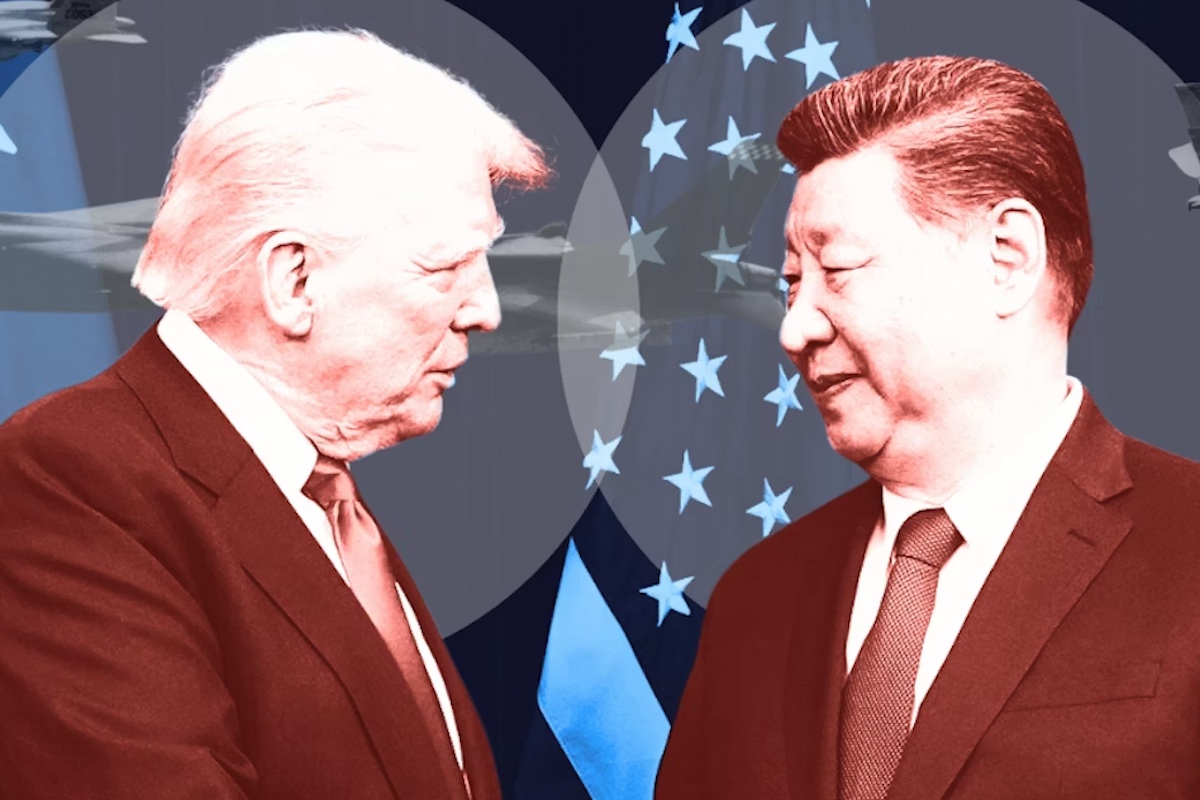
Ahead of U.S. President Donald Trump’s scheduled visit to Beijing this week, international relations scholars have laid out a pragmatic framework for preventing the world’s most impactful bilateral great power rivalry from spiraling into catastrophic conflict. While the summit may produce incremental steps to ease surface-level tensions between the two nations, analysts Kai He and Huiyunanga Feng emphasize a core, unchanging reality: the structural rivalry between Washington and Beijing is unavoidable, and no side can achieve a decisive, lasting victory. The central challenge facing both leaders, they argue, is not eliminating competition altogether, but safeguarding this dynamic relationship from devolving into open conflict — a outcome that is not inevitable, but becomes far more likely without intentional, coordinated guardrails. To keep competition peaceful, the scholars outline three core actionable priorities that both governments must embrace. First, they must uphold credible military deterrence without crossing into deliberate provocation. Second, they should channel competitive energy into institutional engagement and the provision of global public goods, rather than military posturing. Third, they must prevent ideological friction from turning every policy disagreement into an unwinnable zero-sum confrontation. The first core step is establishing deliberate mutual restraint, backed by clear political reassurance, rather than one-sided concessions. Both nations will continue to build military capabilities and balance one another’s influence globally, but the greatest risk stems from repeated misinterpretation: each side frames its own military moves as defensive deterrence, while the other reads the same actions as deliberate provocation. No region embodies this danger more acutely than the long-running impasse over Taiwan. For Beijing, Taiwan is an non-negotiable core sovereignty issue that tests national resolve. For Washington, the island is tied to its credibility as an Indo-Pacific security guarantor, regional stability, and deterrence of any coercive unification process. Both sides claim to defend the existing status quo, both accuse the other of eroding that balance, and both have taken actions that have eroded overall stability in the strait. Instead of demanding unilateral concessions from either side, He and Feng argue for coordinated mutual restraint paired with clearer communication. For example, China could reduce the scale and frequency of coercive military operations near Taiwan, including combat aircraft sorties, naval patrols and drone operations near the island’s air defense identification zone. In exchange, the United States could avoid taking steps that blur the line between longstanding policy of strategic ambiguity and explicit support for Taiwanese formal independence. Contrary to common assumptions, the scholars note that mutual trust is not a prerequisite for stability — clarity and intentional restraint are. To embed this restraint, both sides need a formal, sustained framework for deterrence management that includes ongoing efforts to clarify mutually accepted red lines, reduce misperceptions of each other’s strategic intentions and resolve, and prevent competitive signaling from spiraling into unintended confrontation. During the Cold War, Washington and Moscow eventually learned that an unregulated arms race posed too great a risk to sustain, and built systems to manage competition. He and Feng stress that Washington and Beijing have not yet reached this level of strategic maturity, and must prioritize building these guardrails urgently. The second core priority is channeling rivalry into safer, even productive arenas, rather than forcing confrontation on military or high-stakes geopolitical terrain. Rivalry does not have to be entirely destructive: when guided into institutional competition, it can even deliver collective benefits for the broader global community. Today, this dynamic is already emerging: the U.S. competes through frameworks like the Quad and AUKUS, while China advances its interests through blocs including BRICS and the Shanghai Cooperation Organization. Both sides work to shape the rules, membership and agendas of global and regional institutions to expand their own influence and limit the other’s. While this dynamic is often framed as a new Cold War, institutional competition is inherently one of the safest forms of great power rivalry. Competition pushes institutions to adapt rather than stagnate, encourages new models of regional cooperation, and incentivizes both powers to deliver global public goods — including infrastructure investment, development financing, technological innovation and climate action — to win support from third countries. The competition surrounding global infrastructure financing offers a clear example: China has expanded its global influence through the Belt and Road Initiative and the Asian Infrastructure Investment Bank, while the U.S. and its allies have launched rival infrastructure initiatives to counter that growth. This competition has ultimately benefited developing nations, expanding the range of financing and development options available to them. This dynamic also explains why a sweeping push for full economic decoupling would be a dangerous mistake, the scholars argue. While targeted restrictions in sensitive strategic sectors may be unavoidable, a full break in economic ties would eliminate one of the most critical existing guardrails in the bilateral relationship. As long as the two economies remain deeply intertwined, both sides retain strong incentives to prioritize stability and avoid open conflict. The third core priority is lowering the ideological temperature that has amplified friction across all areas of the relationship. The U.S. and China do not only clash over material interests: they hold fundamentally different political and historical narratives that shape how they interpret every interaction. U.S. policymakers often frame the rivalry as a defense of the liberal international order against authoritarian revisionism, while Chinese leaders frame it as a struggle against foreign containment, historical humiliation and unacceptable interference in their domestic affairs. These are not just rhetorical differences: they shape what each side views as threatening, acceptable, or non-negotiable, and have turned the relationship into an increasingly emotionally and politically charged confrontation. Ideological competition is safest when it remains indirect, He and Feng argue. Neither side is going to convert the other to its political system, and neither will win broad global support through lectures on ideological superiority. A far more effective strategy is competing by example: for the U.S., this means demonstrating that democratic governance can still deliver effective policy, social cohesion and long-term economic vitality. For China, this means proving that its governance model can deliver sustained growth, social stability and productive international cooperation. Both sides must also recognize that ideological overreach carries severe risks. The more Washington frames the rivalry as a global struggle between democracy and autocracy, the more Beijing will view any compromise as an act of capitulation. Similarly, the more Beijing wraps its foreign policy in narratives of anti-hegemony struggle, the more Washington will interpret U.S. restraint as a sign of weakness. Sustained diplomatic engagement remains critical for this reason: if the two powers stop talking, ideological competition will harden and become far more dangerous. The greatest long-term risk in U.S.-China rivalry, the scholars conclude, is that both sides will eventually come to view restraint as weakness, compromise as surrender, and peaceful coexistence as impossible. Once that tipping point is reached, catastrophic conflict becomes far more likely. The most realistic and important goal for bilateral relations right now is not warm friendship, or even full reconciliation. Instead, it is a harder, more modest objective: sustained, managed competition without war. This analysis comes from Kai He, Professor of International Relations at Griffith University, and Huiyun Feng, Professor in the School of Government and International Relations at Griffith University, republished from The Conversation under a Creative Commons license.