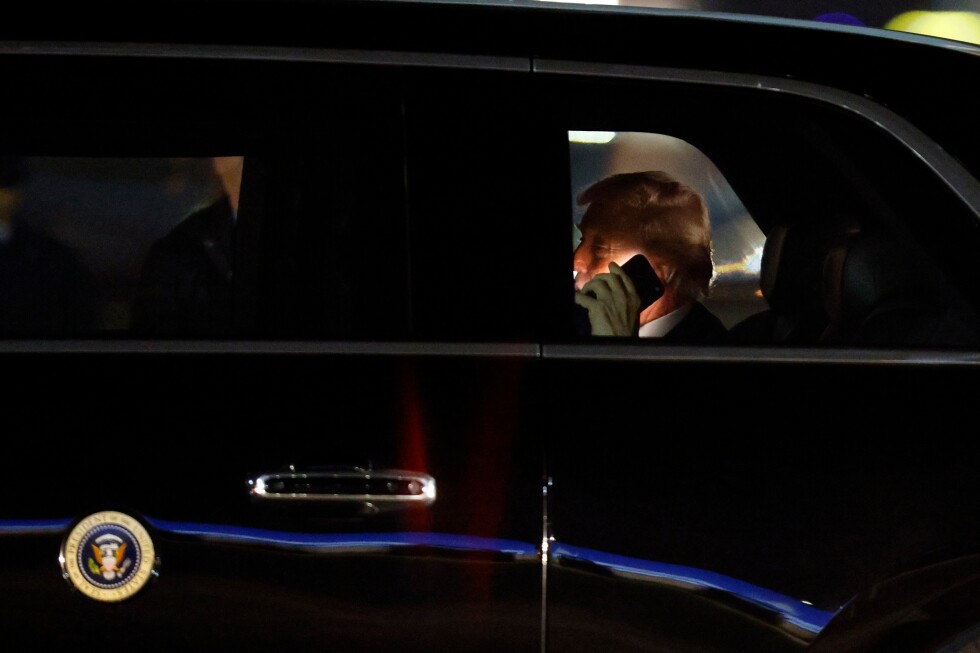
For close to 50 years, every sitting U.S. president has been forced to navigate an extraordinarily delicate diplomatic verbal minefield when addressing U.S. policy toward Taiwan and China. Even the smallest misstatement or off-script comment can send immediate shockwaves through global geopolitics, triggering widespread alarm across major capitals.\n\nUnder the long-standing U.S. \”One China\” policy, Washington formally acknowledges Beijing’s position that Taiwan is part of China, while maintaining only unofficial, people-to-people and security ties with the self-governing island democracy. The framework has intentionally been crafted to remain vague, a diplomatic approach widely referred to as \”strategic ambiguity.\” Under this doctrine, the U.S. pledges to ensure Taiwan retains the necessary capabilities to defend itself against any forced unification attempt by Beijing, but deliberately refuses to explicitly state how far it would go militarily to counter a Chinese attack. As far back as 1995, former Assistant U.S. Defense Secretary Joseph Nye summed up the approach for Chinese officials asking about U.S. responses to a Taiwan crisis: \”We don’t know, and you don’t know.\”\n\n\”The whole idea is that you stick rigidly to the carefully crafted language that’s been built up over decades, you don’t deviate from it at all,\” explained Mike McCurry, former White House press secretary during the Bill Clinton administration. \”Because there are so many stakeholders on all sides listening and paying extremely close attention to every word.\”\n\nCarefully calibrated to preserve Taiwan’s security and de facto autonomy without making explicit irreversible security commitments, while also avoiding unnecessary provocation of Beijing, this long-standing policy is poised to return to the center of global attention ahead of former President Donald Trump’s visit to China this week. A review of modern diplomatic history makes clear that past U.S. leaders have repeatedly stumbled over the wording of the policy, requiring rushed, high-stakes diplomatic damage control to reset expectations.\n\n\”The entire thing relies on the precision of the language,\” said John Kirby, who has served as a spokesperson for the State Department, the Pentagon, and the White House across multiple Democratic administrations. \”You have to be extraordinarily precise when talking about Taiwan because, quite frankly, the stakes could not be higher.\”\n\n### A History of Missteps: When Presidents Strayed From Script\nPresident Joe Biden has repeatedly overstepped the long-standing parameters of the policy, four separate times publicly suggesting the U.S. would intervene militarily if China invaded Taiwan, each time forcing White House officials to quickly step in to clarify that decades of U.S. policy had not changed.\n\nDuring an August 2021 interview with ABC News, Biden was discussing U.S. commitments to mutual defense for NATO allies when he added, \”Same with Taiwan.\” The White House was immediately forced to issue a correction reaffirming that U.S. policy toward Taiwan remained unchanged. That October, during a CNN town hall, Biden again stated the U.S. was committed to defending Taiwan if China launched an attack, prompting an identical walkback from White House staff.\n\nIn May 2022, during a press conference held in Tokyo, Biden answered \”yes\” when asked if he would commit U.S. military forces to defend Taiwan, adding \”That’s the commitment we made.\” The comment forced Defense Secretary Lloyd Austin to publicly reaffirm Washington’s long-standing commitment to the \”One China\” framework just days later. Biden made a similar comment during a September 2022 interview with CBS’ *60 Minutes*, leading to another round of official clarifications from the White House.\n\nThe Trump administration also faced its own share of verbal and protocol blunders during its first term. Then-President-elect Trump broke with decades of precedent in 2016 when he took a direct phone call from Taiwanese President Tsai Ing-wen – a move no U.S. president-elect or president had made since Washington formally cut official diplomatic ties with Taiwan in 1979. Trump later dismissed the backlash to the call, posting on social media: \”Interesting how the U.S. sells Taiwan billions of dollars of military equipment but I should not accept a congratulatory call.\”\n\nThe following year, the Trump White House made another high-profile misstep when a statement about a meeting between Trump and Chinese President Xi Jinping in Germany incorrectly referred to Xi as the president of the Republic of China – the formal name for Taiwan – rather than the People’s Republic of China. The official White House transcript was quickly altered after the error was spotted to correct the wording.\n\nMiles Yu, who served as principal China policy advisor to former Secretary of State Mike Pompeo during the first Trump administration and now leads the China Center at the conservative Hudson Institute, argued that the frequent missteps are inevitable because the framework itself is a \”conceptual trap\” set by Beijing. \”You cannot explain something that’s unexplainable,\” Yu said, noting that he has pushed for the U.S. to abandon ambiguity and explicitly state its commitment to defending Taiwan. He added that the \”One China\” principle, as Beijing frames it to assert Taiwan is an inalienable part of Chinese territory, is \”completely of Chinese making.\”\n\nYu argued that even under the policy of strategic ambiguity, there has never been any real uncertainty about U.S. intentions among China’s top leadership. \”No one inside the Chinese high command has ever believed there is any ambiguity as to America’s resolve to defend Taiwan,\” he said. Instead, he pointed to repeated U.S. military mobilizations in the Taiwan Strait over decades of heightened tensions as clear evidence that Washington has long planned to defend Taiwan in proportion to any threat from Beijing. Today, Trump’s team says U.S. policy has not changed, but rejects the need for the traditional careful verbal gymnastics, pointing to Trump’s approval of multiple major arms sales packages to Taiwan during his time in office.\n\n### The Policy Has Always Been Hard to Articulate\nThe origins of the modern U.S. framework date back to the end of the Chinese Civil War in 1949, when Washington initially recognized Chiang Kai-shek’s Nationalist government as the legitimate ruler of all China, even after that government retreated from the mainland to Taiwan. It was not until 1979, when President Jimmy Carter normalized diplomatic relations with Beijing, that the U.S. formally adopted the \”One China\” policy, after months of closed-door negotiations between the two countries. Even so, Carter later acknowledged that the agreement did nothing to block a future president or Congress from committing U.S. military forces to defend Taiwan if needed.\n\nSubsequent presidents have repeatedly stumbled over the wording of the policy. During a 1998 roundtable in Shanghai, President Bill Clinton committed to the widely accepted \”Three No’s\” pledge: the U.S. does not support Taiwan independence, does not support a \”two Chinas\” or \”one Taiwan one China\” framework, and does not support Taiwan’s membership in international organizations that require statehood for membership. But just one year later, Clinton made off-script comments seeming to suggest he could pursue a military intervention in Taiwan similar to past U.S. military actions abroad.\n\nIn 2001, during an interview with The Associated Press, President George W. Bush was asked whether the U.S. would use military force to counter a Chinese attack on Taiwan, and responded simply \”It’s certainly an option.\” He later was forced to clarify the comment to CNN, saying it did not represent a toughening of U.S. policy, repeating his commitment to do \”what it takes to help Taiwan defend itself.\” Five years later, during a state visit to Washington by then-Chinese President Hu Jintao, a White House announcer mistakenly announced that the national anthem of the Republic of China would be played, instead of the People’s Republic of China, though the error was corrected before the anthem was played.\n\n### Staying On Message Requires Discipline\nA small number of presidents have managed to stick to the carefully crafted script over the years. In 1989, during a state banquet in Beijing, President George H.W. Bush stated that while the U.S. adheres to \”the bedrock principle that there is but one China, we have found ways to address Taiwan constructively without rancor.\” In 2014, during a joint press conference with Xi Jinping in Beijing, President Barack Obama struck a careful balance, saying \”We encourage further progress by both sides of the Taiwan Strait towards building ties, reducing tensions and promoting stability on the basis of dignity and respect.\”\n\nEven so, getting the wording right remains one of the hardest tasks in modern U.S. diplomacy. \”Anybody who has been at the State Department, the Pentagon or even the White House podium can tell you: When the issue of Taiwan came up, you went to your notes,\” Kirby said. \”You didn’t freelance it.\” Kirby admitted that even he once made a mistake when he got overconfident and spoke off-script, mischaracterizing the policy and causing what he called a \”little kerfuffle.\” Any major misstatement, Kirby explained, almost immediately draws pushback from senior U.S. policy officials, who demand an immediate correction: \”You’ll be highly encouraged to make a statement correcting it right away.\”
As Trump heads to China, past US flubs on US policy toward Taiwan can be a warning