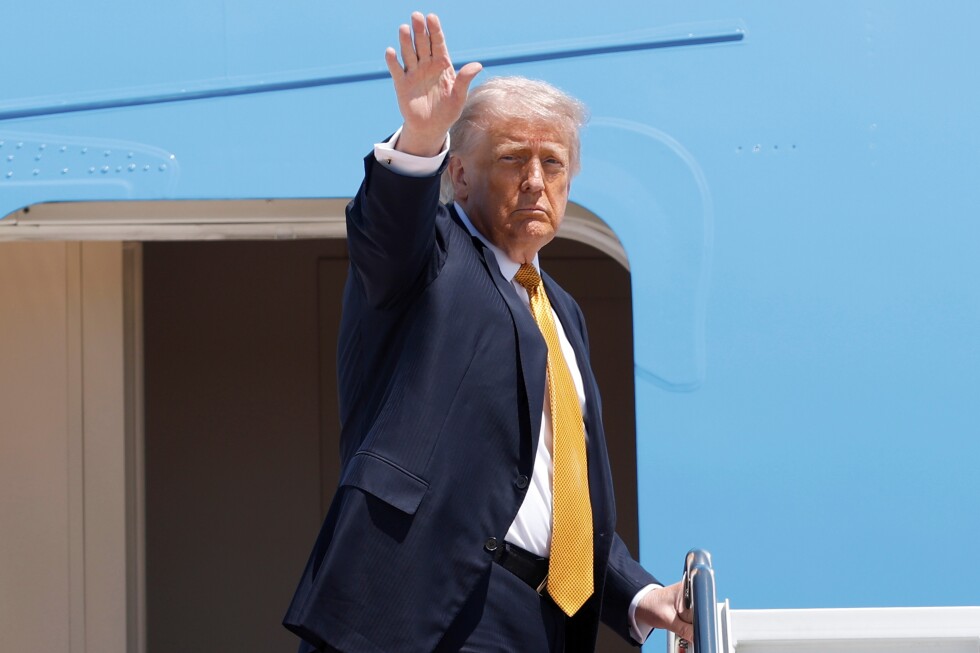
WASHINGTON and BEIJING – As global anxieties over armed conflict, trade frictions, and accelerating artificial intelligence development reach a fever pitch, former U.S. President Donald Trump has departed the White House en route to Beijing, where he will meet Wednesday with Chinese President Xi Jinping for what is shaping up to be one of the most consequential bilateral summits in recent years.
Speaking to reporters ahead of his departure Tuesday, Trump framed the U.S.-China dynamic as a meeting of the world’s two preeminent global powers, noting, “We’re the two superpowers. We’re the strongest nation on Earth in terms of military. China’s considered second.” Despite this public projection of U.S. strength, the trip unfolds at a precarious moment for Trump’s domestic standing, with his approval ratings dragged down by fallout from the U.S.-Israeli war against Iran, which has sent U.S. inflation soaring.
Against this backdrop, Trump is prioritizing trade negotiations, aiming to secure tangible wins through new agreements that would expand Chinese purchases of American agricultural products and civilian aircraft. His administration is also pushing to launch a new bilateral “Board of Trade” mechanism designed to resolve ongoing economic disputes, a step that grows out of the 12-month trade truce reached last October. That truce ended a tense year-long trade war sparked by Trump’s unilateral tariff hikes on Chinese goods, which China countered by leveraging its global dominance of rare earth mineral supplies.
Even as trade sits atop the agenda, the Iran conflict continues to overshadow all other U.S. policy priorities. The war has forced the effective closure of the Strait of Hormuz, a critical global chokepoint for energy shipments, stranding countless oil and liquefied natural gas tankers and pushing energy prices to multi-year highs that threaten to derail fragile global economic growth. Though Iran’s foreign minister Abbas Araghchi held talks in Beijing just last week, Trump played down the need for Chinese mediation, telling reporters, “We have a lot of things to discuss. I wouldn’t say Iran is one of them, to be honest with you, because we have Iran very much under control.”
Two other high-stakes issues will also feature heavily in the closed-door talks: the status of Taiwan and global nuclear arms control. The Chinese government has repeatedly voiced strong objection to planned U.S. arms sales to Taiwan, the self-governing island that Beijing claims as an inalienable part of its sovereign territory. The $11 billion weapons package, authorized by the Trump administration in December but not yet implemented, will be on the agenda, according to Trump himself. Trump has long signaled ambivalence about U.S. commitments to Taiwan, a stance that has sparked widespread speculation that he may be open to rolling back American support for the island democracy. At the same time, Taiwan’s position as the world’s leading producer of advanced semiconductors has made it central to the global AI race, with the U.S. importing more chips and related goods from Taiwan than from mainland China so far this year. Like his predecessor, Trump has pushed policy initiatives to reshore more advanced chip manufacturing to the U.S.
Despite the many sticking points between the two sides, Trump struck an optimistic tone ahead of the meeting, declaring that the U.S.-China relationship will remain strong for decades to come. He also confirmed that Xi has agreed to a reciprocal visit to the U.S. before the end of the year, joking that he only regretted that a new White House ballroom currently under construction would not be completed in time for the high-profile visit. Trump departed Washington on Air Force One accompanied by a delegation of senior aides, family members, and leading tech industry figures, including Nvidia CEO Jensen Huang and Tesla and SpaceX CEO Elon Musk. Following his Wednesday evening arrival in Beijing, Trump will attend a formal state banquet Thursday before holding a working lunch with Xi on Friday and returning to the U.S.
Analysts note that China enters the talks from a far stronger negotiating position than during previous summits with the Trump administration. “Even if they don’t get much on any of their core goals, as long as there’s not a blow-up in the meeting and President Trump doesn’t go away and look to re-escalate, China basically comes out stronger,” explained Scott Kennedy, senior adviser on Chinese business and economics at the Center for Strategic and International Studies, a Washington-based think tank. Key Chinese priorities for the summit include rolling back U.S. restrictions on Chinese access to advanced semiconductors and reducing remaining bilateral tariffs, Kennedy added.
On the global security front, a senior anonymous Trump administration official confirmed that Trump will also propose a new three-way nuclear arms control pact that would include the U.S., China, and Russia, placing binding caps on each country’s deployed nuclear arsenal. China has long rejected participation in such agreements, pointing out that its current stockpile of roughly 600 operational nuclear warheads — per Pentagon estimates — is far smaller than the more than 5,000 warheads each held by the U.S. and Russia. The last remaining bilateral arms control pact between Washington and Moscow, New START, expired in February, ending more than 50 years of binding caps on the world’s two largest nuclear arsenals. As the treaty approached expiration, Trump rejected a Russian proposal to extend the bilateral agreement for one additional year, instead calling for “a new, improved, and modernized” deal that includes Beijing. Pentagon projections estimate China’s nuclear arsenal will grow to more than 1,000 operational warheads by 2030.