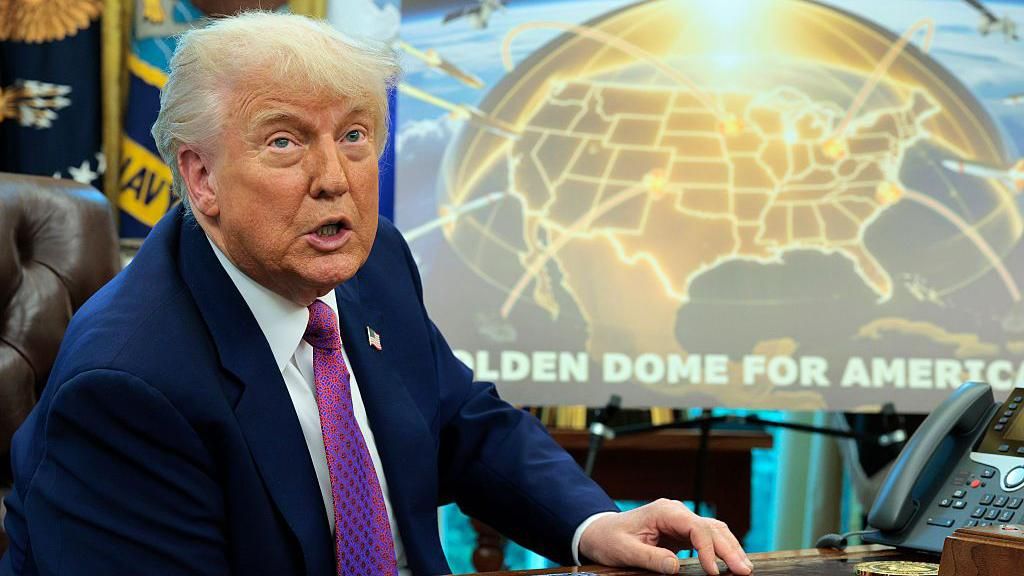
Washington D.C. — A new independent analysis from the nonpartisan Congressional Budget Office (CBO) has delivered a staggering cost projection for U.S. President Donald Trump’s ambitious national missile defense initiative, the “Golden Dome,” finding that developing, deploying, and sustaining the program over 20 years will reach roughly $1.2 trillion (£882 billion) — nearly seven times the total cost the Trump administration initially cited for the project. The CBO report, released publicly this Tuesday, breaks down the unprecedented spending, noting that acquisition costs alone for the multi-domain system will top $1 trillion. That price tag includes development and manufacturing of layered interceptor systems, as well as the construction of a new space-based network for missile warning and tracking, the congressional watchdog confirmed. Unveiled by President Trump just days into his second term in the White House this January, the Golden Dome is designed to blanket the entire continental United States in defensive coverage, capable of countering a wide range of aerial threats ranging from intercontinental ballistic missiles to advanced cruise missiles. The project was framed from its announcement as a response to the growing sophistication of next-generation offensive weapons developed by potential global adversaries. When Trump first announced the outlines of the plan last year, he said the program would require an initial $25 billion investment, with total long-term costs capped at $175 billion (£129.25 billion) — a figure that the new CBO analysis now completely invalidates with its far higher projection. Democratic Senator Jeff Merkley, who formally requested the independent cost estimate from the CBO, issued a sharp rebuke of the proposal following the report’s release. “The President’s so-called ‘Golden Dome’ is nothing more than a massive giveaway to defense contractors paid for entirely by working Americans,” Merkley said in a statement Tuesday. The BBC has reached out to both the White House and the U.S. Pentagon to request comment on the CBO’s findings and the criticism from lawmakers, but has not yet received a response. Beyond the sticker shock of the new cost projection, the report also underscores longstanding technical and strategic doubts surrounding the program. Defense experts and government officials have previously questioned whether a comprehensive nationwide defensive shield can actually be built to cover the United States’ massive landmass, while existing defense systems are already acknowledged to have fallen behind the pace of advanced weapons development by peer adversaries. The CBO’s analysis adds another critical warning: even if the full system is built as designed, it could still be overwhelmed by a large-scale full attack launched by major nuclear powers like Russia or China. The framework for the Golden Dome traces back to an early executive order from President Trump, which initially framed the initiative as an “Iron Dome for America” — a reference to the Israeli regional defense system. The order noted that the threat of advanced next-generation offensive weapons has “become more intense and complex” over time, creating a potentially “catastrophic” vulnerability for the United States. A week into his second term, the President directed the Department of Defense to draft formal development plans for the system, which the White House identified as the top priority to counter “the most catastrophic threat” facing the United States. Per Trump’s original description, the Golden Dome will integrate cutting-edge next-generation technologies across all operational domains: land, sea, and space. Key components include space-based tracking sensors and interceptor capabilities, with the President claiming last year that the system will be “capable even of intercepting missiles launched from the other side of the world, or launched from space.”