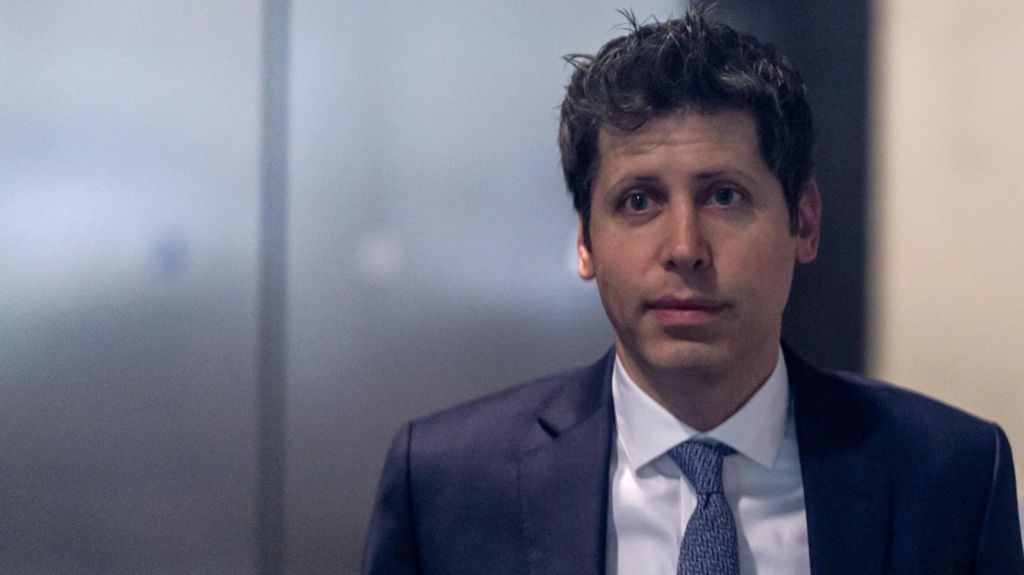
In explosive testimony delivered Tuesday to a federal jury in Oakland, California, OpenAI chief executive Sam Altman laid out new details of a years-long power struggle with Tesla and X owner Elon Musk, revealing the billionaire’s far-reaching bid to seize total control of the ChatGPT-developing AI firm shortly after its founding — including a plan to pass that control to his children upon his death.
The courtroom appearance comes as part of an ongoing lawsuit filed by Musk against Altman and OpenAI, in which the billionaire accuses Altman of abandoning the organization’s original non-profit charter to “loot” the non-profit entity for personal gain. But Altman’s testimony flipped the narrative, arguing that Musk himself was the driving force behind restructuring OpenAI into a for-profit enterprise, all while pushing aggressively to claim full control of the company.
Recalling tense early discussions among OpenAI’s founding team, Altman described a striking exchange that he called “hair-raising.” When his co-founders asked Musk what would happen to control of the company if Musk passed away, Altman said Musk responded that leadership should transfer to his children.
According to Altman, Musk floated multiple concrete proposals to accumulate more power at OpenAI in the years after its 2015 founding. Beyond seeking additional board seats and the top executive role as CEO, Musk even proposed folding OpenAI into Tesla as a wholly owned subsidiary. The core motivation behind this push for a structural overhaul, Altman told the jury, was to access larger amounts of capital at a faster pace than the non-profit structure allowed.
Altman recalled Musk arguing that his high-profile status as a tech billionaire made him the only suitable leader for the organization. Musk allegedly claimed that a single public tweet from him would instantly generate massive value for OpenAI and attract the substantial financial backing the company needed to advance its research.
But Altman and his fellow co-founders Greg Brockman and Ilya Sutskever rejected Musk’s overtures, saying that concentrating full control of OpenAI in a single individual ran directly counter to the organization’s core mission. OpenAI was founded with the explicit goal of developing artificial general intelligence (AGI) — a broadly defined AI system that can outperform humans on nearly all economically valuable tasks — safely and for the public good, Altman noted, and the founding team never believed one person should hold unilateral power over AGI development.
“I was extremely uncomfortable with it,” Altman told the jury. “One of the reasons we started OpenAI was because we didn’t think any one person should be in control of AGI.”
The standoff ultimately led Musk to sever ties with OpenAI in early 2018. He resigned from the company’s board and halted his regular $5 million quarterly donations to the research effort. Altman told the court a blunt email from Musk announcing his exit remains “burned into my memory”: Musk insisted OpenAI had “a zero percent chance, not a one percent chance, of success” without his leadership.
Years later, when OpenAI established its for-profit subsidiary in 2019, Altman extended an offer for Musk to take an ownership stake in the new entity. Altman said Musk declined the offer outright, explaining that he would never invest in a startup that he did not control full stop. The ongoing legal battle between the two high-profile tech leaders centers on the future of one of the world’s most valuable AI companies, and the question of whether OpenAI violated its founding non-profit commitments in its push to commercialize generative AI technology.