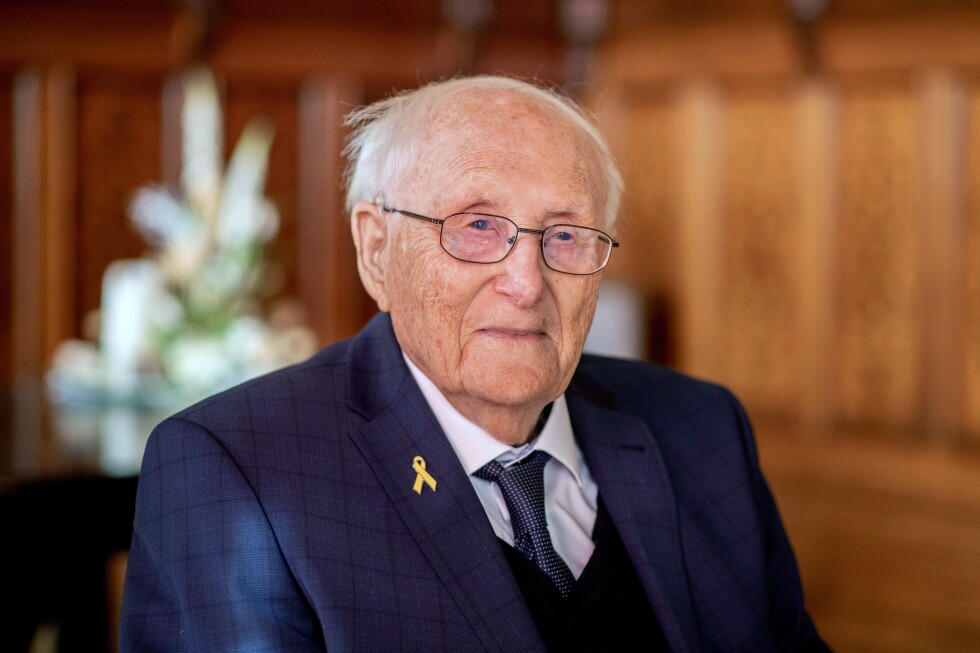
LEER, GERMANY — Local municipal authorities confirmed this Tuesday the passing of Albrecht Weinberg, a 101-year-old Holocaust survivor who endured some of the Nazi regime’s most brutal concentration and death camps, lost nearly his entire family to the genocide, and returned to his native Germany in his 80s to spend his final decades educating new generations about the atrocities he survived.
Weinberg died at his home in Leer, a city in Lower Saxony in northwestern Germany, just a few weeks after celebrating his 101st birthday and attending the premiere of a documentary chronicling his life. Titled *Es ist immer in meinem Kopf* (translated “It is always in my head”), the event drew hundreds of attendees who gathered to honor his decades of work as a witness to history.
Born in 1925 in Rhauderfehn, a small community just outside Leer, Weinberg was a young Jewish man when the Nazi regime rose to power. He was deported and imprisoned in three of the Third Reich’s most infamous death and concentration camps: Auschwitz, Mittelbau-Dora, and Bergen-Belsen. He also survived three deadly forced death marches in the final chaotic weeks of World War II, as Nazi officials emptied camps ahead of advancing Allied forces. Most of his family was murdered in the Holocaust, leaving him as one of the only surviving members of his immediate family.
After decades living in New York, Weinberg made the decision to return to his East Frisian homeland 14 years ago, a choice that surprised many given the trauma he had suffered at the hands of the Nazi German state. From that point forward, local mayor Claus-Peter Horst recalled, Weinberg dedicated himself tirelessly to sharing his experiences with incredible energy, repeatedly warning German communities against the danger of forgetting the horrors of the Nazi era. For years, he spoke regularly to high school groups, community organizations, and public audiences, turning his personal trauma into a warning against rising extremism.
Even in his final years, the memories of his wartime suffering never faded. Speaking to reporters last year, Weinberg acknowledged that the trauma of his camp experiences remained a constant part of his daily life. “I sleep with it, I wake up with it, I sweat, I have nightmares; that is my present,” he said. He also voiced a persistent worry that when the last generation of Holocaust survivors passed away, the collective memory of the atrocities would fade, leaving future generations only with written accounts rather than the personal, human testimony that carried far greater weight.
Weinberg’s legacy also included a powerful act of political protest that drew national attention last year. In 2017, he had been awarded Germany’s prestigious Order of Merit in recognition of his educational work. But he chose to return the honor in 2024 to protest a parliamentary motion that passed with the support of a far-right political party. The motion, put forward by Friedrich Merz — who became Germany’s chancellor in late 2024 — called for significantly stricter border policies that would turn away most irregular migrants arriving at Germany’s borders. Weinberg’s protest highlighted his lifelong commitment to speaking out against far-right extremism, decades after he survived it.
Following the announcement of his death, tributes poured in from across Germany and the global Jewish community. Ron Prosor, Israel’s ambassador to Germany, wrote on the social platform X that he had gotten to know Weinberg well over the years, praising him as a unique “bridge — between past and present, between pain and hope, between the dead he could never forget and the young people whom he encouraged to seek the truth.”