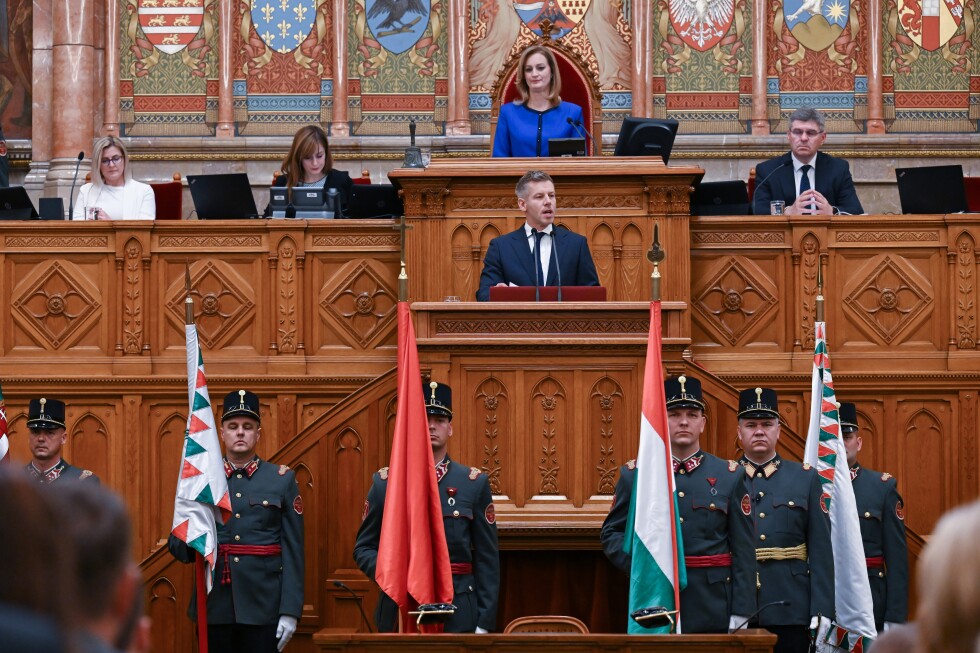
In a landmark political shift that reshapes both Hungary’s domestic trajectory and European Union dynamics, Péter Magyar’s new 16-member cabinet was officially sworn into office on Tuesday in Budapest, completing the full transfer of power away from Viktor Orbán, who led Hungary with a nationalist-populist agenda for 16 years. This historic handover follows a stunning electoral upset last month, where Magyar’s pro-European Tisza Party secured an unprecedented two-thirds parliamentary majority — a result unmatched in Hungary’s post-Communist history.
Magyar, a 45-year-old lawyer who assumed the prime ministership on Saturday, moved through parliamentary confirmation hearings for his cabinet in just two days, a deliberate timeline that signals his urgency to dismantle the political system Orbán built over nearly two decades. Tisza’s landslide victory gave the party 141 of the 199 total seats in parliament, pushing Orbán’s long-ruling Fidesz party from 135 seats to just 52, with the far-right Mi Hazánk movement holding the remaining six seats.
In remarks delivered moments after his cabinet’s swearing-in inside Hungary’s parliament, Magyar drew a clear line between his administration and his predecessor’s leadership. Stating that the new government would “be the government of all Hungarians” and act as “a servant of the nation and not of the prime minister”, he directly challenged the concentrated power that defined Orbán’s tenure. He outlined his core mandate: undoing the “destruction, division, backwardness and loss of trust” accumulated over the past 20 years, and rebuilding Hungary into a “functioning, livable and self-reliant country”.
A top priority for Magyar’s electorate is holding former Fidesz officials and their affiliated business allies accountable for alleged widespread corruption and misconduct during Orbán’s administration. To advance this goal, the new government plans to establish a National Asset Recovery and Protection Office, a dedicated body tasked with investigating and recovering public funds misused under the previous regime. Magyar has also committed to Hungary joining the European Public Prosecutor’s Office, a move that will allow EU investigators to probe cross-border fraud and the mismanagement of EU funding allocated to the country.
Media reform is another immediate policy focus: Magyar has vowed to suspend programming at Hungary’s public broadcaster, long decried as a partisan mouthpiece for Fidesz, until full editorial objectivity can be guaranteed. He has also called on all senior public officials appointed during Orbán’s tenure — including the Hungarian president, attorney general, head of the national media authority, and chief justice of the Constitutional Court — to resign by May 31 to clear the way for independent appointments aligned with democratic norms.
Structurally, the new government expands the cabinet from 12 ministries under Orbán’s final administration to 16, with standalone portfolios for health, environmental protection, and education, all of which were merged into larger departments under the previous government. This restructuring is part of a broader overhaul of state institutions, with Magyar prioritizing the restoration of democratic governance and the rule of law, both of which eroded significantly during Orbán’s time in power.
Beyond domestic reform, Magyar’s administration is set to transform decision-making dynamics within the EU. Orbán frequently used veto power to block bloc-wide initiatives, most recently blocking new support packages for Ukraine, creating repeated deadlock for the union. The new Hungarian government has made unlocking approximately 17 billion euros ($20 billion) in frozen EU funds its top foreign policy priority. The funds, frozen by the EU over rule-of-law and corruption concerns during Orbán’s tenure, are critically needed to revitalize Hungary’s stagnant economy, which has seen little to no growth for four consecutive years.
In a Facebook video posted the day before the cabinet swearing-in, new Hungarian Foreign Minister Anita Orbán, a career diplomat and foreign policy expert, confirmed that her ministry’s core mission will be to “bring EU funds home” and “consolidate Hungary’s place in Europe and in the EU”. Other key cabinet appointees include former Shell executive István Kapitány, who takes on the role of Minister of Economy and Energy, and former Erste Bank economist András Kármán, who serves as Minister of Finance. This report included contributions from AP correspondent Don McNeil reporting out of Brussels and AP writer Béla Szandelszky based in Budapest.