Two major overlapping developments have rocked the ongoing conflict in Ukraine this week: a high-stakes corruption probe targeting one of Volodymyr Zelenskyy’s closest former aides has unfolded in Kyiv, even as Russia resumed large-scale drone strikes after a three-day Victory Day ceasefire and announced plans to deploy a cutting-edge intercontinental nuclear missile by the end of 2026.
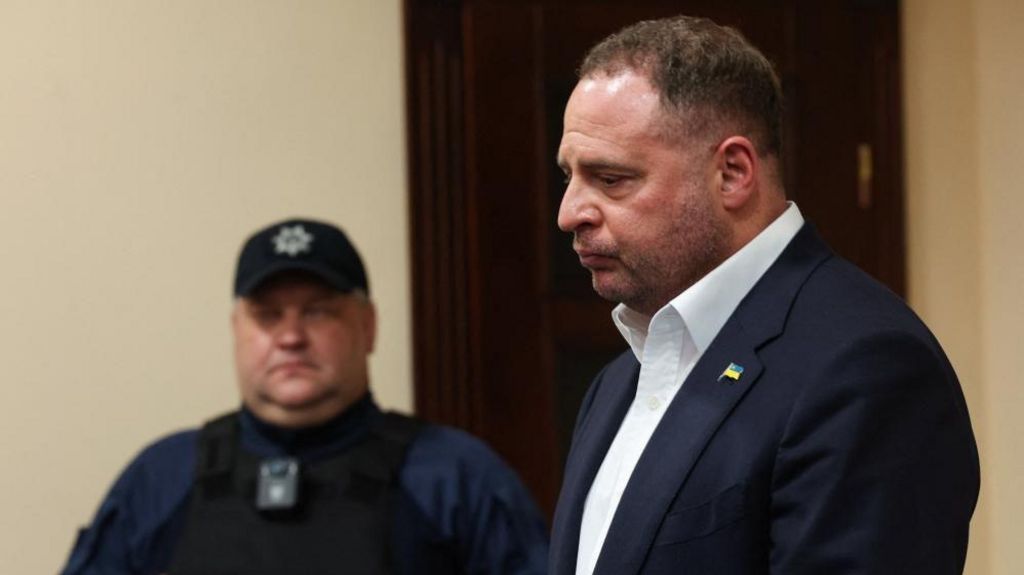
On Tuesday, Andriy Yermak, who once served as head of Ukraine’s presidential office and Zelenskyy’s most senior advisor through the opening years of Russia’s full-scale invasion, appeared before a Kyiv court following formal designation as a suspect in a multi-million dollar money laundering scheme. Yermak, who stepped down from his post last November after anti-corruption agents raided his apartment, has forcefully pushed back against the claims. Speaking to reporters hours ahead of his scheduled court appearance, Yermak stated, “I do not have any house, I only have one flat and one car.” His defense attorney, Ihor Fomin, has repeatedly described the allegations against his client as “baseless”, telling Ukraine’s public broadcaster Suspilne that the unsubstantiated charges were driven by unprecedented public pressure, rather than evidence of wrongdoing.
The suspicions against Yermak center on two separate alleged corruption schemes. The first is an elite luxury housing development named “Dynasty” outside Kyiv, where investigators claim roughly $10.5 million in construction funds were laundered through illegal channels. The case is also tied to a broader ongoing inquiry into an alleged $100 million embezzlement ring within Ukraine’s state-owned nuclear energy sector. Nabu, Ukraine’s National Anti-Corruption Bureau, and SAPO, the Anticorruption Prosecutor’s Office, the two agencies leading the investigation, have confirmed that six additional people have been named as suspects alongside Yermak, and have released partial transcripts of wiretapped conversations as part of their evidence. Prosecutors are requesting that the Kyiv court impose either pre-trial detention or set bail at approximately $4 million. In a key clarification for national politics, Nabu’s leadership stressed that President Zelenskyy himself is not part of the ongoing pre-trial investigation.
Yermak was once one of the most powerful figures in Zelenskyy’s government, leading Ukraine’s diplomatic negotiations with the United States and serving as the president’s closest confidant throughout the first phase of the full-scale invasion. This corruption case is the latest high-profile fallout from Operation Midas, a sweeping anti-corruption probe that has already ensnared multiple other former senior officials and members of Zelenskyy’s old inner circle. Former Deputy Prime Minister Oleksiy Chernyshov has been charged with abuse of office, former Energy Minister Herman Haluschenko was detained while attempting to cross the Ukrainian border, and businessman Timur Mindich, a one-time business partner of Zelenskyy who co-owned his former production studio Kvartal 95, has fled Ukraine after being named a suspect. All individuals named in the probe deny any criminal wrongdoing.
The unfolding corruption scandal carries significant geopolitical weight for Ukraine, as it comes as the country pursues formal accession to the European Union. Brussels has repeatedly made clean governance and robust independent anti-corruption efforts a core requirement for Ukraine’s membership bid. Last year, Zelenskyy was forced to reverse a controversial law that would have weakened the operational independence of Nabu and SAPO after widespread domestic protests and sharp criticism from EU officials.
Simultaneously, military tensions have spiked across the region following the end of Russia’s three-day Victory Day ceasefire, marking the 80th anniversary of the Soviet Union’s victory over Nazi Germany in World War II. Overnight, Russia launched a massive drone assault targeting multiple regions across Ukraine, with more than 200 drones launched. Ukrainian authorities confirmed that the attacks left at least one civilian dead. Kyiv, which had seen a period of relative calm in the days leading up to the strikes, faced new air raid alerts across the capital overnight. For its part, the Russian Ministry of Defense claimed it had shot down more than 100 Ukrainian drones launched into Russian territory over the preceding 24 hours.
Military and diplomatic positioning has shifted in recent days following conflicting statements from Russian and Ukrainian leaders over the prospects of peace talks. At the weekend, Russian President Vladimir Putin suggested that the war was “coming to an end”, but Kremlin spokesperson Dmitry Peskov clarified on Tuesday that “a lot of homework is still to be done”, indicating that a planned meeting between Putin and Zelenskyy is unlikely to happen in the near future. Zelenskyy has repeatedly rejected Russian overtures, stating earlier that Moscow has “no intention of ending this war” and is actively preparing for new offensive operations.
In one of the most provocative announcements of the week, Putin confirmed on Tuesday that Russia will deploy the new Sarmat intercontinental ballistic nuclear missile by the end of 2026. The missile has an advertised maximum range of 35,000 kilometers, putting any target on the globe within striking distance. The Russian Ministry of Defense released newly published footage of a Sarmat test launch this week, with Putin describing the system as “the most powerful missile system in the world”. Putin added that development work on three other next-generation strategic nuclear weapons — the Burevestnik nuclear-powered cruise missile and a nuclear-powered torpedo — is in its final stages of completion.