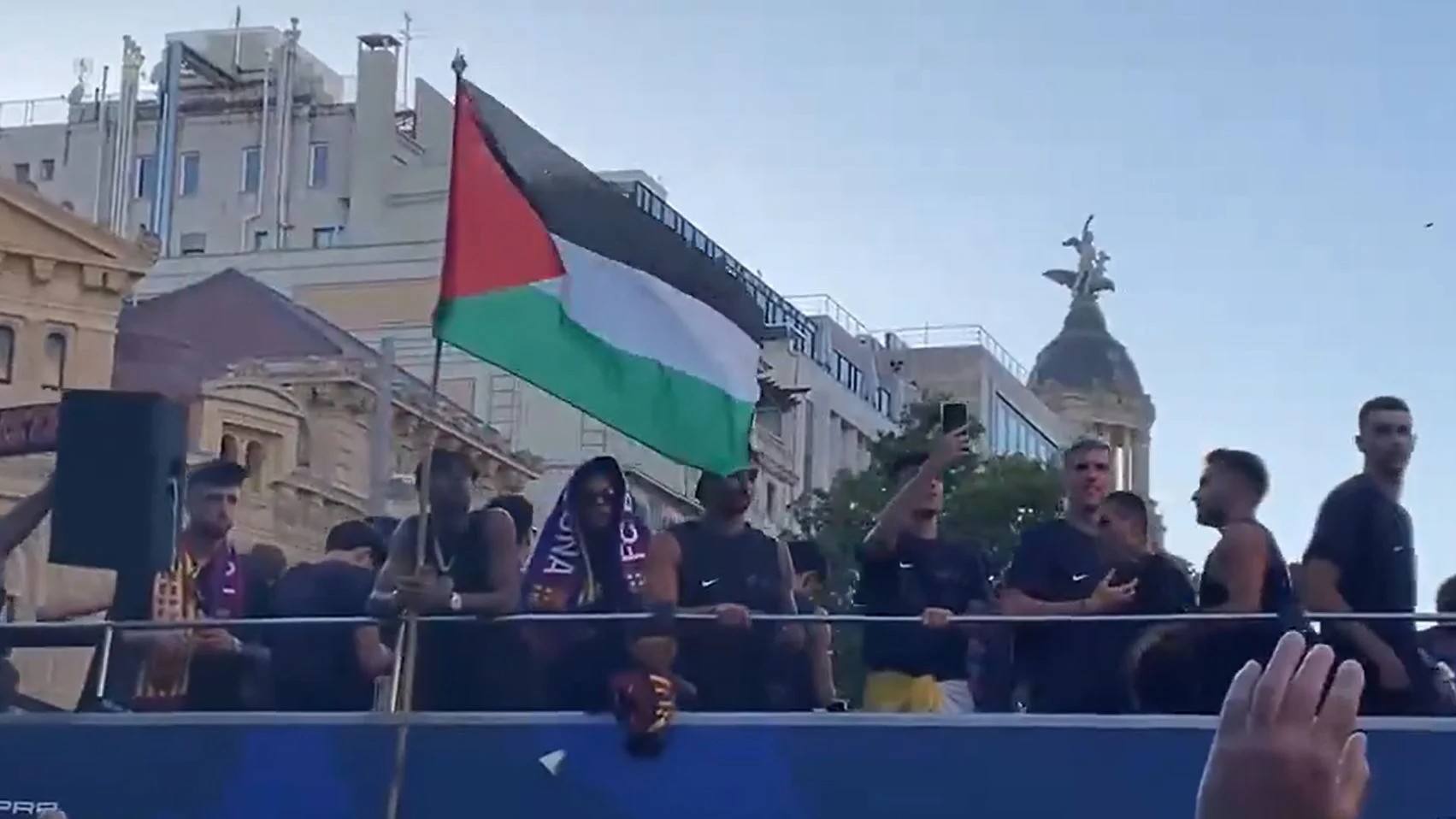
Barcelona’s 2024-2025 La Liga title celebrations took an unexpectedly political turn on Monday, when 18-year-old football phenom Lamine Yamal brought a large Palestinian flag onto the team’s open-top victory parade, drawing widespread acclaim across social media platforms for the high-profile act of solidarity. The moment came just 24 hours after Barcelona sealed their latest domestic championship with a decisive 2-0 win over bitter El Clasico rivals Real Madrid, drawing tens of thousands of jubilant fans into the streets of the Catalan capital to celebrate with the squad.
Yamal, one of the sport’s most globally recognized young talents, is no stranger to using his massive public platform to speak out against injustice. Last month, he openly condemned anti-Muslim chanting from Spanish supporters during a national team friendly match against Egypt. In a candid public statement released after the match, Yamal, who is Muslim, said the chant “Whoever doesn’t jump is a Muslim” was unacceptable. “I know it was aimed at the opposing team and wasn’t something personal against me, but as a Muslim, this still counts as disrespectful and unacceptable behaviour,” he said at the time. “Football was created for enjoyment and cheering, not for insulting people because of who they are or what they believe in.”
Yamal’s gesture also is not unique among Spanish footballers in recent weeks. Just seven days prior, former Barcelona winger Ilias Akhomach unfurled a Palestinian flag during title celebrations for his current club Rayo Vallecano, after the side secured a spot in the UEFA Conference League final with a semi-final win over France’s Strasbourg.
Catalonia, and Barcelona in particular, has long been a hub for pro-Palestine activism in Spain. The city has served as the departure point for international aid flotillas organized to break the Israeli military blockade of the Gaza Strip, a role that has cemented the region’s reputation as a center of pro-Palestine organizing in Europe.
The act of solidarity from Yamal also aligns with the Spanish federal government’s longstanding, high-profile stance on the Israeli-Palestinian conflict, which has put Madrid at odds with both Israel and the United States in recent months. Spain is one of the only European governments to have repeatedly and openly condemned Israel’s military campaign in Gaza, officially labeling the actions a genocide. In 2024, Madrid became one of the first Western governments to formally recognize Palestinian statehood, a decision that prompted Israel to immediately recall its ambassador from Madrid. By 2025, the government expanded its actions, banning all Israeli ships and aircraft carrying weapons bound for Israel from accessing Spanish ports and airspace, as part of a nine-part package of restrictive measures against Israel.
Diplomatic relations between the two nations have been frozen since late 2024, when Spain recalled its ambassador to Israel for consultations amid the escalating row. Israel has not had an ambassador posted to Madrid since 2024, leaving bilateral ties at their lowest point in decades. More recently, tensions have flared again over the joint US-Israeli military campaign against Iran. Spanish Prime Minister Pedro Sanchez has publicly labeled the military strikes illegal under international law, and refused the United States’ request to access jointly operated Spanish military bases in southern Spain for operations linked to the Iran campaign.
That decision triggered an angry public response from US President Donald Trump, who accused Spain of acting in an “unfriendly” manner and threatened to impose sweeping trade restrictions on the country in retaliation. Despite the pressure, Sanchez has stood firm on his position, maintaining Spain’s commitment to upholding international law across the Middle East.