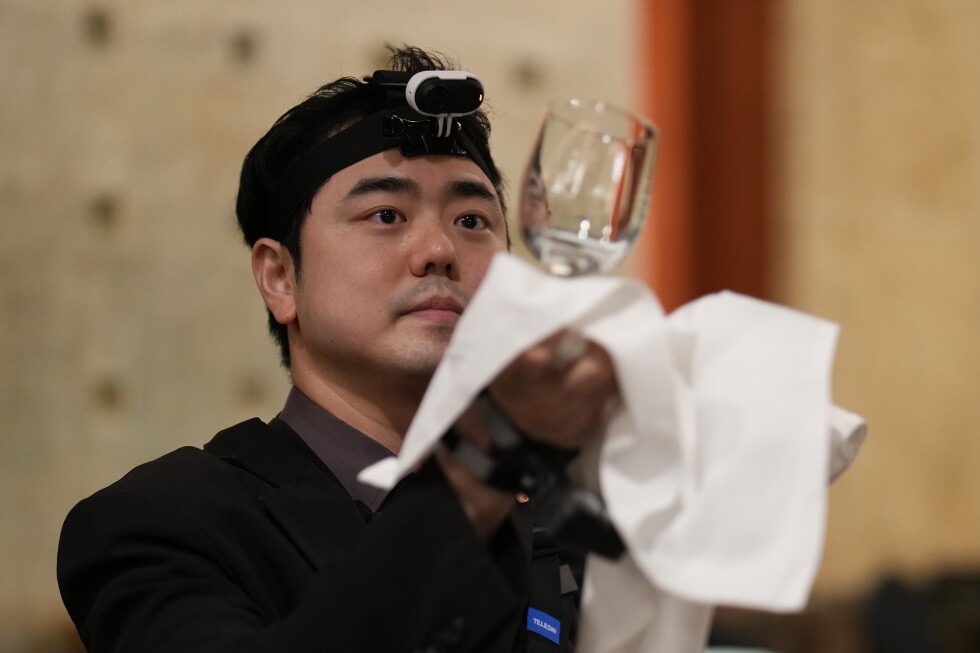
In a sprawling banquet hall at Seoul’s five-star Lotte Hotel, veteran banquet worker David Park goes through a routine he has mastered over nine years: folding a crisp linen napkin, polishing cutlery, and arranging table settings. What makes this routine different from his thousands of previous shifts is the array of body cameras strapped to his head, chest, and hands — every subtle movement, every fine adjustment of his fingers is being recorded and stored in a growing database. This data will not go to waste; it will one day teach a robot to perform the same exact tasks.
Park is one of roughly 10 skilled Lotte Hotel food and beverage staff contributing their expertise to RLWRLD, a South Korean artificial intelligence startup building a comprehensive library of human manual skills to power the next generation of AI-driven robots. The young company is not only working with hospitality giants like Lotte: it also collects motion data from logistics employees at South Korea’s CJ Group, tracking how workers grip, lift, and move goods in busy warehouses, and from staff at Japanese convenience chain Lawson, mapping the precise movements staff use to arrange in-store food displays.
The end goal of RLWRLD’s work is to build a universal AI software layer that can be integrated into robots deployed across a wide range of workplaces, from manufacturing floors to commercial service sites, with an eventual expansion into domestic home environments. For the startup’s engineers, the top priority is replicating the manual dexterity of human hands — a core capability they believe will unlock the full potential of humanoid robots, the technology they expect to define the future of physical AI.
RLWRLD sits at the forefront of a growing wave of South Korean high-tech firms and manufacturers racing to capture a share of the unproven but intensely competitive global physical AI market. Unlike traditional factory robots built to perform a single repetitive task, physical AI describes autonomous machines that combine AI processing and sensor technology to perceive, make decisions, and adapt to unpredictable real-world environments. While experts still debate whether these machines will live up to the hype of transforming global industries, physical AI sits at the center of South Korea’s national ambition to turn its existing strengths in semiconductor manufacturing and industrial production into a leadership position in the global AI economy.
South Korea’s bet on physical AI comes after the country concluded it could not easily compete with U.S. firms in generative chatbot technology, where American companies hold a huge advantage thanks to dominance in English-language digital data and language research. By contrast, physical AI relies on vast datasets of human manual skill — a resource South Korea has in abundance thanks to its deep base of skilled manufacturing and service workers. The national government doubled down on this strategy just last month, launching a $33 million initiative to digitize the tacit, instinctive expertise of veteran master technicians into a training database for manufacturing robots, a move designed to boost productivity and counter the challenges of the country’s aging and shrinking workforce.
Major South Kong conglomerates have already laid out clear timelines for rolling out AI-powered robots. RLWRLD, which just unveiled its first general-purpose robotics foundation model last week, projects that industrial AI robots will reach large-scale deployment by roughly 2028. Hyundai Motor, for example, plans to roll out humanoids built by its subsidiary Boston Dynamics to its global production facilities starting with its new Georgia plant in 2028. Samsung Electronics, the country’s chip and electronics giant, aims to transition all of its manufacturing sites to AI-driven operations with humanoids and specialized robots across production lines by 2030.
“South Korea has a highly developed manufacturing sector and the focus is squarely on humanoids tailored specifically for those industries,” explained Billy Choi, a professor at Korea University’s Center for Human-Inspired AI Research.
Despite the widespread optimism from government and industry leaders, South Korea’s push into AI-powered robotics has sparked significant pushback from national labor groups. Unions warn that widespread robot adoption could displace human workers and erode the skilled workforce that has long been the backbone of South Korea’s economic competitiveness — the very asset the country is relying on to train its AI robot systems. In January, after Hyundai’s union raised alarms that robots could trigger a widespread “employment shock,” South Korean President Lee Jae Myung struck back, framing AI as an unstoppable “massive cart” that requires workers to adapt to changes arriving “faster than expected.”
“Mastery of skills is ultimately a human achievement — even if AI can replicate existing abilities, the continuous development of craft will remain fundamentally human,” said Kim Seok, policy director at the Korean Confederation of Trade Unions. He warned that mass robot deployment would risk “severing the pipeline” for new skilled labor, and called on policymakers and employers to collaborate with workers to address job security concerns and win buy-in for the AI transition.
While humanoid robots developed by U.S. and Chinese firms have already demonstrated impressive physical capabilities — from backflips to long-distance running — RLWRLD business strategy lead Hyemin Cho argues that mastery of fine, delicate manual tasks with human-like hands is what will unlock widespread adoption of humanoids across industrial and domestic settings.
“Capturing motion data in real-world settings is extremely important and the quality of that data matters greatly,” Cho noted.
After the company collects raw footage of skilled workers performing tasks, RLWRLD engineers repeat the same movements while outfitted with cameras, VR headsets, and motion-tracking gloves to capture additional granular data. This combined dataset is then used to train test robots, which are often guided by RLWRLD “pilots” operating wearable control devices. The process captures minute details that are critical for dexterous movement, including joint angles and the exact amount of force a human applies when handling an object, according to RLWRLD robotics team member Song Hyun-ji.
One of the startup’s test labs is tucked into a cluttered 34th-floor suite inside the Lotte Hotel itself, tangles of wires and computing equipment covering worn carpet, with infrared laser tracking poles standing in the corners. Under an original crystal chandelier, the only remaining trace of the room’s former luxury use, a wheeled test robot with black, human-shaped metal hands moves back and forth with a low mechanical whir. During a recent demonstration, the robot slowly lifted and repositioned cups in a mock minibar setup, though it did knock over one small dish. More recent test footage shows a far more advanced prototype: a full humanoid carefully opening a box, placing a computer mouse inside, closing the lid, and setting the finished box on a conveyor belt.
Most industrial robots, including Boston Dynamics’ well-known Atlas humanoid, use task-specific gripper hands with two or three fingers. RLWRLD is among a small cohort of companies developing AI systems for five-fingered hands designed to closely mimic human touch. While five-fingered designs may not be necessary for all factory tasks, they will be critical for robots operating in home environments where close interaction with humans and everyday human objects is required, professor Choi explained.
Hospitality workers like Park turn out to be ideal sources of training data for robots learning precise, nuanced manual tasks, and the skills captured in this data can also be transferred to industrial robot use, Cho said. Even today, humanoids still struggle with speed: a full humanoid would need several hours to clean a hotel guest room that a human worker completes in roughly 40 minutes. Even so, Lotte Hotel expects robots will be ready to handle cleaning and other back-of-house banquet tasks by 2029. The hotel chain also plans to launch a robot rental service for other hospitality and service businesses, with a potential future expansion into residential home use.
Park, who has contributed his own skills to training the robots, says he does not fear being replaced entirely. “If you look at the entire process of preparing for an event in back-of-house areas, we think humanoids might be able to take over about 30% to 40% of that workload,” he explained. “It will be difficult for them to replace the remaining 50%, 60% and 70%, which involves actual human-to-human interaction.”
With heavy competition from global players including Tesla and a flood of Chinese firms pouring billions of dollars into humanoid development, South Korea is betting its deep pool of skilled human expertise will give it an edge in turning the promise of physical AI into a commercial and industrial reality.