As U.S. President Donald Trump prepares to depart for his highly anticipated visit to Beijing this week, long-simmering trade tensions, deep economic ties between China and Iran, and shifting bilateral dynamics threaten to dampen the warm goodwill Trump has long projected for his Chinese counterpart Xi Jinping. Weeks ahead of his departure, Trump already took to social media to predict Xi would greet him with a warm embrace, a reflection of the consistent public praise he has lavished on the Chinese leader throughout his political career, framing Xi as a formidable competitor worthy of his respect.
Unlike Trump’s historic 2017 first-term visit to Beijing — which Beijing designated a “state visit-plus” marked by unprecedented ceremonial fanfare — this year’s trip is expected to be far lower in scale and shorter in duration. Trump, who has openly expressed discomfort with long-haul flights and extended stays away from Washington and his personal properties, will only spend roughly three partial days on the ground in China, with ceremonial arrangements that experts say will not match the grandeur of his first trip.
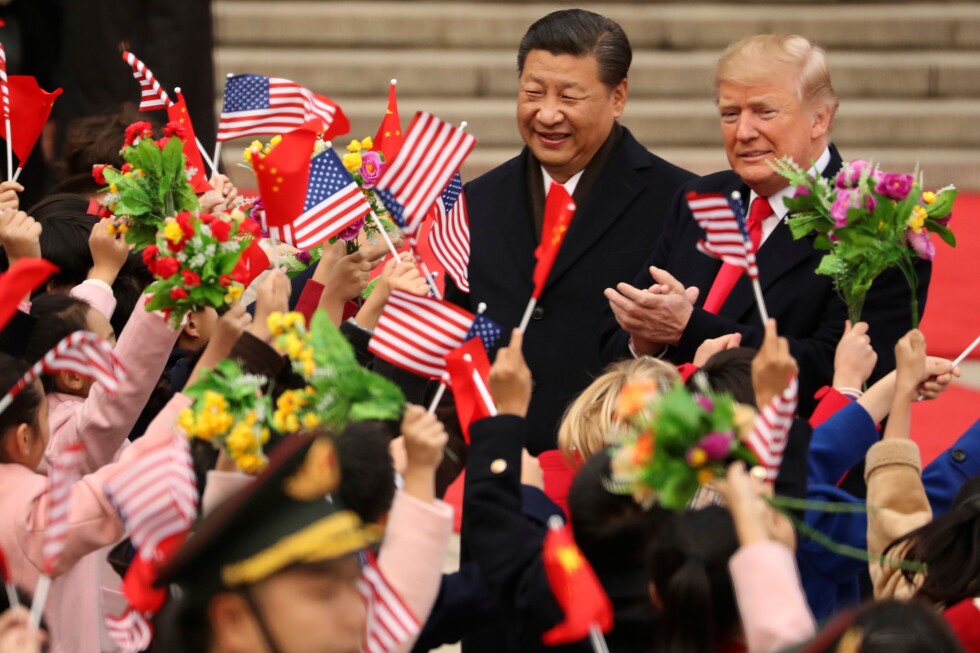
The 2017 visit set a unique bar for high-level diplomatic spectacle between the two leaders. China rolled out an extraordinary red-carpet welcome: military bands played state honors, uniformed children waved national flags and chanted welcomes, Xi personally hosted Trump and first lady Melania Trump for a private tour and dinner inside the Forbidden City, an honor never before extended to a foreign leader since the founding of the People’s Republic of China. The next day, a formal welcome ceremony and full military parade was held at the Great Hall of the People, capped by a state banquet featuring footage of Xi’s earlier visit to the U.S. and a clip of Trump’s granddaughter Arabella singing a song in Mandarin. Such extraordinary treatment is rarely extended to visiting world leaders: when British Prime Minister Keir Starmer toured the Forbidden City earlier this year, Xi did not attend, the site remained open to the general public, and Starmer shared the space with ordinary tourists.
Jonathan Czin, a former China director at the Biden administration’s National Security Council and current Brookings Institution fellow, noted that tensions between the two powers already ruled out a repeat of the 2017 “state visit-plus” format long before the recent escalation of conflict over Iran. “Even before this whole conflagration with Iran, they weren’t going to go state visit-plus like last time, just because things are tense,” Czin explained.
Ali Wyne, senior U.S.-China research and advocacy adviser at the Washington-based Crisis Group, acknowledges that Chinese organizers will still work to craft a memorable experience for Trump, who has long been drawn to displays of grandeur. “The Chinese delegation will likely do its utmost to ensure that Trump leaves Beijing believing that he has just concluded the most extraordinary state visit of his two presidencies,” Wyne said. But he added that the purpose of this pageantry has shifted significantly from 2017: today, “Xi has a much better understanding of Trump, and the administration’s own national security strategy and national defense strategy recognize China as a near-peer.”
Expectations for major breakthroughs from this summit are far lower than they were for Trump’s first visit, Czin argued. Chinese negotiators are likely to hold off on offering major concessions on trade or other core issues, he explained, as they time their strategy around upcoming U.S. midterm elections. Beijing is working from the theory that the closer the U.S. approaches Election Day, the more leverage it will hold in negotiations, he noted.
The Republican Party is currently fighting to retain control of Congress, with recent polling showing most Americans hold negative views of Trump’s economic policies and believe the U.S. overstepped in its recent actions against Iran. Even so, the White House has pushed back against low expectations, arguing that Trump’s past hardline stance on tariffs (though many of those tariffs were ultimately struck down by the U.S. Supreme Court) leaves the U.S. in a strong negotiating position. “President Trump cares about results, not symbols,” White House spokesperson Anna Kelly said. “But even still, the president has a great relationship with President Xi, and the upcoming summit in Beijing will be both symbolically and substantively significant.”
The coming year could bring four scheduled meetings between the two leaders: after Trump’s Beijing visit, he plans to host Xi at the White House, he is expected to attend the November Asia-Pacific Economic Cooperation summit in Shenzhen, China, and Xi is scheduled to attend the December Group of 20 summit hosted at Trump’s Doral, Florida resort. Czin cautioned that not all of these meetings may ultimately take place, noting that Xi, like Trump, is not fond of extensive foreign travel, and Xi prioritizes institutional authority over the personal, relationship-driven diplomacy that Trump prefers. Czin also pointed to January’s major Chinese military reshuffle, which saw the replacement of multiple officials with long-standing personal ties to Xi’s family, as evidence of this approach.
Even so, Wyne noted that Xi recognizes the unique opportunity presented by Trump’s leadership. Xi “appreciates that he is unlikely to deal with another U.S. president who admires him as greatly and embraces as narrow a view of strategic competition,” Wyne said. That dynamic means Xi may “attempt to pocket as many economic and security concessions from Trump as possible.”
Trump has repeatedly emphasized his positive personal rapport with Xi for years. In a 2024 interview with The Wall Street Journal’s editorial board, Trump said, “Xi was actually a really good … I don’t want to say ‘friend.’ I don’t want to act foolish. ‘He was my friend.’ But I got along with him great.” Trump has even suggested that military confrontation over Taiwan can be avoided solely because of his personal relationship with Xi, despite recent signals that his administration is considering new arms sales to the self-governing island.
The Beijing visit, originally scheduled for March, was postponed earlier this year amid the early escalation of conflict with Iran. The conflict has put Beijing in a delicate position: as the largest purchaser of Iranian oil, China holds deep economic ties to Tehran, and the ongoing conflict has already added headwinds to China’s already slowing projected economic growth. China helped broker a fragile ceasefire in the Strait of Hormuz after Iran blocked the waterway and disrupted global energy markets, though efforts to reopen the strait did not go as far as Trump pushed for. If Beijing can help lock in a lasting ceasefire, that move could strengthen its hand in upcoming trade negotiations with the U.S.
Trade issues remain the core sticking point for bilateral talks. The $250 billion in non-binding trade deals Trump announced during his 2017 visit never fully materialized, and a $200 billion round of trade agreements reached in 2020 also largely failed to be implemented before the end of Trump’s first term. Last year, Trump’s announcement of steep new global tariffs prompted retaliation from Beijing, which halted purchases of U.S. soybeans and tightened export controls on rare earth minerals critical to U.S. manufacturing. Tensions have eased somewhat since a trade truce was reached last fall, which kept new tariffs on hold for both sides. The Trump administration has made cutting the U.S. trade deficit with China a top policy priority, while asserting it aims to expand overall bilateral trade at the same time.
“I expect great stability in the relationship,” Treasury Secretary Scott Bessent said. “But that doesn’t mean our trade deficit can’t continue dropping.” Kelly reiterated that the president comes to the summit prepared to win tangible gains for American voters. “Trump doesn’t travel anywhere without bringing deliverables home to our country,” she said. “Americans can expect the president to deliver more good deals for the United States while in China.”