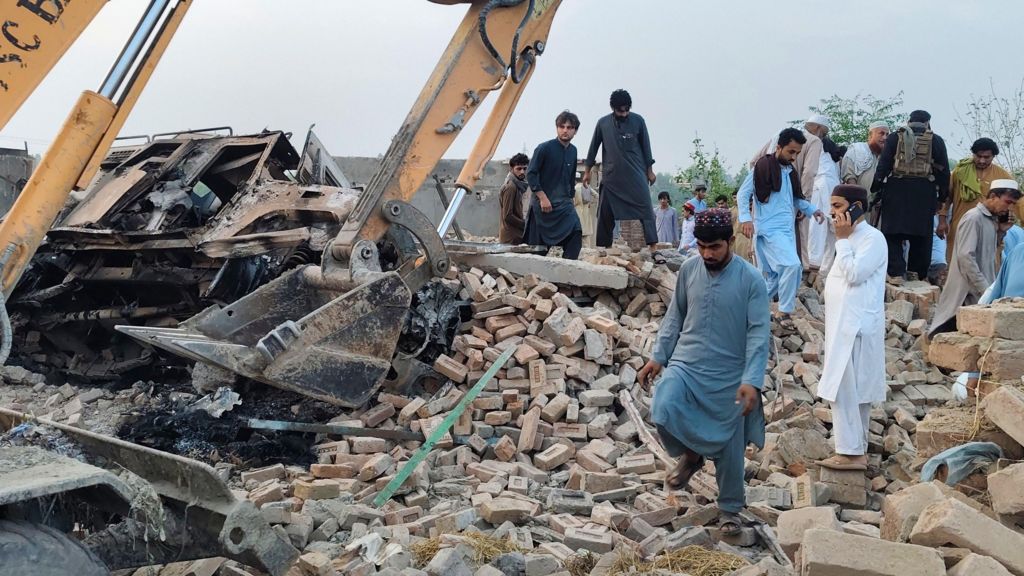
A devastating coordinated attack targeting a police checkpoint in Pakistan’s northwestern Khyber Pakhtunkhwa province has left 15 law enforcement officers dead, regional authorities confirmed Sunday. The assault, carried out late Saturday in Bannu district, unfolded in multiple phases that caught responding officers off guard.
According to local police accounts, a suicide bomber first drove an explosives-laden vehicle directly into the perimeter of the guard post, triggering a massive detonation that leveled the checkpoint structure. Photos released from the attack site show extensive destruction: the checkpoint is reduced to crumbled concrete, with twisted metal fragments and charred debris scattered across the surrounding ground.
After the initial blast, the remaining assailants moved into an adjacent building and opened gunfire on surviving officers. When additional security units rushed to the area to reinforce the outpost, they too came under sustained enemy fire. Rescue teams later pulled three wounded officers alive from the rubble; all three were immediately transported to a nearby medical facility and are currently reported to be in stable condition. Authorities have launched a full search and clearance operation to secure the area and track down any remaining attackers.
The assault has been claimed by Ittehad-ul-Mujahideen, a fast-growing Islamist militant coalition that official records confirm has ties to the Pakistani Taliban. The alliance formed only last year in April 2025, when three separate violent factions — the Hafiz Gul Bahadur Group (HBG), Lashkar-e-Islam, and Harkat Inqilab-e-Islami Pakistan (HIIP) — merged to expand their operational reach, according to data from the Pakistan Institute for Conflict and Security Studies. The institute notes that HBG has a long track record of carrying out lethal attacks in Bannu district, while U.S.-based Combating Terrorism Center at West Point has previously documented Lashkar-e-Islam’s formal alliance with the Pakistani Taliban.
Local senior police official Sajjad Khan praised his personnel’s conduct during the unprecedented attack. “Our force has shown courage and bravery in this difficult situation,” Khan said in an official statement, adding, “This cowardly act of extremists is intolerable and the blood of those killed will be accounted for.”
Pakistani President Asif Ali Zardari offered formal condolences to the families of the fallen officers, reaffirming the nation’s unwavering support for its security forces. “The nation stands shoulder-to-shoulder with its security forces,” Zardari’s statement read. “The nefarious intentions of terrorists will be defeated.”
This latest attack comes as Pakistan continues to grapple with persistent insurgent violence across multiple regions. Earlier this year in February, a suicide bombing targeting a mosque in the capital city of Islamabad killed dozens of people and wounded more than 160, an act that the Islamic State group claimed responsibility for. That attack followed just days after a wave of coordinated gun and bomb assaults in southwestern Pakistan’s Balochistan province, where a violent separatist insurgency has persisted for decades.
Longstanding geopolitical tensions around militant activity have strained relations between Pakistan and neighboring Afghanistan. The Pakistani government has repeatedly accused Afghan authorities of harboring militant groups that use Afghan territory to plan and launch attacks inside Pakistan, a claim the ruling Afghan Taliban has consistently denied.