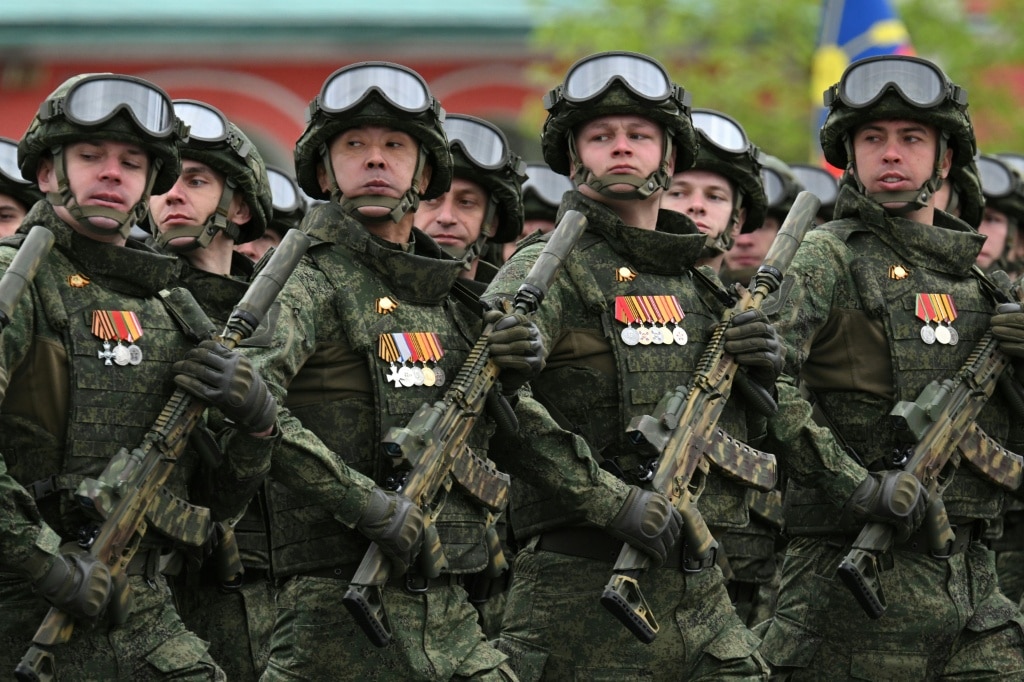
On Saturday, Russia’s annual Victory Day commemoration marking the Soviet Union’s 1945 defeat of Nazi Germany unfolded far differently than usual on Moscow’s Red Square, with a drastically downsized parade overshadowed by the ongoing full-scale war in Ukraine and punctuated by a new US-brokered three-day truce between Moscow and Kyiv.
For 25 years, Russian President Vladimir Putin has centered the legacy of the Soviet World War II victory as a core ideological pillar of his leadership, with past celebrations featuring elaborate displays of military hardware, thousands of marching troops, and dozens of high-profile foreign dignitaries. But this year, a wave of recent long-range Ukrainian strikes on Russian territory forced the Kremlin to tighten security measures and slash the scale of the event, marking the first time in nearly 20 years that no heavy military equipment was featured in the parade. Only a small group of foreign leaders, most from Russia’s close allied nations, attended the ceremony: the heads of state of Belarus, Malaysia, Laos, Uzbekistan and Kazakhstan, a sharp drop from 2024’s guest list that included Chinese President Xi Jinping.
In his opening address to the assembled parade participants – which included Russian military units and a contingent of soldiers from North Korea – Putin invoked the World War II victory to rally domestic support for what Russia calls its “special military operation” in Ukraine, framing the conflict as a fight against a NATO-backed aggressive force. “The great feat of the generation of victors inspires the soldiers carrying out the goals of the special military operation today,” Putin told the crowd. “They are confronting an aggressive force armed and supported by the entire NATO bloc. And despite this, our heroes move forward. I firmly believe that our cause is just.”
The scaled-back event came amid growing war fatigue among many Russian residents in Moscow, where strict security measures included widespread street closures and intentional mobile internet disruptions. Speaking to AFP, 36-year-old Moscow economist Elena summed up the muted public mood: “Nothing. I need the internet, and I don’t have it,” she said, adding she had no plans to watch the parade broadcast.
The lead-up to the parade was marked by escalating tensions: Russia had threatened to carry out a massive strike on central Kyiv if Ukraine disrupted the Moscow commemoration, and urged foreign diplomatic staff to evacuate the Ukrainian capital ahead of the event. Ukrainian President Volodymyr Zelensky had initially pushed back against the idea of a truce tied to the Russian celebration, warning Russia’s allies against attending the event.
That changed after former US President Donald Trump, who has prioritized ending the Ukraine war, announced a three-day ceasefire agreement between the two warring parties that would take effect starting May 9, accompanied by a large-scale prisoner exchange. “Hopefully, it is the beginning of the end of a very long, deadly, and hard fought War,” Trump wrote on his Truth Social platform Friday. The Kremlin later clarified that as of the announcement, there were no plans to extend the temporary truce beyond its three-day timeline.
Zelensky ultimately confirmed Ukraine would abide by the ceasefire, issuing a formal order barring Ukrainian forces from launching attacks to disrupt the parade and noting the truce would allow for the exchange of 1,000 detained service members from each side. “Red Square is less important to us than the lives of Ukrainian prisoners who can be returned home,” Zelensky said in a statement.
In the first overnight period of the truce, both the Ukrainian Air Force and Russian Ministry of Defense reported a sharp drop in drone attacks compared to previous nights, a promising sign for the temporary agreement. This ceasefire marks the third attempted truce between Russia and Ukraine this week, after two earlier agreements fell apart quickly.
Now entering its fifth year, the war in Ukraine has killed hundreds of thousands of people and become the deadliest conflict in Europe since World War II. US-mediated peace talks have stalled since February, when the United States shifted its diplomatic and military focus to its ongoing conflict with Iran. While the current truce has reduced violence temporarily, it remains unclear whether it will open a path to longer-term negotiations to end the wider war.