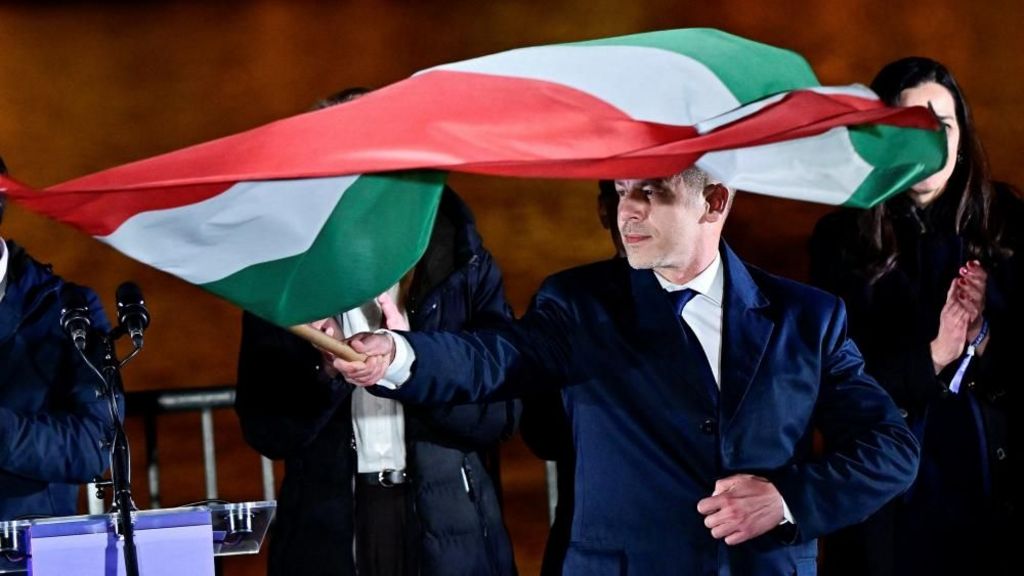
Nearly four weeks after a stunning electoral upheaval that ended 16 years of conservative rule under Viktor Orbán, Hungary is set to swear in its new prime minister, Péter Magyar, leader of the upstart Tisza party. The political transformation is one of the most dramatic in modern European history: founded just two years ago, Tisza now controls 141 of 199 seats in the national parliament, rising from zero representation to an absolute majority in a single electoral cycle.
To mark the historic transition, Magyar has organized a large-scale “celebration of freedom and democracy” scheduled for Saturday along the Danube riverfront outside Budapest’s parliament building, where he has urged Hungarian citizens to join in crossing what he calls the “gateway of regime change.”
The defeat of Orbán’s long-ruling Fidesz party has triggered what appears to be a full implosion of the once-dominant political force. Fidesz’s parliamentary representation collapsed from 135 seats to just 52 in the latest vote, and Orbán alongside most of his top party allies have announced they will not take their newly won seats in the legislature. The former prime minister and his team have only issued a vague pledge to “rebuild the national side,” leaving their long-term political futures completely uncertain.
In the weeks since the election, new allegations of systemic corruption against Fidesz — which held unchallenged control of Hungary’s government since 2010 — emerge on a near-daily basis. Magyar ran on a platform promising not just a change in governing leadership, but a full “change of system” to root out graft and institutionalize accountability.
It remains unclear whether Orbán will even attend Saturday’s opening parliamentary session, even as a non-participating guest. Incoming cabinet member Zoltán Tarr, tapped to serve as Minister for Social Relations and Culture, laid out the new government’s immediate priorities in comments to the BBC, noting: “The main priority is to set up the government… on the ruins of the previous one. We are ready to face a very grim economic situation. But at the moment, we just don’t know the severity.”
Years of directing state contracts and public funds to business circles closely aligned with Fidesz were compounded by a massive pre-election spending spree launched by the Orbán administration in the final eight months of its term. The result has left Hungary’s national budget deficit already swollen to nearly hit the full-year target set by the previous government, creating an immediate fiscal crisis for the incoming administration.
The Tisza leadership has moved quickly to position itself as a morally transparent alternative to Fidesz, taking decisive steps to address even hints of impropriety. Just days after the election, prominent businessman György Wáberer — who defected from Fidesz to Tisza a week before voting — revealed he had donated €280,000 to the new party. Magyar immediately returned the full sum to avoid any conflict of interest. When public outcry erupted on social media over the nomination of Magyar’s brother-in-law, Márton Melléthei-Barna, for the post of justice minister, Melléthei-Barna withdrew his candidacy just days later, saying he wanted to ensure “not even the slightest shadow is cast on the transition.”
Incoming ministers have stressed that their efforts to address past wrongdoing will not amount to political retribution, but that anyone found guilty of financial crimes will face full legal accountability. A new government body, the Office for the Recovery of Stolen Assets, will be established to pursue misappropriated public funds. Rejecting calls for rapid, show trials for former officials accused of siphoning national wealth, Tarr explained: “I don’t think that we should talk about a guillotine. We are talking about investigations and actions which are totally in line with the rule of law. Interestingly enough, the current chief prosecutor, and the police, have started certain investigations which they did not start before the election. They are questioning people.”
A source close to Hungary’s prosecutor’s office told the BBC that what was once a trickle of prosecutions against high-profile Fidesz-connected figures has now become a steady stream, noting: “not because we didn’t want to prosecute before, but because the police and the tax office were reluctant to gather evidence. What has changed is that people are now coming forward. So a lot more evidence is suddenly available.”
One high-profile target of ongoing investigations is the sprawling media empire owned by Gyula Balásy, which won hundreds of millions of euros in state contracts over the past decade and ran Fidesz’s hostile political campaigns against groups and figures labeled “enemies of the nation” — including philanthropist George Soros, Ukrainian President Volodymyr Zelensky, and Péter Magyar himself. In an emotional interview last week, Balásy offered to hand over all his companies and investments to the Hungarian state, though he continues to deny any criminal wrongdoing. Authorities have already frozen the bank accounts of several of his linked companies. A second major investigation is focused on Hungary’s National Cultural Fund, specifically its £57.2 million Urban Civil Fund, over allegations that public money was illegally diverted to Fidesz election candidates.
Beyond corruption investigations and fiscal stabilization, the new Magyar government faces a series of daunting policy challenges. The most pressing is unlocking €17 billion in European Union funds that the European Commission froze over rule of law concerns during the Orbán administration. Recent Brussels-based sources have warned that a portion of these funds could be permanently lost if the new government does not move quickly to meet required reforms.
Other unresolved policy issues include reaching a unified position on the EU’s new migration pact, which the Orbán government fiercely opposed. The pact is set to enter full force on June 12, and Hungary currently faces daily fines of €1 million from the European Court of Justice over non-compliance related to its treatment of migrant arrivals. Public opinion polling shows that Tisza voters, much like Fidesz voters before them, remain deeply concerned about irregular migration. Voters also broadly share skepticism of Ukraine’s bid to join the EU, and Magyar has echoed Orbán’s position that Hungary will need to maintain imports of Russian oil and natural gas at least in the short term to avoid energy disruptions.
Despite the long list of challenges, incoming cabinet member Tarr remains optimistic about the new government’s prospects. He argues that the European Union is prepared to work with Hungary’s new leadership as it implements reforms, and he dismisses concerns that the wave of popular enthusiasm that propelled Tisza to victory will fade into disillusionment. Celebrations of the electoral win that began along the Danube on April 12 will continue this Saturday, with thousands of supporters expected to gather again. “I’m not worried, I’m excited… We are serving the country. We are serving the people. We are not here to rule. We are here to serve. We are here to fulfil a mandate,” Tarr said.