For decades, Washington’s unwavering support for Israel amid ongoing conflicts in the Middle East, including the current war in Gaza and escalations against Iran, has been shaped by a mix of strategic geopolitical interests and a powerful ideological undercurrent: Christian Zionism. This unique fusion of religious belief and political advocacy has quietly shaped U.S. foreign policy for more than a century, and remains a dominant force in contemporary Republican politics even as it faces growing criticism for its ties to extremism and underlying antisemitic undertones.
At its core, Christian Zionism is a political-religious ideology that centers on the belief that Jewish resettlement in the Holy Land – an area encompassing modern-day Israel, Israeli-occupied Palestinian territories, and parts of neighboring Egypt, Lebanon, Syria, and Jordan – is a required step to fulfill biblical prophecies. Adherents argue that this mass return will pave the way for the Second Coming of Jesus Christ, the Rapture, and the End Times, when all faithful Christian believers will be taken to heaven. While most Christian Zionists back the existence of the State of Israel, many go further to openly endorse Israeli occupation and settlement expansion in the West Bank and Gaza. A central, deeply controversial tenet of the ideology holds that once Jews have returned to the Holy Land, they must convert to Christianity – a requirement that many Jewish communities and leaders have labeled inherently antisemitic.
The origins of Christian Zionism stretch back to 16th-century Europe in the wake of the Protestant Reformation, when Protestant theologians in England and Scotland began framing Jewish people as essential to the fulfillment of end-times prophecies outlined in the Book of Revelation, including the arrival of a thousand-year Messianic Age. When Puritan groups migrated to North America in the 17th century, they carried these ideological beliefs with them, planting the roots of Christian Zionism in what would become the United States.
The movement gained significant momentum in the 19th century through the Dispensationalist movement, led by Anglo-Irish minister John Nelson Darby, which promoted a literal interpretation of the Bible and divided human history into distinct divine eras called “dispensations”, including the Rapture and a period of apocalyptic Tribulation. Influential political and religious figures across the United Kingdom and United States soon adopted the ideology: British reformer Lord Shaftesbury publicly pushed for Jewish resettlement in Israel, while American Evangelical pastor William Blackstone’s 1878 bestseller *Jesus is Coming* cemented Christian Zionism as a mainstream belief among U.S. evangelicals. Eventually, these ideas aligned with the growing Jewish Zionist movement, particularly the work of secular founder Theodor Herzl, who popularized Zionist goals on the global stage. In 1917, UK Foreign Secretary Arthur Balfour, a sympathetic Christian Zionist, issued the landmark Balfour Declaration, which pledged British support for a Jewish national home in Palestine.
Today, Christian Zionism’s strongest base of support is among Evangelical Christians, a broad umbrella of Christian denominations that prioritize evangelizing to non-believers and hold a literal, fact-based interpretation of the Bible as the ultimate source of moral guidance. Estimates place the global Evangelical population between 300 million and 600 million of the world’s 2 billion Christians. According to 2024 Pew Research Center polling, roughly 73 million U.S. adults identify as Evangelical Protestants, accounting for 21% of the national population – compared to just 5.8 million Jewish Americans recorded in Pew’s 2020 survey. More than half of U.S. Evangelicals reside in the Southern states and southern Midwest, a region known as the Bible Belt that forms a core voting bloc for the socially conservative Republican Party, which has dominated the area since the 1960s and carried every Bible Belt state in Donald Trump’s 2024 presidential election victory.
Christian Zionism has shaped U.S. Middle East policy for more than a century. In the 1940s, Evangelical activists formed a core part of the American Christian Palestine Committee, which lobbied heavily for the creation of the State of Israel. In the 1980s, President Ronald Reagan, a self-identified “born-again” Protestant, courted Evangelical voters by regularly referencing Armageddon end-times theology. Today, the ideology holds prominent sway in the second Trump administration: key officials including Secretary of War Pete Hegseth, U.S. Ambassador to Israel Mike Huckabee, and House Speaker Mike Johnson are all Evangelical Christian Zionists, as was former Vice President Mike Pence during Trump’s first term. Televangelist Paula White-Cain, Trump’s personal spiritual advisor, explicitly framed unwavering support for Israel as a biblical mandate in a 2024 statement, writing, “In this pivotal moment in human history, we are called to STAND with ISRAEL! This isn’t about politics; this is about living in harmony with the WORD of God!”
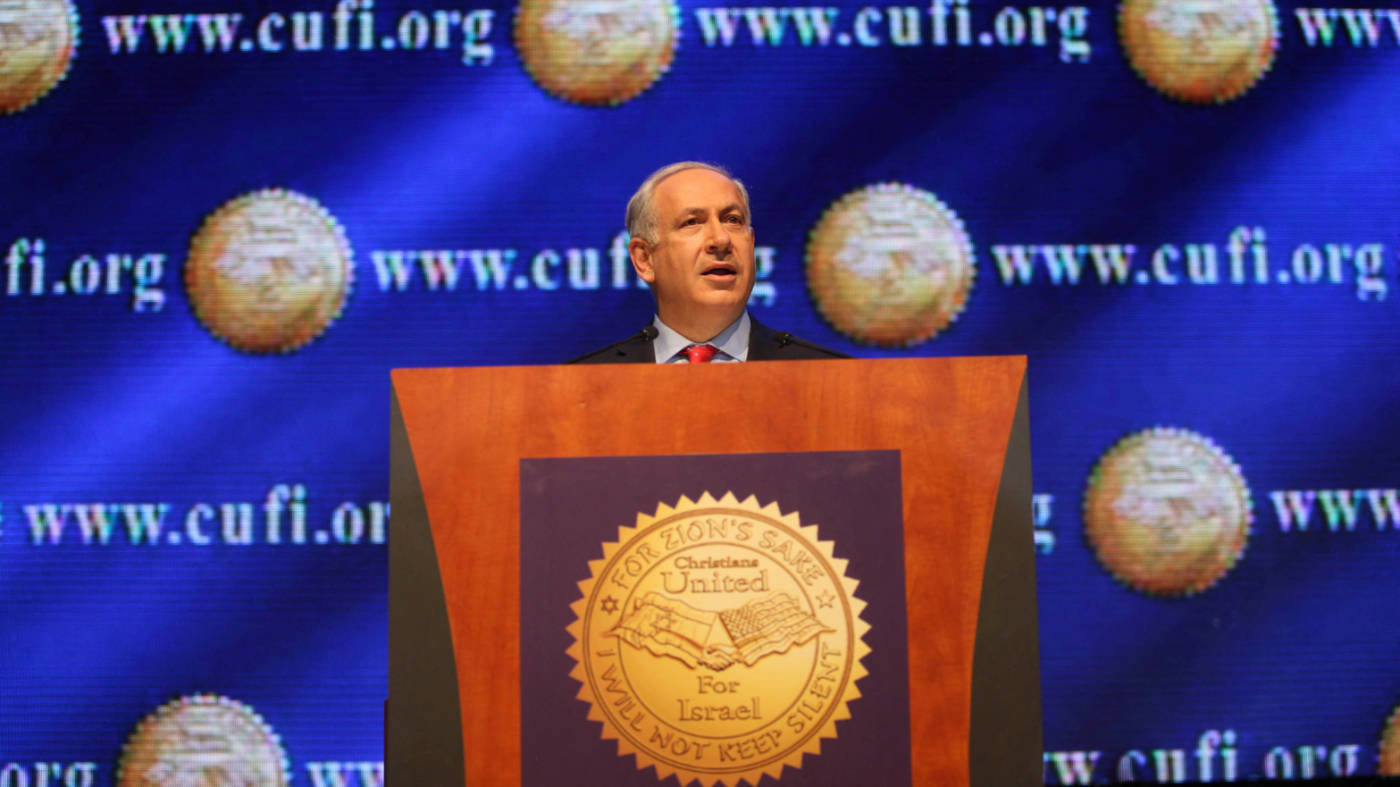
The most powerful Christian Zionist lobbying group in the U.S. is Christians United for Israel (CUFI), led by prominent televangelist John Hagee. With more than 10 million members, CUFI is twice the size of the American Israel Public Affairs Committee (AIPAC), the leading Jewish pro-Israel lobby. The group claims credit for key policy shifts including the 2018 Trump administration decision to move the U.S. Embassy from Tel Aviv to Jerusalem. In a 2019 interview with the *Jerusalem Post*, Hagee recalled discussing the embassy move with Trump months before it was announced, and praised Trump as “the most pro-Israel president” in U.S. history. Trump himself acknowledged the movement’s outsized role in the decision, telling a 2020 Wisconsin rally that the move was “for the Evangelicals” and noting, “the Evangelicals are more excited by that than Jewish people, it’s incredible!”
Harvard Kennedy School international affairs professor Stephen Walt, co-author of the landmark 2003 study *The Israel Lobby and US Foreign Policy*, told Middle East Eye that Christian Zionism has expanded pro-Israel advocacy far beyond the American Jewish community, reinforcing the work of AIPAC and shaping the views of key policymakers like Huckabee. But Walt also noted that support for the ideology and for unwavering pro-Israel policy has declined among U.S. Evangelicals in recent years. “I believe it is less influential than it once was, in part because Evangelicals have focused on other issues and because some parts of the Evangelical community have been disturbed by Israel’s behaviour, which has caused its support to plummet within the US population,” he explained. Recent Pew polling backs this assessment, finding that support for Israel has waned across all segments of the U.S. population, including Evangelicals, amid Israel’s ongoing military campaign in Gaza.
Critics have also accused leading Christian Zionist figures of using biblical prophecy to justify escalated conflict, including the recent U.S.-backed war on Iran. Hours after the start of hostilities in March, Hagee claimed in a sermon that “prophetically, we’re right on cue”, and prayed that God would destroy the enemies of Zion and the United States. Hegseth has repeatedly cited biblical verses (including a fictional verse featured in the film *Pulp Fiction*) in public statements during the conflict, and called for “overwhelming violence of action against those who deserve no mercy” during a Pentagon prayer service early in the war. Even U.S. military commanders have faced accusations of framing the conflict as part of a divine End Times plan: an anonymous U.S. officer told the Military Religious Freedom Foundation in March that his commander ordered troops to be told the war was “all part of God’s divine plan”, and repeatedly cited passages from the Book of Revelation referencing Armageddon and the imminent return of Jesus Christ.
While Christian Zionism holds far less sway in Europe, where Evangelicals make up only an estimated 3% of the population, the movement is growing in other regions. It has expanded across parts of sub-Saharan Africa and South Korea, where Evangelicals account for roughly 20% of the population. In Brazil, Christian Zionism was a core ideological influence during far-right Evangelical President Jair Bolsonaro’s 2019-2023 tenure; Bolsonaro campaigned on moving Brazil’s embassy to Jerusalem in 2018, a promise he never fulfilled, and his son Flavio, a 2026 presidential candidate, repeated the same pledge earlier this year.
Beyond its policy impact, Christian Zionism has faced sustained criticism for its inherent antisemitism. University of Nottingham Professor Emeritus of Historical Theology Thomas O’Loughlin explained to MEE that “Christian Zionism does not see any purpose in Judaism, which it views as only a passing phenomenon. It sees Christians as having superseded Judaism. Christian Zionism only supports the return of the Jews to the Holy Land because [it believes] the Jews must be gathered back so that when the whole scattering of Israel is reversed, they can then be given a chance to convert to Christianity.” This core tenet, he argued, makes the ideology “ultimately antisemitic”.
Multiple prominent Christian Zionist leaders have a documented history of antisemitic and anti-religious remarks. In a 2010 interview, Trump advisor and televangelist Robert Jeffress, who led the opening prayer at the 2018 U.S. Embassy dedication in Jerusalem, stated, “Judaism – you can’t be saved being a Jew. You know who said that, by the way? The three greatest Jews in the New Testament: Peter, Paul and Jesus Christ. They all said Judaism won’t do it.” He also labeled Islam and Mormonism “heresy from the pit of hell”. In the late 1990s, Hagee claimed the Holocaust was allowed by God to push Jews to return to Israel, saying, “How did it happen? Because God allowed it to happen. Because God said my top priority for the Jewish people is to get them to come back to the land of Israel.”
Interestingly, Israeli leaders have actively cultivated close ties to leading Christian Zionists despite the ideology’s antisemitic core. In December 2025, Israeli Prime Minister Benjamin Netanyahu told a gathering of Evangelical leaders in Palm Beach, Florida that “You are representatives of the Christian Zionists who made Jewish Zionism possible. It’s hard for me to conceive the emergence of the Jewish state, the re-emergence of the Jewish state, without the support of Christian Zionists in the United States, also in Britain, but the main thrust was in the United States in the 19th century.”
Even so, the ideology is broadly rejected by most mainstream Christian denominations outside of Evangelicalism. Non-Evangelical Protestant traditions including Lutheranism and Anglicanism reject Christian Zionist beliefs, as do Eastern Orthodox churches and the Catholic Church, which only established formal diplomatic relations with Israel in 1993 and publicly supports a two-state solution to the Israeli-Palestinian conflict. In January 2026, the heads of Orthodox, Catholic, and Protestant churches in Jerusalem issued a joint statement condemning Christian Zionism amid ongoing Israeli violations of the Status Quo agreement for shared holy sites. The statement called Christian Zionism a “damaging ideology” that “misleads the public, sow confusion, and harm the unity of our flock.” O’Loughlin noted that mainstream Christian theologians widely dismiss the ideology’s core claims, with Orthodox thinkers particularly labeling it a fundamental misreading of Christian theology.
As conflicts across the Middle East escalate and Christian Zionism remains a powerful force in U.S. politics, the debate over its ideological roots, political impact, and ethical standing continues to shape global conversations about the future of the region.