Tensions surged once again across the Middle East on Friday, after a U.S. fighter jet struck two Iranian-flagged tankers in the Gulf of Oman to enforce a port blockade, triggering immediate Iranian retaliation and throwing a already shaky truce into deep jeopardy. This new outbreak of violence comes as Tehran weighs a latest U.S. negotiation proposal aimed at ending the 10-week-old conflict that began with joint U.S.-Israeli strikes on Iran.
According to U.S. Central Command, an F/A-18 Super Hornet deployed precision munitions against the two vessels near the Gulf of Oman, the critical maritime gateway to the Strait of Hormuz, to stop the ships from reaching Iranian territorial waters. A senior Iranian military official quickly confirmed retaliatory action had been taken, telling local media that the country’s navy had launched strikes in response to what it called “a ceasefire violation and American terrorism”. The official added that after a brief exchange of fire, active clashes had ceased as of Friday afternoon.
This latest confrontation follows an overnight flare-up in the Strait of Hormuz, a waterway that carries roughly a fifth of the world’s daily oil consumption, whose strategic importance has been underscored by senior Iranian officials. Mohammad Mokhber, an adviser to Iran’s Supreme Leader, recently compared controlling influence over the strait to holding “an atomic bomb”, noting that the ability to shape global energy markets through policy in the strait represents an unparalleled strategic opportunity that Tehran will never relinquish. This week, Tehran established a new regulatory body to oversee vessel transits through the strait and collect transit tolls, according to shipping industry outlet Lloyd’s List.
Washington delivered its latest settlement proposal to Tehran via Pakistani mediators this week, which would extend the current Gulf truce to create space for negotiations on a permanent end to the conflict that began when U.S. and Israeli forces launched strikes on Iran on February 28. Since the outbreak of war, Iran effectively closed the Strait of Hormuz, triggering chaos in global energy markets and pushing crude oil prices sharply upward, which prompted the U.S. to impose a counter-blockade on Iranian ports.
On Friday, U.S. Secretary of State Marco Rubio, speaking during an official visit to Rome, reiterated that Iranian control over the strait is “unacceptable” and said Washington was awaiting Tehran’s official response to the proposal by the end of the day. “I hope it’s a serious offer, I really do,” Rubio told reporters. Iranian foreign ministry spokesman Esmaeil Baqaei told Iran’s ISNA news agency Friday that the proposal remains “under review, and once a final decision is reached, it will certainly be announced”.
The violence follows a previous clash Thursday night, when U.S. Central Command said Iran launched missiles, drones and small attack craft against three U.S. warships transiting the strait. U.S. officials reported no American vessels were hit, and said U.S. forces retaliated against Iranian land bases. Iran’s Khatam al-Anbiya Central Military Command pushed back on the U.S. account, saying the clash began when U.S. vessels targeted an Iranian tanker heading toward the strait, and accused American forces of striking civilian areas. U.S. President Donald Trump told reporters Thursday the truce remained in effect despite the clash, saying “Yeah, it is. They trifled with us today. We blew them away.”
Iran has accused regional U.S. allies of cooperating in the recent strikes, though it has not named specific countries. The United Arab Emirates announced Friday it had intercepted a barrage of Iranian drones and missiles that left three people wounded in UAE territory. Earlier this week, U.S. President Donald Trump first announced a large-scale U.S. naval operation to reopen the strait to commercial shipping, then reversed course just two days later to resume diplomatic efforts. Multiple Saudi sources told Agence France-Presse Friday that Riyadh has rejected U.S. requests to use Saudi military bases and airspace for the aborted Hormuz operation, with one source noting the kingdom “felt it would just escalate the situation and would not work”.
Beyond the Gulf, the parallel ceasefire between Israel and Iran-backed Hezbollah in Lebanon also came under severe strain Friday. Hezbollah announced it had launched a missile strike against an Israeli military base, in retaliation for an Israeli strike in Beirut that killed a top Hezbollah commander this week, as well as ongoing attacks on southern Lebanese villages. The Israeli military confirmed air raid sirens activated across multiple northern Israeli cities Friday, and Hezbollah also reported additional Israeli strikes on its positions in southern Lebanon.
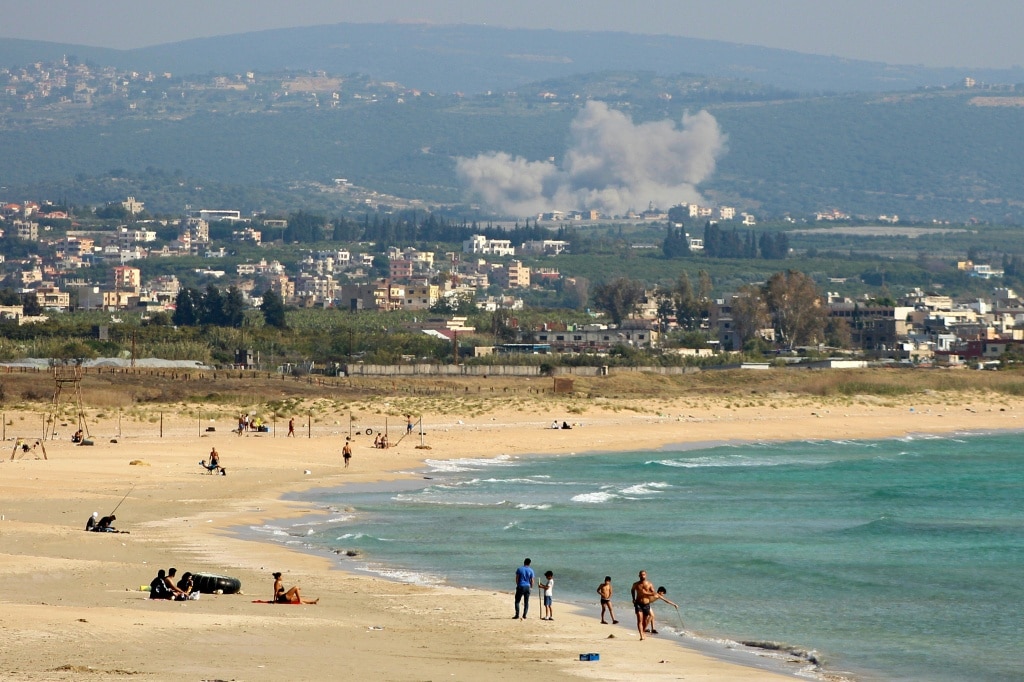
Israeli forces have continued targeted strikes against Hezbollah despite the ceasefire, and Wednesday carried out its first attack on Beirut’s southern suburbs in a month, confirming it killed a senior Hezbollah commander. Fresh Israeli strikes in southern Lebanon’s Tyre district Friday killed four people, Lebanon’s health ministry confirmed, and Lebanon’s state-run National News Agency reported a wave of attacks across multiple areas of southern Lebanon. This new round of violence comes ahead of scheduled direct negotiations between Lebanon and Israel in Washington next week, talks that Hezbollah has vehemently opposed. Israel and Lebanon have remained officially in a state of war since 1948.