SAO PAULO, Brazil — Brazil’s President Luiz Inácio Lula da Silva has repeatedly highlighted his administration’s landmark progress reining in Amazon deforestation, a win that is set to be confirmed when official annual data drops in October. Early projections indicate the 2025-2026 deforestation rate will hit its lowest point since 2012, a dramatic reversal from the record-high deforestation seen under former President Jair Bolsonaro’s environmentally deregulatory tenure. But this hard-won progress masks growing, underrecognized threats that continue to erode the world’s largest tropical rainforest, from the creeping damage of forest degradation to looming legislation that could cripple Brazil’s core anti-deforestation enforcement tool.
The Amazon spans nine South American nations, with Brazil holding more than 60% of the total forest area — meaning ecological changes in the Brazilian Amazon shape the fate of the entire biome. While the Lula administration has cut total clear-cutting dramatically, official satellite data from Brazil’s real-time DETER monitoring system shows that forest degradation, the gradual damage of forest ecosystems from activities like illegal logging, wildfires, and drought-linked die-off, has outpaced full deforestation in recent years. Between August 2025 and April 2026, deforestation alerts marked roughly 1,700 square kilometers of cleared forest, while degradation affected more than 4,420 square kilometers of partially damaged woodland. Unlike clear-cutting, which leaves an obvious mark on satellite imagery, degradation progresses slowly and quietly. “Degradation is slower and more silent. It is like a chronic condition,” explained Taciana Stec, a climate policy specialist at Brazilian climate think tank Talanoa.
This chronic damage is already pushing the rainforest closer to a catastrophic tipping point. Today, the Amazon still acts as a critical global carbon sink, absorbing massive volumes of the planet-warming carbon dioxide driving climate change. But if degradation and stress continue, scientists warn the forest could cross an irreversible threshold where it emits more carbon than it absorbs, triggering full or partial biome collapse. A 2024 study published in *Nature* estimates that between 10% and 47% of the Amazon could reach this critical tipping point by 2050 if current stress levels persist.
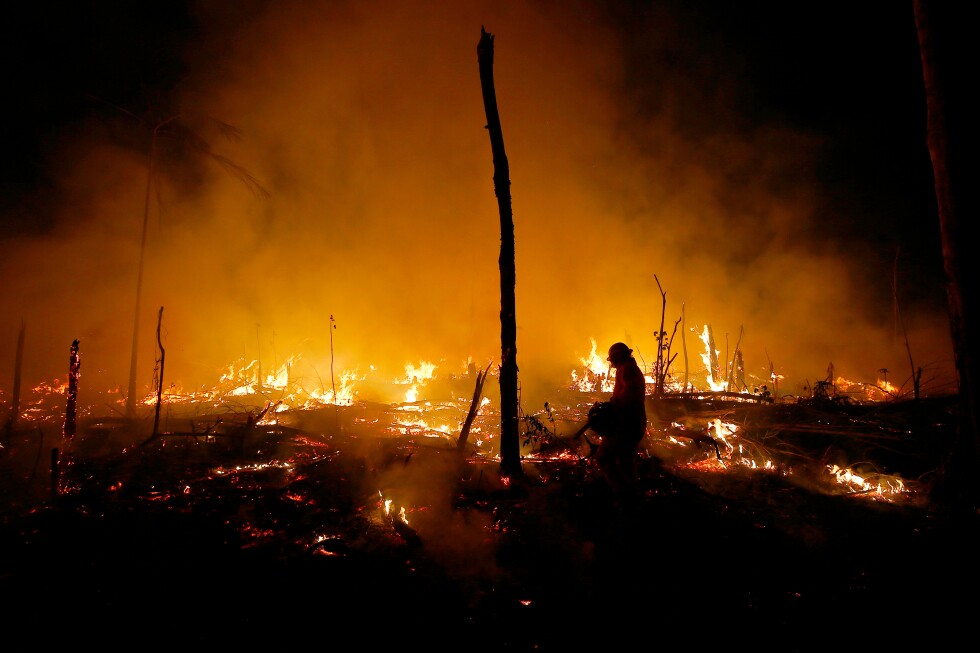
The threat of extreme weather will only amplify this damage. A strong El Niño event, the cyclical warming of equatorial Pacific waters that drives higher temperatures and drier conditions across the Amazon, is projected for 2026. The 2023-2024 El Niño event already offered a preview of this risk: temperatures rose 2 to 4 degrees Celsius above the Amazon’s historical average, and severe drought fueled the worst wildfire season the region had seen in 20 years. During that event, forest degradation increased at a rate three times faster than deforestation fell, erasing much of the progress made to cut clear-cutting, according to research by Guilherme Mataveli, a scientist at Brazil’s National Institute for Space Research (INPE). A partially degraded forest remains standing, but loses much of its ecological function, making it far more vulnerable to additional stress from drought and fire. “If the Amazon were a human patient with a chronic illness, El Nino would strike like a flu, triggering a fever that leaves the body weaker and more vulnerable,” Stec noted. “Two years later, the flu returns. But this time, the patient has not fully recovered. The fever burns hotter, and the illness hits harder.”
New long-term research has underscored this persistent damage. A 20-year study led by Yale University researcher Leandro Maracahipes, published in April in *Proceedings of the National Academy of Sciences*, found that repeated wildfires do not immediately turn the Amazon into savanna, as many earlier models predicted. Instead, the forest remains standing but permanently degraded: it loses specialized native species that rely on dense old-growth cover, and becomes far more susceptible to future damage. “The forest is resilient, but our message is that we need to preserve it even more, and urgently,” Maracahipes said. “And it has to be now.”
Beyond climate and ecological threats, environmental regulators are bracing for a major legislative setback that could gut Brazil’s successful anti-deforestation policy. A fast-track bill sponsored by lawmaker Lucio Mosquini, currently pending a vote in Brazil’s lower house of Congress, would bar Brazil’s top environmental enforcement agency IBAMA from issuing sanctions for illegal deforestation based solely on satellite monitoring — the core pillar of Brazil’s current successful deforestation control efforts. Mosquini argues that satellite-based penalties unfairly harm farmers, who are not given an opportunity to defend themselves. But IBAMA officials note that farmers already have 20 days to challenge penalties, and can have sanctions overturned if they prove deforestation was legally authorized.
IBAMA first adopted satellite monitoring in 2016 to complement limited on-the-ground inspections in remote parts of the rainforest. Bolsonaro halted the policy in 2019 as part of his administration’s deregulatory agenda, leading to a 15-year high in Amazon deforestation by 2021. When Lula returned to the presidency in 2023, his administration immediately restored the remote monitoring policy, driving the sharp drop in deforestation seen today. Political analysts expect the bill to pass, given the outsized political and economic influence of Brazil’s powerful agribusiness sector. If approved, it would be “a major environmental setback,” IBAMA President Jair Schmitt told the Associated Press. “In effect, you end up encouraging environmental offenders and unfair competition.” Schmitt compared satellite monitoring to speed cameras used by traffic enforcement: it is impossible to station a law enforcement officer on every corner of a city, just as it is impossible to place an IBAMA agent on every square kilometer of the 5 million square kilometer Brazilian Amazon.
To address the growing threat of wildfires in the 2026 season, the Lula administration has already hired 4,600 new firefighters and launched expanded real-time monitoring of high-risk areas. IBAMA has combined historical fire data, deforestation records, and weather forecasts to identify properties at extreme risk of fire, and has ordered landowners in those areas to implement preventive measures. Still, Indigenous fire brigades on the ground already warn that conditions are worsening faster than expected. “The situation this year is worrying. We’re still in the rainy season, and we’ve already recorded two fires in April,” said Tainan Kumaruara, a member of the Indigenous volunteer Guardioes Kumaruara fire brigade in Para state. “The forest is different from what it was 10 years ago. It’s much drier. The trees no longer behave as they did.”
Experts say addressing the growing threat of degradation will require Brazil to expand its focus beyond just stopping clear-cutting, to prioritize large-scale forest restoration. Brazil has committed to restoring 12 million hectares of degraded Amazon forest by 2030 under the Paris Climate Agreement, and the Brazilian Environment Ministry reports that 3.4 million hectares are already in the process of recovery. Even so, the dual threats of accelerating degradation and pending anti-enforcement legislation mean the long-term future of the Amazon remains far from secure, even with the Lula administration’s progress cutting deforestation.