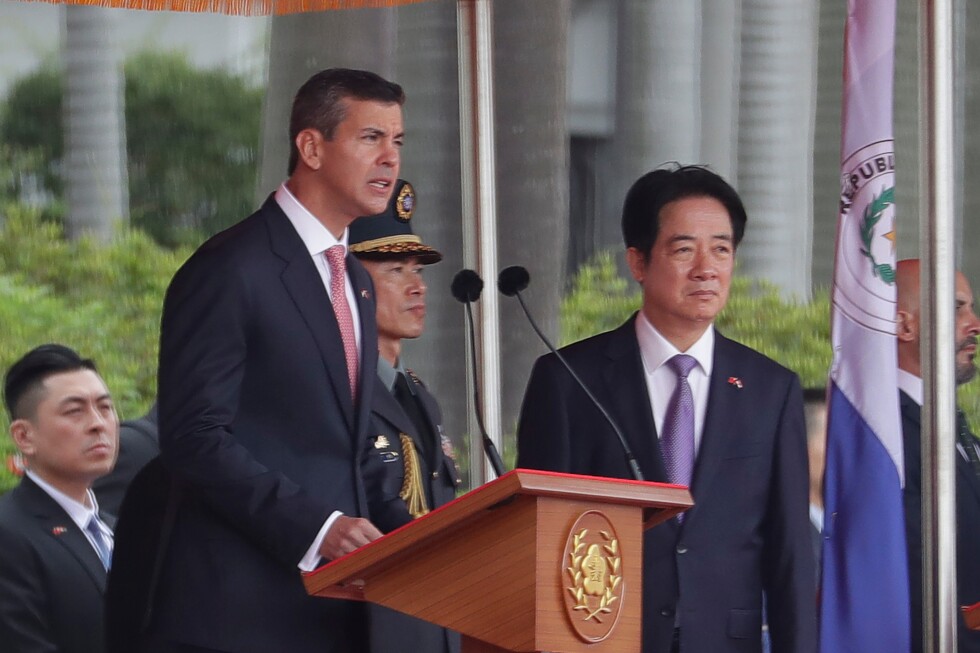
TAIPEI, Taiwan — On a high-profile visit to the self-ruled island democracy of Taiwan, Paraguayan President Santiago Peña delivered a clear message of diplomatic solidarity Friday, one day after China issued a formal demand that the South American nation cut its official ties with Taipei. Currently, Paraguay stands as the only remaining South American country that recognizes Taiwan, making it one of just 13 UN-unrecognized states worldwide that maintain full diplomatic relations with the island. For decades, Beijing has claimed Taiwan as an inalienable part of its sovereign territory, and in recent years, it has intensified two parallel campaigns to isolate Taipei: ramping up military pressure through frequent air and sea incursions around the island, and actively courting Taiwan’s remaining diplomatic allies to switch recognition to Beijing.
Speaking at a military honors reception outside Taiwan’s presidential office, Peña framed the event as a tangible symbol of the unshakable commitment between Taipei and Asunción to deepen their long-standing bilateral partnership. Through an interpreter, he noted that the two sides share core foundational values including democracy, personal freedom, and universal human rights, and reiterated that Paraguay would remain a steadfast international advocate for Taiwan. “Paraguay highly values this relationship,” Peña stated, later expanding on that commitment during closed bilateral talks with Taiwanese President Lai Ching-te. In that meeting, Peña issued a formal call to the global community: the people of Taiwan deserve the right to determine their own future in line with democratic and equitable principles. He also pushed back against Taipei’s exclusion from global bodies, arguing that barring Taiwan from the United Nations system is not only a fundamental injustice but also erodes the legitimacy of the UN as an institution that claims to represent democratic nations globally.
Lai thanked Peña and the Paraguayan government for their public, unflinching support for Taiwan and its bid for meaningful international participation. “I believe the friendship between Taiwan and Paraguay will further deepen, and our cooperation will grow closer through this visit,” Lai said in his public remarks. Following their meeting, the two leaders oversaw the signing of several new bilateral agreements, highlighted by a memorandum of understanding focused on investment in an artificial intelligence computing center on Taiwan.
This public reaffirmation of ties came just 24 hours after Chinese foreign ministry spokesperson Lin Jian urged Paraguayan officials to “come to the right side of history as soon as possible” and sever all diplomatic relations with Taiwan. Lin emphasized that the one-China principle is a widely accepted norm of international relations, noting that 183 countries around the world currently maintain official diplomatic ties with the People’s Republic of China.
In comments to Taiwan’s Central News Agency ahead of his four-day visit, Peña revealed that he had met with Honduran President Nasry Asfura on the sidelines of a regional event earlier this year. While the pair did not directly discuss whether Honduras would reverse its 2023 decision to cut ties with Taiwan and establish relations with Beijing, Peña told Asfura that Paraguay has built a strong, mutually beneficial relationship with Taipei. Asfura, who was elected with open backing from former U.S. President Donald Trump, has already ordered a full review of all existing bilateral agreements between Honduras and China, stoking widespread speculation that Honduras could distance itself from Beijing as part of a broader Trump administration push to reduce Chinese economic and political influence across Latin America.
Peña’s visit is the latest high-profile diplomatic engagement for Lai, who just completed a trip last week to Eswatini, Taiwan’s last remaining diplomatic ally in Africa. Lai was forced to postpone that trip earlier after multiple regional countries denied his aircraft overflight permission, a move widely attributed to diplomatic pressure from Beijing. Beijing never publicly confirmed or denied that it pressured those countries, but did express “high appreciation” for their adherence to the one-China principle.
The cross-strait split dates back to 1949, when the Chinese Communist Party defeated the Nationalist Party in a brutal civil war and established the People’s Republic of China on the mainland. The defeated Nationalist forces retreated to Taiwan, which has since evolved from decades of martial law to a fully functional multi-party democracy. Today, the island maintains its own governance, military, and foreign policy, while Beijing continues to claim it as part of its territory.