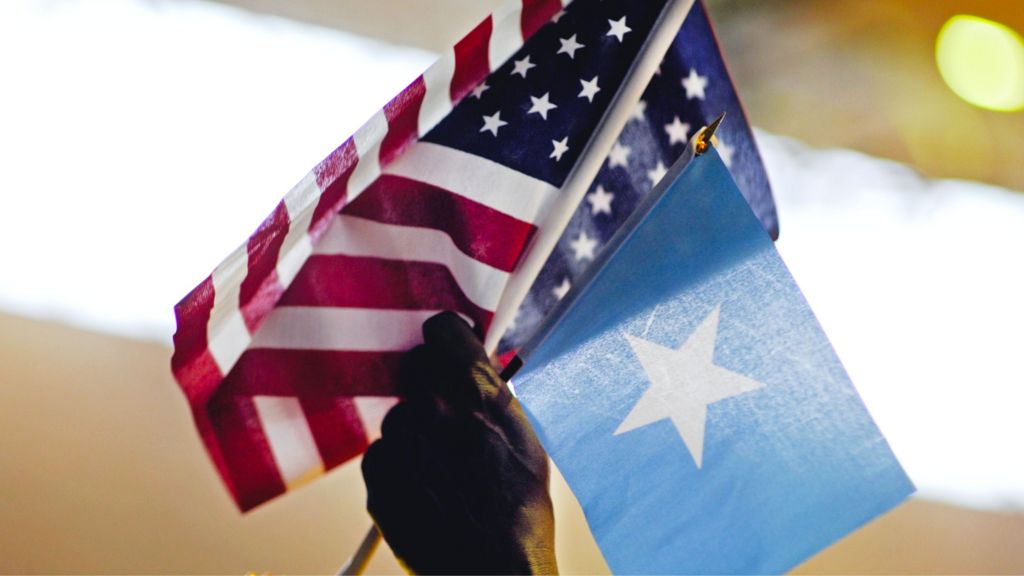
For more than 30 years, Minnesota has hosted the largest Somali diaspora community outside of the African continent, with thousands of migrants seeking safety from decades of civil conflict, Islamist insurgency, and catastrophic drought in their homeland. Today, that community remains trapped in a climate of pervasive dread, months after federal officials announced the end of a high-profile, large-scale immigration enforcement deployment that roiled the state and sparked nationwide protest.
The deployment, dubbed Operation Metro Surge, at its peak brought thousands of Immigration and Customs Enforcement (ICE) agents to Minnesota, before the Trump administration’s border leadership announced a drawdown in mid-February, leaving only what was described as a “small contingent” of officers behind. But for many Somali residents, the official end of the surge has brought no end to the uncertainty and fear that has upended daily life across Minneapolis’s Somali neighborhoods.
Abdi, a 23-year-old Somali migrant who requested anonymity for his protection, is one of hundreds of community members now living in the shadows. Fleeing forced recruitment by al-Shabab, the al-Qaeda-aligned insurgent group controlling large parts of Somalia, Abdi made the perilous journey to the U.S. in 2022, paying $15,000 to smugglers to cross the deadly Darién Gap jungle, where he encountered the corpse of another fallen migrant along the route. After successfully crossing the U.S.-Mexico border, he applied for asylum and received Temporary Protected Status (TPS), a federal designation that allows people from conflict-ravaged nations to live and work legally in the U.S. through 2029. Even with his legal status, Abdi never stays in one residence for more than five nights, sneaks to work under cover, and lives in constant dread that agents will knock on his door. “It hasn’t ended,” he told reporters. “I don’t know when they will show up at my house.”
Abdi is far from alone. Local community members report that ICE agents continue to conduct unannounced home raids, and even people with valid TPS documentation have been detained. The Trump administration had moved to terminate TPS protections for roughly 2,500 Somali migrants by March 17, claiming security conditions in Somalia had improved enough for migrants to return. A federal judge has since temporarily blocked the order, but the damage to community trust has already been done. Compound this with disparaging public comments from former President Donald Trump, who has referred to Somali immigrants as “garbage” and openly stated “I don’t want them in our country,” and the community has been left with a clear sense that they are being intentionally targeted.
U.S. Census Bureau data puts the total Somali-origin population in the U.S. at roughly 260,000, more than half of whom are U.S.-born citizens, with thousands more naturalized. Community leaders emphasize that the number of undocumented Somali residents in the state makes up only a tiny fraction of the overall community, yet the entire population has been swept up in the enforcement dragnet. Even dual U.S.-Somali citizens have been detained in raids, and families separated by deportations remain too fearful and traumatized to speak publicly. For anyone deported, a 10-year or longer bar on reentry applies even if they have children who are U.S. citizens.
The Department of Homeland Security (DHS) has defended Operation Metro Surge as a public safety success, claiming the operation arrested more than 11,000 “criminal illegal aliens” that it says were endangering Minneapolis residents, blaming local sanctuary policies for creating a space for criminal activity. DHS maintains that any person present in the U.S. legally has nothing to fear from the operations, and defends the controversial tactic of masked, unidentifiable agents carrying military-grade weapons as a necessary safety measure to protect officers from doxxing and rising assaults on staff.
Local political leaders have pointed out a glaring contradiction at the heart of the federal government’s policy. “The federal government is saying there’s no need for Temporary Protected Status in the United States, while at the same time warning people not to travel to Somalia because it’s dangerous,” Minneapolis Mayor Jacob Frey told reporters, questioning the logic of the administration’s position. Even as daily life slowly begins to resume in most parts of the city, the impact of the surge remains visible: dozens of local businesses and restaurants remain shuttered after their owners and staff were detained, and car owners have abandoned vehicles in public lots too afraid to return to claim them.
Congresswoman Ilhan Omar, the first Somali-American elected to the U.S. House of Representatives and a frequent target of Trump’s criticism of the Somali community, says the fear has seeped into every corner of community life, affecting children, healthcare access, and basic daily activity. She argues that the tactics used in this surge marked a dangerous break from past immigration enforcement even under prior administries with high deportation rates. “The process… was done without creating chaos [and] fear,” Omar said. “What we saw here looked like a war zone.” Omar also pushed back on attempts to tie the immigration crackdown to a separate public fraud scandal involving a Somali community charity that fraudulently billed the state for child meal programs during the COVID-19 pandemic, noting that the vast majority of people indicted in that case are U.S. citizens. That scandal forced Democratic Governor Tim Walz to drop his re-election bid, and federal investigators expanded the probe with new raids on 12 local childcare centers just last week.
Even Republican state Senator Jim Abeler has criticized ICE’s tactics, framing the ongoing crisis as a long-standing, bipartisan failure of national immigration policy. “Our national immigration policy is a mess – it’s been a bipartisan failure for a decade,” he said. Trump’s inflammatory remarks have already eroded what limited support he had among socially conservative Somali voters in Minnesota; one former Trump voter told reporters she now regrets her ballot, saying “If I hadn’t voted for him, he couldn’t have called us ‘garbage’.”
Amid the ongoing fear, the crisis has fostered unusual cross-community solidarity. Faith leaders from Somali Muslim congregations and local Christian churches have partnered to build informal community alert systems, sending out real-time warnings when ICE agents are spotted in neighborhoods. Volunteer observers, including retired local residents, patrol the streets and use whistles to alert nearby residents of approaching agents, noting that after the drawdown, agents have operated more secretly, blending into civilian areas to avoid detection. The movement came at a deadly cost: two volunteer community organizers, Renee Good and Alex Pretti, both U.S. citizens, were killed by ICE agents during the peak of the surge in January.
For migrants like Abdi, the community networks offer small measures of comfort, but cannot erase the shattered hope many brought with them to the U.S. “We hoped for a future in America. Our dream has been shattered,” he said. “I would rather live in hiding here for the rest of my life than go back to Somalia, because my life would be at risk.”