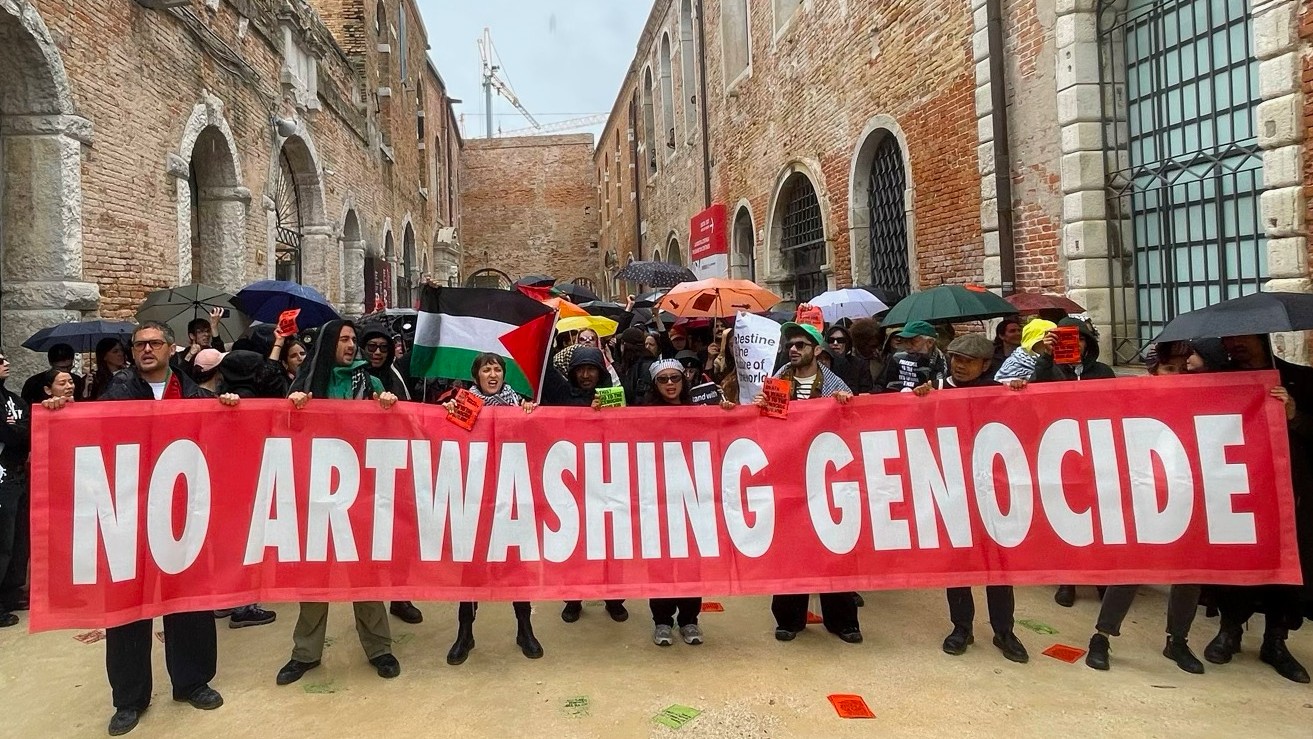
One of the world’s most prestigious international arts events, the 2026 Venice Biennale, has become the center of a growing global protest movement demanding the exclusion of Israel’s national pavilion, with a 24-hour cross-sector cultural strike scheduled for Friday during the festival’s pre-opening events. This planned industrial action marks the first organized strike in the 130-plus year history of the iconic exhibition, growing out of mounting demonstrations that launched on the festival’s opening press week over both Israel and Russia’s inclusion in this year’s event.
The unrest began on Wednesday, when the Art Not Genocide Alliance (ANGA), the coalition leading the protest movement, held a mass direct action outside Israel’s temporary exhibition space at the Venice Biennale’s Arsenale complex. Hundreds of demonstrators, including participating artists, Biennale workers, and activist supporters, assembled with placards reading “No artwashing genocide” and “No genocide pavilion” to hear addresses from cultural figures taking part in this year’s event. Protesters argue that Israel has no place at a global arts gathering after it killed dozens of Palestinian artists and destroyed hundreds of cultural and artistic sites during its ongoing military campaign in Gaza, which the coalition describes as a state-led genocide.
In a public statement released during the demonstration, ANGA reaffirmed the group’s core position: “We are here to express our refusal to tolerate genocidal destruction in the name of freedom.”
The Wednesday protest came after Biennale leadership refused to respond to a March 17 open letter from ANGA demanding the immediate expulsion of Israel’s national pavilion. The letter, which called for Israel’s full exclusion from the event, was signed by 236 participating artists, curators, and Biennale workers, including internationally renowned cultural figures Alfredo Jaar, Brian Eno, Lubaina Himid, Yto Barrada, and Cauleen Smith.
“No artist or cultural worker should be asked to share a platform with this genocidal state,” the letter read. “As long as Israel exists by means of genocide, ethnic cleansing and apartheid, it must not be represented at the Venice Biennale.” The letter also highlighted that Israeli military operations have deliberately targeted cultural infrastructure, a core value the Biennale claims to uphold.
ANGA has repeatedly clarified that its opposition targets state representation, not individual Israeli artists. “A national pavilion at the Venice Biennale is an official cultural representation of that state,” the group explained in comments earlier this year. ANGA added that it opposes the use of dissenting Israeli artists who oppose the Gaza campaign as “cultural cover for state violence,” noting that the current setup forces all participating Israeli artists into an impossible position, requiring them to legitimize the state’s actions regardless of their personal political beliefs.
This year’s controversy is not an isolated incident. The 2024 art Biennale saw ANGA launch a similar campaign against Israel’s participation, collecting more than 24,000 signatures on an open letter demanding exclusion. That campaign ultimately ended when the selected Israeli artist, Ruth Patir, voluntarily closed the pavilion in protest of Israel’s military actions. In response to Patir’s move, the Israeli government added a mandatory clause to the 2026 pavilion contract requiring the selected artist to keep the space open for the full run of the event.
For 2026, Israel is not exhibiting in its permanent Giardini pavilion, which it has operated since 1952. The Israeli culture ministry claimed the permanent space needed structural renovations, so the Biennale granted Israel permission to host its exhibition in a temporary space at the Arsenale rather than requiring it to rent private venue space. ANGA has condemned this accommodation as “an explicit institutional endorsement of Israel at a moment of escalating violence” in Gaza and the occupied West Bank.
Friday’s 24-hour cultural strike, a first in Biennale history, is being coordinated by ANGA alongside a coalition of local and international grassroots cultural groups including Biennalocene, Sale Docks, Mi Riconosci, and Vogliamo Tutt’altro. Three major Italian trade unions — Associazione Difesa Lavoratori (ADL Cobas), Unione Sindacale di Base (USB), and Confederazione Unitaria di Base (CUB) — have also joined the call for action. This is not the first time Italian labor groups have taken action against Israel: Italian dockworkers have previously staged industrial action refusing to load military cargo bound for Israel.
“This is the first ever organised strike to occur within the Biennale,” ANGA said. “It will be a crucial moment, bringing together different organisations and sending a clear message during the pre-opening days of the Biennale.”
Israel’s inclusion is not the only point of contention at this year’s festival. The Biennale has also drawn widespread criticism for allowing Russia to return to the exhibition for the first time since Moscow’s full-scale invasion of Ukraine in 2022. While the Italian culture ministry has publicly supported Israel’s participation, it has publicly opposed Russia’s inclusion. Russia’s 2026 entry is co-led by Anastasia Karneeva, daughter of a former Russian intelligence officer, and Ekaterina Vinokurova, daughter of Russian Foreign Minister Sergey Lavrov.
Biennale chairman Pietrangelo Buttafuoco, a right-wing Sicilian journalist who converted to Islam in 2015, defended the festival’s decision to include both countries during a Wednesday press conference. “This whole world born of the French revolution, the Enlightenment and secularism has flipped into its exact opposite: a laboratory of intolerance, and demands for censorship, closure and exclusion,” Buttafuoco said. “The Biennale is not a court; it is a garden of peace. We cannot shut it down, we cannot boycott as an automatic response. We must discuss. We may disagree, and we do so forcefully.”
The Venice Biennale alternates annually between art and architecture editions, and opens to the general public on Saturday after a week of private pre-opening events, with protests expected to draw thousands of additional demonstrators to Venice this week.