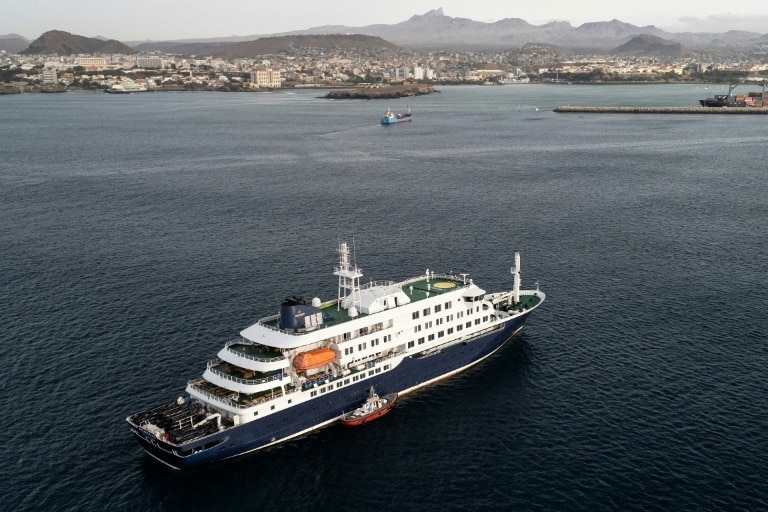
A deadly hantavirus outbreak on a polar expedition cruise ship has sparked sharp criticism from a passenger who says crew leadership downplayed the risk of infection and allowed normal operations to continue even after the first death was recorded.
Turkish travel vlogger Ruhi Cenet, 35, joined the 88-passenger MV Hondius in Ushuaia, Argentina on April 1 to document a stop at Tristan da Cunha, the remote South Atlantic archipelago. The voyage began as a comfortable, idyllic journey: the ship carried 59 crew members to cater to guests, most of whom were senior amateur birdwatchers aged 60 and older. The calm routine shattered on the morning of April 12, when the captain announced over the ship’s intercom that a 70-year-old Dutch passenger had died the previous day.
In video footage Cenet recorded on board, the captain told passengers that the ship’s doctor had confirmed there was no risk of infection, and attributed the death to natural causes. At the time, leadership did not even consider that a highly contagious pathogen could be spreading through the vessel – a decision Cenet calls deeply reckless, even as the ship’s own British doctor would later develop severe symptoms consistent with hantavirus infection.
“What shocked me most was that life went on completely as usual after the announcement,” Cenet told AFP in a remote interview. Videos he shared show elderly passengers continuing to gather for buffet meals with no social distancing or face coverings. Out of an abundance of caution, Cenet and his cameraman began self-isolating in their cabin immediately, despite having no confirmed information about a virus outbreak.
Three people on the MV Hondius have now died from the virus: the initial Dutch victim, his wife, and a German female passenger. The World Health Organization has confirmed that at least five additional passengers have definite or probable cases of hantavirus, a rare zoonotic disease that causes severe respiratory illness and can be fatal in untreated cases.
Cenet says he remains deeply troubled by the ship’s scheduled stop at Tristan da Cunha days after the first death, when all passengers were allowed to disembark and interact with the island’s small local population. “It’s the most remote inhabited island on Earth, with almost no hospital infrastructure and barely any doctors,” he explained. “That’s my biggest regret – we shouldn’t have landed there after the first fatality. It could have turned into a worst-case scenario for the islanders.”
Cenet and around 20 other passengers disembarked at the British overseas territory of Saint Helena on April 24. The next day, he boarded a repatriation flight to South Africa – alongside the first victim’s wife, who was already showing severe symptoms. She died less than 24 hours after boarding the flight. After clearing processing in South Africa, Cenet returned to his home in Istanbul, where Turkish health authorities told he did not need mandatory quarantine as long as he showed no symptoms. He has continued voluntary self-isolation out of caution.
The MV Hondius spent weeks quarantined in waters off Cape Verde, and on Wednesday departed for Spain’s Canary Islands. An acquaintance still on board told Cenet that passengers are now required to isolate in their cabins and wear face coverings when in shared spaces. Looking back, Cenet argues that expedition cruise lines operating in remote regions lack basic emergency infrastructure to handle disease outbreaks. Passengers paid roughly $10,000 each for the voyage, he noted, and the ship relied on just one physician to handle all medical needs.
“I think these kinds of ships should have on-site labs and all the necessary emergency equipment to handle outbreaks when you’re thousands of miles from the nearest major hospital,” Cenet said. “One doctor simply isn’t enough.”