The 2024 Venice Biennale, one of the world’s most prestigious and longest-running contemporary art events, kicked off its press preview period this week mired in geopolitical controversy, sparked by the controversial inclusion of Russia in the festival for the first time since Moscow’s full-scale invasion of Ukraine in 2022. What was meant to be a global celebration of artistic vision has instead become a flashpoint for international tensions, drawing mass protests, institutional resignations, funding threats, and boycott calls that have thrown the entire event into turmoil.
The most high-profile demonstration took place outside the Russian pavilion on Wednesday, when bare-breasted activists from two iconic protest groups—Ukrainian feminist collective Femen and Russian opposition punk band Pussy Riot—took united action against Russia’s participation. Dressed in matching pink balaclavas, the activists set off pink smoke bombs to draw attention to their cause, as they denounced the presence of a Russian national pavilion amid the ongoing full-scale war.
“We are here to remind that the only Russian culture, the only Russian art today is blood,” Femen leader Inna Shevchenko told assembled reporters. “This pavilion stands on Ukrainian mass graves.” This marked the first time the two groups have collaborated on a public protest, a sign of the widespread anger the decision has sparked across both Ukrainian and anti-war Russian circles.
The controversy over Russia’s inclusion has rippled across the entire event, triggering cascading consequences that have forced major changes to the 2024 Biennale’s structure. Last week, the entire international jury resigned in protest, announcing they would refuse to award prizes to nations led by officials facing arrest warrants from the International Criminal Court—a designation that covers both Russia and Israel. In response to the unrest, organizers have postponed the Biennale’s traditional opening awards ceremony from May 9, the festival’s first public day, all the way to November 22, the final day of the six-month run. Organizers have instead restructured awards to allow public voting, extending eligibility to all national participants including Russia, a move they framed as upholding “the principle of inclusion and equal treatment.”
The decision to allow Russia’s participation this year came despite the fact that Russia was not extended an official invitation, and despite widespread opposition from European and Italian political leaders. The European Union has threatened to cut 2 million euros ($2.3 million) in core grant funding for the Biennale over the decision, arguing that European taxpayer money should not support events that include Russian participation amid the ongoing war. A European Commission spokesman emphasized that cultural events backed by the bloc must uphold democratic values, freedom of expression, and inclusive dialogue—values the bloc says are not respected in modern Russia. The EU has also requested formal clarification from the Italian government over whether hosting the Russian delegation violates existing European sanctions against Moscow.
Italy’s national government has also openly opposed Russia’s inclusion, with Culture Minister Alessandro Giuli confirming he will boycott the event entirely in protest of the decision.
In a compromise reached amid escalating pressure, the Russian pavilion will not be open to the general public for the entire run of the Biennale, which is open to visitors from May 9 through November 22. Instead of in-person public exhibits or live performances, the Russian pavilion’s show, titled “the tree is rooted in the sky,” will only be recorded during this week’s press previews, with footage later projected on large outdoor screens for public viewing. Russia’s ambassador to Italy, Aleksei Paramonov, confirmed that restrictions tied to European sanctions bar any live public performances by Russian artists beyond the press preview period, and condemned the restrictions as unreasonable.
“There is truly something painful and unreasonable about the European Union’s obsession with targeting Russian culture and art with sanctions and restrictions of all kinds,” Paramonov said in a statement posted to Facebook.
Biennale President Pietrangelo Buttafuoco, who has repeatedly defended the decision to include Russia, argued that the festival has always served as a space for global dialogue even amid geopolitical division. “If the Biennale were to start selecting not works but affiliations, not visions but passports, it would cease to be what it has always been: the place where the world comes together, and all the more so when the world is torn apart,” Buttafuoco told reporters Wednesday.
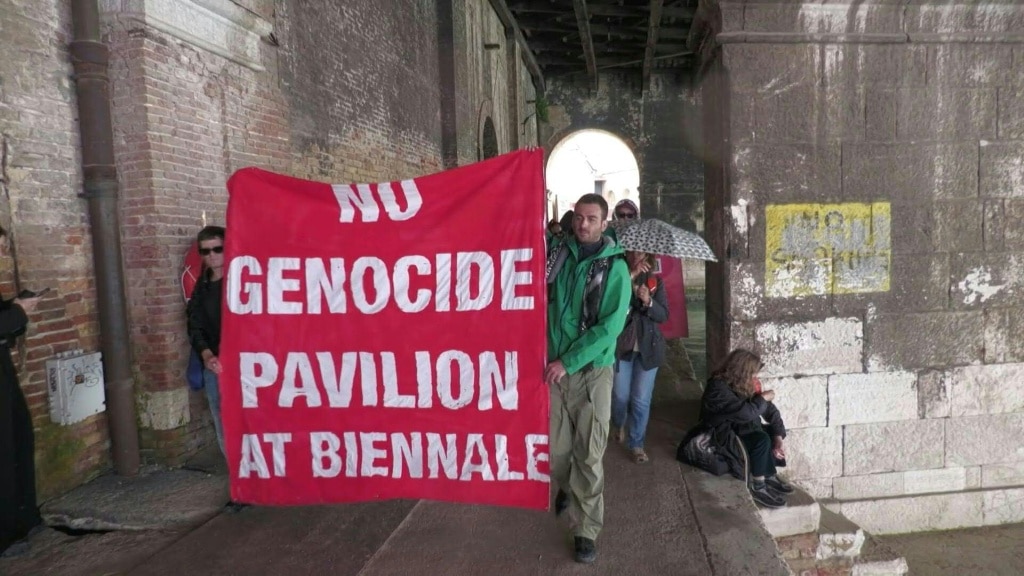
Controversy is not limited to the Russian pavilion, however. Pro-Palestinian activists also staged a large demonstration outside the Israeli pavilion Wednesday, drawing roughly 100 participants who carried banners reading “No artwashing genocide” amid ongoing Israeli military operations in Gaza. Just as with Russia, the ICC has issued an arrest warrant for Israeli Prime Minister Benjamin Netanyahu, a key reason the Biennale jury resigned last week. Iran, which was originally scheduled to participate in the 2024 Biennale, withdrew entirely after Israeli strikes on Iranian targets in late February.
This year’s controversy marks a sharp shift from the 2022 Venice Biennale, held shortly after Russia’s full-scale invasion of Ukraine. At that event, Russian artists and curators voluntarily withdrew from the pavilion in protest of the war, and Biennale organizers banned all Russian government officials from attending the event.