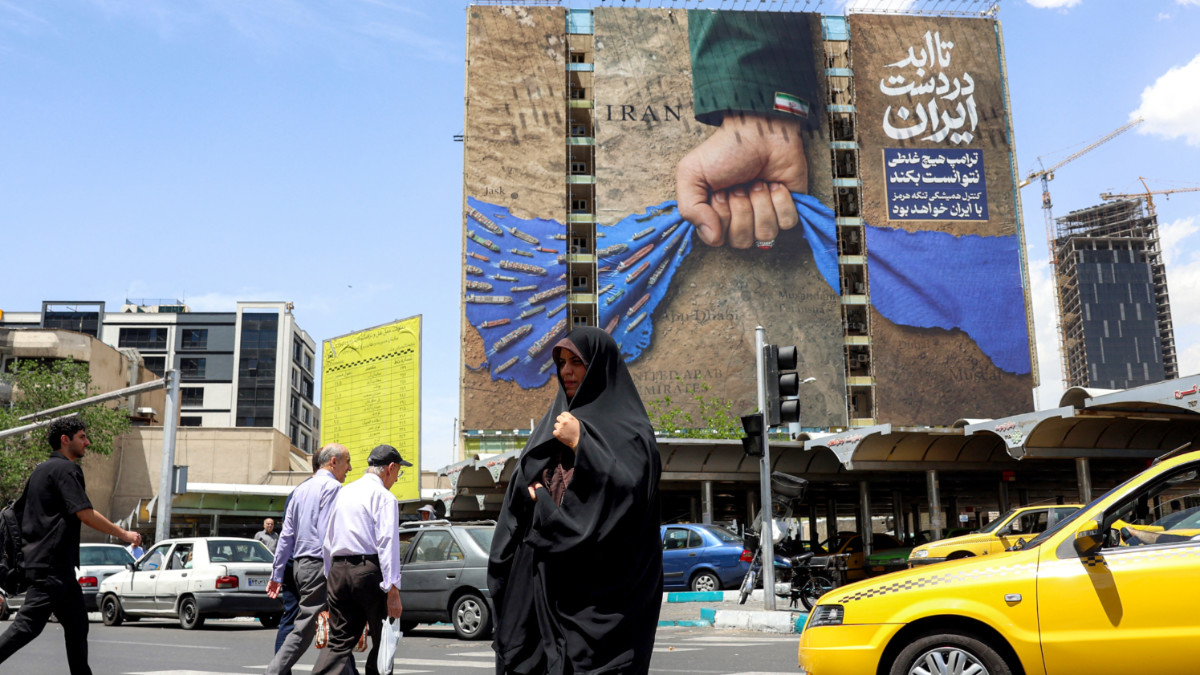
On Tuesday, a former high-ranking US official made a stark prediction about long-term control of the strategic Strait of Hormuz, arguing that Iran will retain dominance of the critical waterway indefinitely—no matter what provisions any eventual US-Iran peace deal includes. This outlook, he says, is already pushing vulnerable Gulf Arab states to accelerate the construction of alternative oil and gas export infrastructure to escape Iran’s strategic chokehold over the world’s most important energy chokepoint.
Amos Hochstein, who served as a senior energy and Middle East policy advisor to former US President Joe Biden, laid out his assessment in an interview with Bloomberg. When asked about ongoing negotiations between the Trump administration and Iran aimed at ending the ongoing US-Israeli military campaign against the Islamic Republic, Hochstein left little room for ambiguity: “The Strait of Hormuz is under Iranian control forever — basically for the foreseeable future. Nobody in the market should look at what the deal says eventually and believe it on [the] straits. Iran will control the straits.”
Hochstein noted that while political leaders in Washington may accept any language about reopening the strait in a final agreement, regional Gulf states understand full well that Iran will hold de facto power over access to the waterway moving forward. “Everybody in Washington will believe it. Nobody in the Gulf,” he said. “They know the Iranians are now going to control this.”
The strategic waterway has emerged as the central sticking point in the current US-Iran peace negotiations, with both sides imposing blockades to assert territorial and military control. Iran has been blocked from moving its own oil tankers out of the Strait of Hormuz and the adjacent Gulf of Oman, but Tehran has in turn blocked exports from neighboring Gulf Arab states through the waterway. Tensions have escalated sharply in recent days: earlier this week, Iran announced it had struck a US warship that attempted to breach its blockade, and also launched drone and missile attacks targeting the United Arab Emirates, in what was widely interpreted as a response to US naval activity in the region.
Following the Trump administration’s rejection of an Iranian proposal to reopen the strait in exchange for a ceasefire and a delay to negotiations over Iran’s nuclear program, Iran confirmed Wednesday it is reviewing a new peace proposal put forward by the US. For his part, Trump said Wednesday he believes a final agreement with Iran is “very possible,” but issued a blunt threat to resume large-scale bombardment of the country if talks collapse, adding that the US will only accept nothing less than Iran’s “surrender.”
Against this backdrop of uncertainty, Hochstein says Gulf states have already begun moving forward to build new pipeline infrastructure that bypasses the Strait entirely. Smaller Gulf nations including Kuwait and Bahrain have been completely cut off from their traditional export routes through the waterway, and Qatar’s liquefied natural gas exports have been brought to a complete halt, forcing the country to extend force majeure on LNG shipments through June.
Larger regional players that already had partial bypass infrastructure in place have fared far better. Saudi Arabia, for example, continues to export roughly five million barrels of crude per day via its East-West Pipeline, which moves oil from Gulf production fields to the Red Sea for export. The UAE operates a pipeline to the Indian Ocean port of Fujairah, allowing it to maintain exports at roughly half of pre-war levels. Iraq, another major oil exporter heavily reliant on the Strait, is also rushing to develop alternative routes: this week, Baghdad launched its first crude oil exports via the al-Yarubiya-Rabia border crossing with Syria, with 70 tanker trucks carrying crude north for export out of Mediterranean ports. Iraq is also working to expand the capacity of an existing oil pipeline running north to Turkey to boost alternative exports.
Far from being a prohibitive investment, Hochstein argued that the cost of new bypass infrastructure is relatively modest given the scale of energy exports from the region: “It’s not even that expensive. A few billion dollars. But a few billion dollars in what we’re talking about doesn’t cost very much.”
Beyond the geopolitical shift, the disruption to Strait of Hormuz shipping has already created massive dislocations in global energy pricing, with huge gaps between benchmark futures prices and the actual physical cost of crude. Hochstein pointed out that benchmark prices quoted on global markets do not reflect actual trading costs, noting: “$110 of Brent oil is only available on a Bloomberg terminal. You can’t buy that barrel. That barrel of Brent oil is selling for $150. $145 some days, $155, even $170.”
This discrepancy is not new: HSBC CEO Georges Elhedery noted last month that extreme price disparities exist across different markets, with the most severe impacts hitting energy-importing low-income nations with no domestic oil production. Elhedery reported that spot crude prices have reached as high as $286 per barrel in Sri Lanka. Hochstein warned that this supply shortage will not stay confined to vulnerable low-income countries: “We have physical shortage already, but it’s just in countries we don’t care about. But then it will go to middle-income countries, like Vietnam and Thailand, then it goes to Japan and Korea, and then it comes here.”