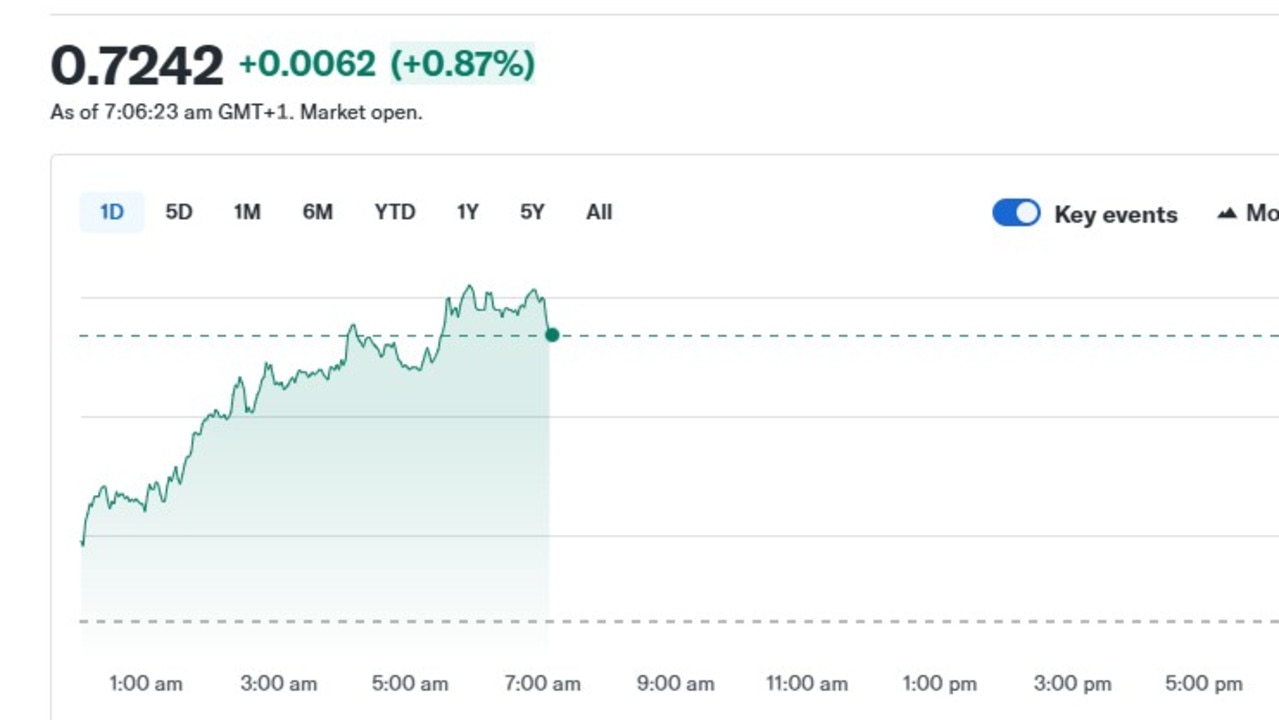
The Australian dollar has surged to a four-year peak against the U.S. dollar, a rally driven by the Reserve Bank of Australia’s recent interest rate increase that has created clear winners and losers across the domestic economy, from cross-border travelers to mortgage-holding households.
After the RBA implemented a 25-basis point rate hike on Tuesday, pushing the official cash rate to 4.35%, the Australian dollar climbed to its highest level against the greenback since June 2020. As of this reporting, one Australian dollar purchases 72.48 U.S. cents, marking a significant upward shift for the commodity-linked currency.
Global X investment strategist Billy Leung explained that the Australian dollar’s momentum stems from the country’s unusual position as an outlier in global monetary policy. While most major developed economies have paused rate hikes and begun pricing in future cuts, Australia continues to tighten borrowing costs due to an unresolved inflation crisis that has persisted longer than many policymakers and analysts expected.
Unlike peer economies that cut rates more aggressively and held them lower for longer in the wake of the COVID-19 pandemic, Australia now faces persistent domestic inflation pressures that have forced the central bank to act even as global inflation cools. The RBA could not look past the oil price volatility triggered by escalating tensions between the U.S., Israel, and Iran, which have pushed crude prices above $110 a barrel and added to existing inflationary headwinds.
Current economic data backs the RBA’s hawkish stance: trimmed mean inflation is projected to rise back to 3.8% by June, real household spending grew 0.7% in the first quarter, and the national labor market has remained unexpectedly resilient. Tuesday’s rate increase marked the third consecutive hike in the RBA’s current tightening cycle, and opinion among economic experts remains divided on whether additional rate increases will be needed to bring inflation under control.
The RBA board’s vote on the hike reflected that division: eight of nine members supported lifting the cash rate, while one member advocated for holding rates steady at the previous 4.10% level. In a post-meeting statement, the board emphasized that inflation at 4.6% remains far above the central bank’s 2-3% target range, and left the door open for future policy tightening. The board added that it will closely monitor incoming economic data and shifting global economic conditions to guide future decisions.
“Having raised the cash rate three times, monetary policy is well placed to respond to developments and the board is focused on its mandate to deliver price stability and full employment,” the statement read. “It will do what it considers necessary to achieve that outcome.”
Leung added that another key factor driving the Australian dollar’s rally is the eroding yield advantage of the U.S. dollar. With the U.S. Federal Reserve holding rates steady and market expectations building for upcoming rate cuts, global investors searching for higher yield have increasingly turned to the few developed markets like Australia that are still offering attractive carry returns.
When combined with elevated global oil prices driven by Middle East tensions, the conditions for a rally by Australia’s commodity-linked currency, backed by a hawkish central bank, are nearly ideal, Leung noted. He also clarified a common misperception about the rally: the Australian dollar’s gain is not a sign of exceptional strength in the domestic Australian economy.
“The Aussie is not rallying because the domestic economy is booming,” Leung said. “It is rallying because the inflation problem most of the developed world believes has been dealt with remains very much alive in Australia, and the RBA has chosen to confront it directly.”
For consumers, the stronger dollar delivers immediate benefits for two key groups: Australians planning overseas travel, who will see their buying power increase when exchanging currency, and domestic importers, who will pay less for goods sourced from overseas. The flip side of the rate hike that drove the rally, however, is higher monthly mortgage repayments for millions of Australian households, adding to ongoing cost-of-living pressures across the country.