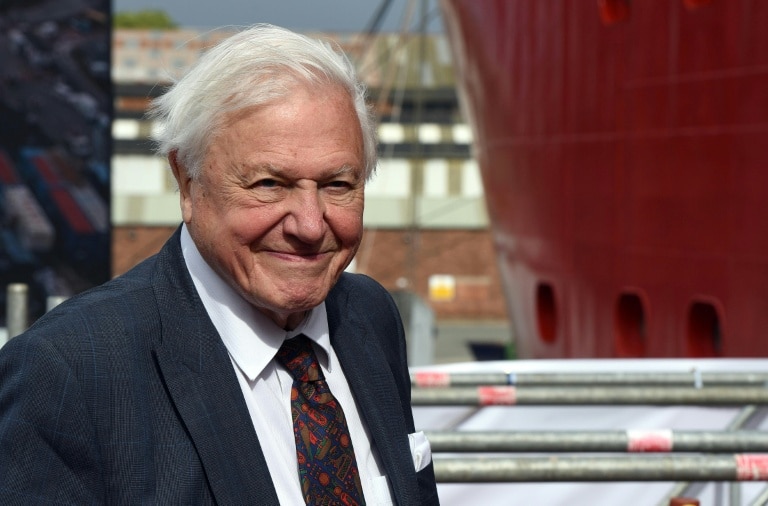
As the clock ticks toward Friday, the global community is preparing to mark a historic milestone: the 100th birthday of David Attenborough, the legendary naturalist, broadcaster, and climate advocate whose decades of work have redefined how humanity understands the planet we call home. For nearly 80 years, Attenborough has been the guiding voice leading audiences into the most isolated, awe-inspiring corners of the Earth, turning far-flung wild landscapes into familiar fixtures in living rooms across every continent.
Attenborough’s lifelong connection to the natural world took root in childhood, growing into an academic foundation with university studies in geology and zoology before he joined the BBC in the early 1950s to launch what would become an unparalleled broadcasting career. His 1979 magnum opus *Life on Earth* — which alone has drawn an audience of more than 500 million viewers worldwide — remains one of the most watched nature documentaries in history. It was in this series that Attenborough shared one of his most iconic personal encounters: a close, unplanned meeting with a family of mountain gorillas in the Rwandan wilderness, an experience he still calls “bliss” and “extraordinary” decades later. Recalling the moment ahead of his centenary, Attenborough described how an adult female gorilla gently twisted his head to meet his gaze, while two young gorillas settled on his lap as cameras rolled: “I was simply transported,” he said.
Over the decades that followed, Attenborough built a catalog of landmark series including *Planet Earth II*, *Blue Planet II*, *Life in the Freezer*, and *Paradise Birds*, each capturing the fragile, extraordinary beauty of ecosystems from polar ice caps to tropical rainforests. Peers across academia and science communication say his impact extends far beyond entertainment. Sandra Knapp, research director at London’s Natural History Museum, told Agence France-Presse that Attenborough’s work “has expanded people’s horizons” and gifted global audiences access to places “we would never otherwise go” — a gift that has inspired generations of scientists, conservationists, and nature lovers. Jean-Baptiste Gouyon, a professor of science communication at University College London, notes that Attenborough achieved what few thought possible: he turned natural history programming into a cultural phenomenon as popular as mainstream football, fostering a widespread, unmatched sense of wonder and passion for the natural world among the general public.
His influence has crossed generational and national boundaries, earning acclaim from figures across public life, royalty, and entertainment. Britain’s heir to the throne Prince William has hailed him as a “national treasure,” and the late Queen Elizabeth II knighted him in 1985. American pop star Billie Eilish, whose praise underscores Attenborough’s cross-generational appeal, has celebrated his “deep love and knowledge of our planet,” noting that “The animal kingdom brings out the childlike curiosity within us all.”
In recent decades, Attenborough has pivoted from simply documenting the natural world to sounding the alarm about the existential threats it faces. In 2006, after waiting for conclusive scientific proof of human-caused climate change, he publicly dropped his earlier skepticism and joined the global movement calling for urgent action. Even well into his 90s, he continued to make hard-hitting, unflinching documentaries: his 2025 film *Ocean* saw him condemn the industrial fishing practices of wealthy nations, calling the exploitation “modern colonialism at sea.” Most recently, in early 2026, he released *Wild London*, which explores the unexpected wildlife thriving in his native British capital, from urban foxes and reintroduced beavers to tiny harvest mice and hedgehogs. At the 2021 UN Climate Summit in Glasgow, he shared a message of cautious hope that remains central to his public advocacy: “Perhaps the fact that the people most affected by climate change are no longer some imagined future generation, but young people alive today… will give us the impetus we need to rewrite our story, to turn this tragedy into a triumph. We are, after all, the greatest problem-solvers to have ever existed on Earth.”
Now 100 years old, Attenborough no longer treks through remote jungles or crosses scorching deserts to film new content, but he has not stepped away from storytelling. After a lifetime of global travel, he still resides in the quiet, leafy southwest London suburb of Richmond — his favorite place on Earth, he has confided — in the family home he shared with his late wife Jane, where he raised their two children. Rejecting the label of celebrity even as he became a global household name, Attenborough has always focused attention on the natural world rather than his own fame, a trait Gouyon says has been key to his enduring connection with audiences.
To celebrate the centenary of the British icon, the BBC is spearheading a week-long slate of special programming dedicated to Attenborough’s life and decades of work. Classic episodes of his most beloved series are being rebroadcast, with an extensive catalog of his work available to stream on the BBC’s iPlayer service. The celebration will culminate on his birthday with a 90-minute live event hosted at London’s iconic Royal Albert Hall, bringing together fans and admirers to honor the life and legacy of the man who taught the world to love the natural world.