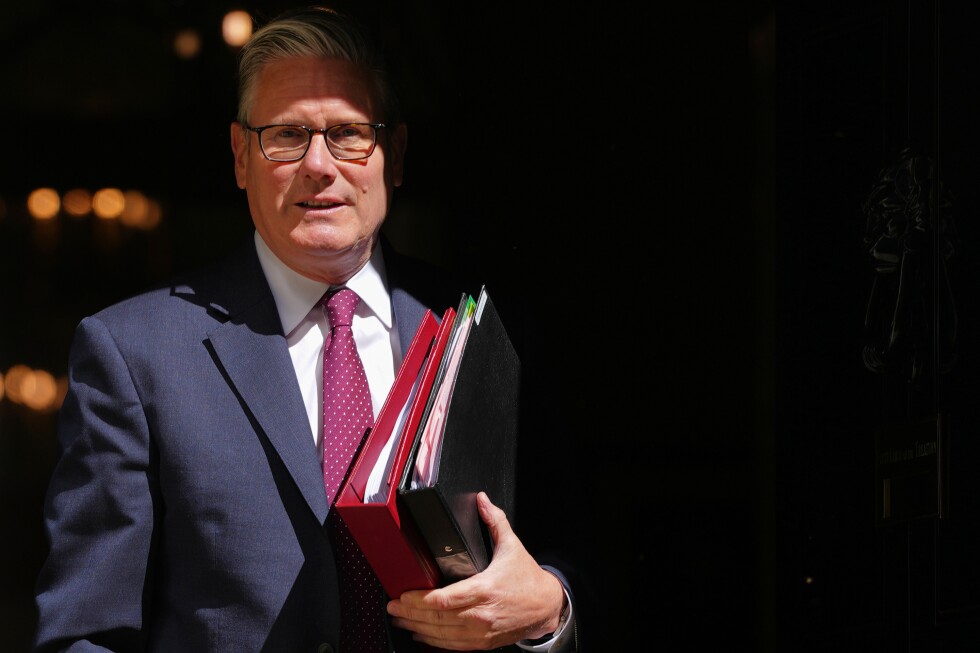
LONDON – British voters are heading to the polls on Thursday for a set of elections that carries profound implications for Prime Minister Keir Starmer’s embattled premiership and marks the latest step in the United Kingdom’s transition to an uncharted era of fragmented multiparty governance. The outcome of Thursday’s votes, which cover local government seats across England and legislative elections for the semiautonomous governments of Scotland and Wales, is widely projected to deliver a severe blow to Starmer’s center-left Labour Party.\n\nPlunged into negative approval ratings by persistent economic weakness and ongoing questions over his leadership judgment, Starmer has found Thursday’s midterm contests framed as a de facto public referendum on his two-year-old government by opposition parties. Hard-right Reform UK has even centered its campaign on the slogan “Vote Reform, Get Starmer Out,” capturing the intensity of attacks on the embattled prime minister. While the next scheduled UK national general election is not required until 2029, a catastrophic rout on Thursday could open the door to a party revolt against Starmer, less than two years after he won a landslide national victory. Luke Tryl, a senior analyst at polling firm More in Common, summed up the public mood, noting that Starmer has become a receptacle for widespread public disappointment and disillusionment across the country.\n\nStarmer’s political standing has collapsed amid a string of high-profile missteps that have piled up since he took office in July 2024. His administration has struggled to deliver on core campaign promises: boosting sluggish economic growth, repairing overstretched public services, and easing the crippling cost-of-living crisis. These challenges have been compounded by the outbreak of conflict between the U.S.-Israeli coalition and Iran, which has disrupted global oil shipments through the Strait of Hormuz, driving up energy prices and worsening economic headwinds. The prime minister’s credibility took a particularly damaging hit from his controversial decision to appoint Peter Mandelson, a figure long tied to disgraced financier Jeffrey Epstein, as Britain’s ambassador to Washington. Starmer already survived one leadership crisis in February, when a group of Labour lawmakers including the party’s Scottish leader publicly called for him to step down over the Mandelson appointment.\n\nPolitical forecasters project that Labour will lose more than half of the 2,500 local council seats it currently defends across England. The party is expected to bleed support to rivals on both its left and right flanks: the left-wing Green Party is set to gain ground in London, while Reform UK is targeting working-class former Labour strongholds in northern England. Tony Travers, a government professor at the London School of Economics, described the electoral moment as deeply perilous for Starmer. “After a series of policy U-turns and in an economy where there isn’t much money to spend on anything, his opponents are lining up,” Travers explained.\n\nA poor showing could trigger an immediate leadership challenge from high-profile Labour figures, including Health Secretary Wes Streeting, former Deputy Prime Minister Anglea Rayner, and popular Greater Manchester Mayor Andy Burnham. Under Labour Party rules, a challenger needs the backing of 80 House of Commons lawmakers – equal to one-fifth of the party’s parliamentary caucus – to trigger a formal leadership contest. For Burnham, any bid would first require him to win a seat in Parliament to be eligible for the top job. Alternately, Starmer could face growing party pressure to announce a clear timetable for an orderly departure rather than force an immediate open revolt.\n\nTim Bale, a politics professor at Queen Mary University of London, noted that Labour’s parliamentary party remains divided on the timing of any leadership change, opening the possibility of a temporary reprieve for Starmer. “His parliamentary party are unsure as to whether now is the right time to unseat him, so there might be a stay of execution,” Bale said. But he added that the broader shift within the party is clear: “it’s a case of when rather than if he goes.”\n\nBeyond the fate of Starmer’s premiership, Thursday’s election is widely seen as a defining milestone in the long-term fragmentation of Britain’s political landscape. For generations, major losses for Labour would have automatically translated into major gains for the main center-right rival, the Conservative Party. But the Conservatives remain deeply unpopular after 14 turbulent years in power that ended when Labour won the 2024 national election. Instead, the main beneficiaries of Labour’s declining support are projected to be Nigel Farage’s right-wing Reform UK, the left-leaning Green Party, and pro-nationalist devolved parties in Scotland and Wales.\n\nTravers noted that Britain’s long-standing “two-and-a-half party system” – which positioned the Liberal Democrats as the permanent third force – is rapidly evolving into a far more fragmented five-party system. This shift has created unprecedented opportunities for pro-devolution and pro-independence parties across the UK’s devolved nations.\n\nIn Wales, where Labour has dominated devolved politics for a century and held power since the Welsh Senedd was established in 1999, polls point to a historic seismic shift. Labour is projected to fall to third place, behind Plaid Cymru (the Party of Wales) and Reform UK, which are currently running neck-and-neck for the top spot. Plaid Cymru leader Rhun ap Iorwerth, who is on track to become Wales’ next first minister if current polling holds, declared that the old order of British politics is finished. “The old politics is gone,” he said. “Labour is not going to win this election.”\n\nA Plaid Cymru victory in Wales would leave three out of four of the UK’s constituent nations led by pro-independence parties. Northern Ireland has already been governed by Irish nationalist party Sinn Féin, which supports unification with the Republic of Ireland, in a power-sharing arrangement with the pro-British Democratic Unionist Party. In Scotland, the Scottish National Party (SNP), which has held power in the Scottish Parliament since 2007, has pledged to hold a second referendum on Scottish independence if it wins a majority in Thursday’s election. Scottish voters rejected independence in a 2014 referendum, but shifting public mood and long-running frustration with Westminster rule have reshaped the political landscape north of the border.\n\nWhile Plaid Cymru has said an independence referendum is not on the immediate agenda for the next term, with its short-term priorities focused on gaining greater tax-raising and spending autonomy from Westminster, the party shares the ultimate goal of breaking away from the UK. ap Iorwerth argued that the current constitutional arrangement of the UK is no longer fit for purpose, saying: “We need a fundamental redesign of Britain. This is an unequal union.”