In a sudden Tuesday evening announcement from Dubai, United Arab Emirates, former U.S. President Donald Trump said he is halting the U.S. military mission to escort stranded commercial vessels through the blockaded Strait of Hormuz, pausing operations to give diplomatic negotiations time to finalize a deal to end the ongoing Iran war. The U.S. naval blockade of Iranian ports, however, will stay firmly in place.
The pause comes just one day after U.S. forces launched the operation to open a secure shipping corridor through the strategic waterway, which has been choked off by Iran since the conflict began. In his social media statement, Trump cited three key factors driving the decision: requests from Pakistan and other regional nations, the military gains the U.S. has made during the campaign against Iran, and what he called “Great Progress” toward a full, final agreement with Iranian negotiators. The White House has declined to offer additional context or confirm the details of the negotiation progress Trump referenced.
The current conflict kicked off on February 28, when the United States and Israel launched joint military strikes against Iranian targets. A ceasefire has been in place for nearly a month, but the truce has remained deeply fragile as tensions over control of the strait continue to escalate.
In a parallel diplomatic development, official Chinese state news agency Xinhua confirmed Wednesday that Iranian Foreign Minister Abbas Araghchi met with his Chinese counterpart Wang Yi in Beijing. This trip marks Araghchi’s first visit to China since the war began, a meeting that carries significant weight given China’s deep economic and political ties to Tehran that grant Beijing unique leverage over the Iranian government. Ahead of the meeting, U.S. Secretary of State Marco Rubio publicly urged China to pressure Iran to lift its control of the strait, a critical global energy chokepoint.
Before Trump’s announcement, Rubio told reporters at a White House press briefing that any lasting peace agreement would require Iran to meet two core U.S. demands: rolling back Tehran’s disputed nuclear program, and reopening the Strait of Hormuz to unimpeded global commercial traffic. “We would prefer the path of peace,” Rubio said, framing the U.S. push to open the strait as a strictly defensive mission focused on rescuing thousands of stranded civilian mariners. Rubio described the trapped sailors as “sitting ducks, they’re isolated, they’re starving, they’re vulnerable,” noting that at least 10 sailors have already died since the strait was closed.
During the first day of the U.S. operation Monday, American military forces said they sank six small Iranian boats that threatened commercial shipping. To date, only two commercial vessels have successfully traversed the new U.S.-guarded corridor, while hundreds of ships remain bottled up in the Persian Gulf. Iranian officials have disputed the U.S. account of the clash, with Iranian state media reporting that two small civilian cargo vessels were hit in the strikes, killing five civilian crew members. Iran has also decried the U.S. corridor effort as a direct violation of the existing ceasefire.
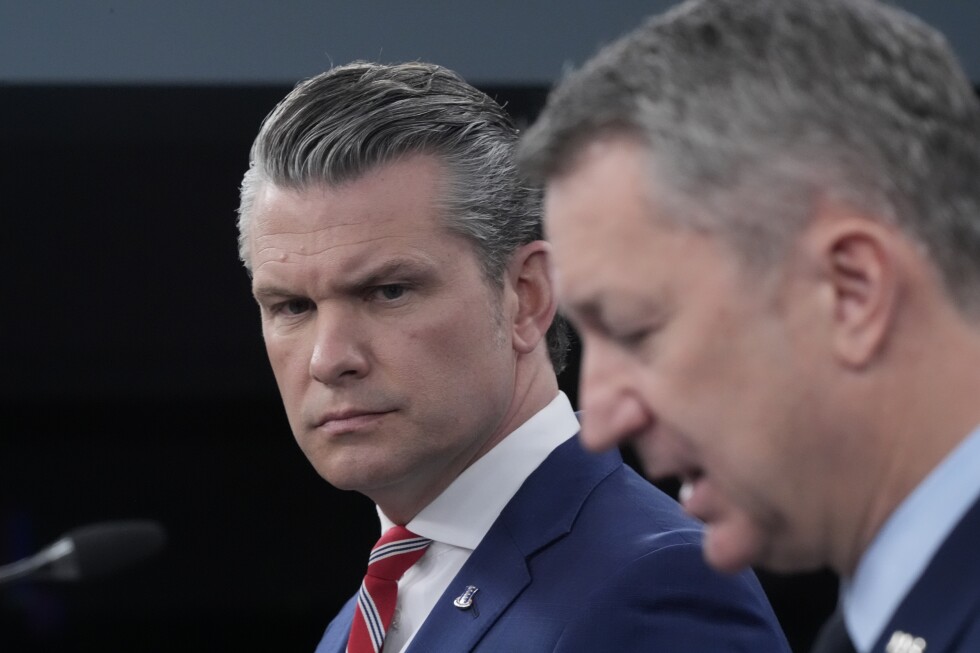
Top U.S. military leaders have downplayed the escalation, however. Speaking at a Pentagon press briefing Tuesday, Defense Secretary Pete Hegseth and Chairman of the Joint Chiefs of Staff Gen. Dan Caine said Iran’s retaliatory attacks had not crossed the threshold into “major combat operations.” Caine called Tuesday “a quieter day” in the strait, adding that more than 100 U.S. military aircraft are now patrolling the airspace above the waterway to secure the corridor. The U.S. blockade of Iranian ports, implemented April 13, has already cut off most of Tehran’s oil export revenue, severely straining Iran’s already ailing economy. Caine also emphasized that U.S. forces would not open fire unless fired upon first. “There’s no shooting unless we’re shot at first, OK? We’re not attacking them,” Rubio echoed to reporters at the White House.
Iran’s top parliamentary speaker and chief nuclear negotiator Mohammad Bagher Qalibaf offered a muted response to the U.S. mission, signaling that Tehran has not yet committed to a full response. In a post on X, Qalibaf said, “We know full well that the continuation of the status quo is intolerable for America; while we have not even begun yet.” He did not directly reference the backchannel negotiations between the U.S. and Iran, which are currently being mediated through Pakistan.
The closure of the strait has already sent shockwaves through the global economy: before the war, the waterway carried the vast majority of global oil and natural gas exports, as well as fertilizers and other key petroleum products, and its closure has caused global fuel prices to surge dramatically. Breaking Iran’s control of the strait would also eliminate Tehran’s most powerful geopolitical leverage, a key goal for the Trump administration as it pushes for deep cuts to Iran’s nuclear program.
Major global shipping companies remain deeply wary of the new U.S. corridor, even after the pause. Danish shipping giant Maersk confirmed one of its operated vehicle carriers successfully exited the strait Monday with U.S. military assistance, but leading container line Hapag-Lloyd AG said its risk assessment “remains unchanged” and that transits through the strait “are for the moment not possible for our ships.” Former military officers with experience in the region have also warned that opening the 34-kilometer wide strait is an extremely dangerous and challenging operation, even with military escorts— a security measure the U.S. is not currently providing for most commercial vessels. Currently, Iran requires all transiting vessels to use a northern corridor along the Iranian coastline, where ships must undergo vetting by the Islamic Revolutionary Guard Corps and in many cases pay fees to the Iranian government. The U.S.-backed corridor runs through Omani territorial waters to the south, outside of Iran’s control.
Iran’s retaliatory strikes have fallen heaviest on the United Arab Emirates, a key U.S. Gulf ally. The UAE Defense Ministry confirmed it faced a second consecutive day of Iranian drone and missile attacks Tuesday, though no damage or casualties were reported. On Monday, Emirati air defense systems intercepted 15 missiles and four Iranian drones, with one wayward projectile sparking a fire at a major UAE oil facility that wounded three Indian nationals. The British military also reported two cargo ships were set ablaze off the UAE coast Monday, and a second cargo vessel was hit by an “unknown projectile” in the strait Tuesday. Iran has officially denied launching any attacks on the UAE “in recent days,” per a statement read by joint military command spokesman Ebrahim Zolfaghari on Iranian state TV.
The Trump administration has also drawn scrutiny for its handling of congressional war oversight, citing the April 8 ceasefire to argue the president is not required to submit a formal update to Congress under the War Powers Resolution. The 1973 law requires presidents to secure formal congressional approval for military action within 60 days of launching operations.