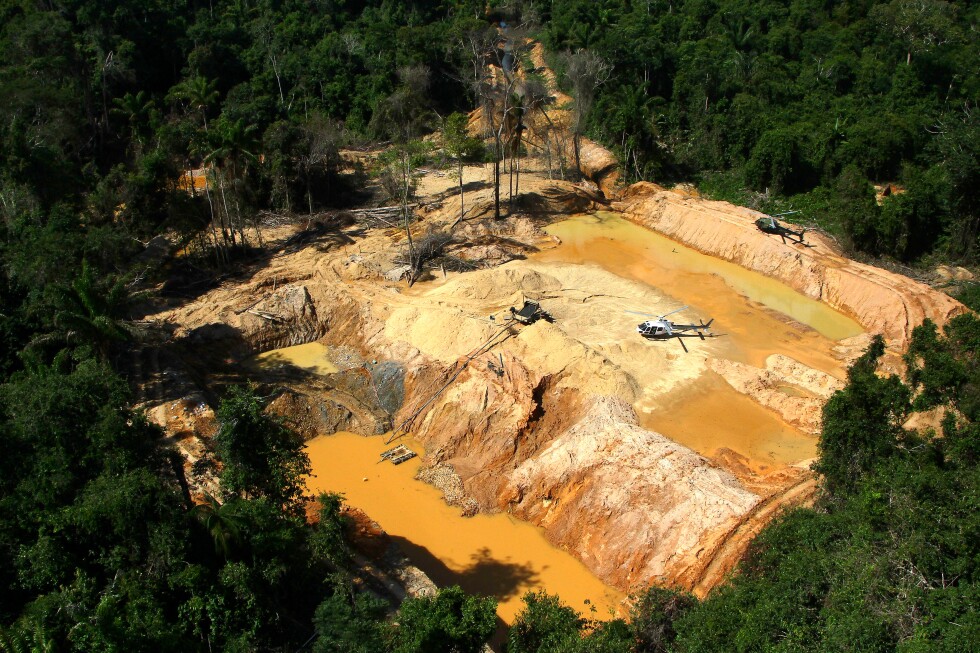
Driven by years of steadily climbing global gold prices, a new, destructive gold rush is tearing through protected zones of Brazil’s Amazon rainforest, accelerating irreversible deforestation and pushing mercury contamination to dangerous, public health-threatening levels, according to new research from leading environmental organizations and Brazilian law enforcement officials.
A joint study published Tuesday by U.S.-based non-profit Amazon Conservation and Brazilian socio-environmental non-profit Instituto Socioambiental lays bare the rapid spread of unregulated mining across the Xingu region, a vast, globally significant protected forest corridor that spans the states of Pará and Mato Grosso. The research combined high-resolution satellite mapping with on-the-ground field surveys to document the encroachment of illegal operations into three formally protected conservation units, a trend that has accelerated sharply since 2024.
The Terra do Meio Ecological Station, one of the region’s most intact protected ecosystems, recorded its first confirmed cases of illegal mining activity only in September 2024. By the end of 2025, deforestation linked to mining operations had already expanded to 30 hectares (74 acres). At the Altamira National Forest, cumulative deforestation from illegal mining reached 832 hectares (2,056 acres) between 2016 and September 2025. A newly opened mining front established in 2024 grew to 36 hectares (89 acres) by October 2025 alone, accounting for nearly half of all mining-related forest loss recorded in the conservation unit that year. Satellite monitoring also uncovered a hidden clandestine airstrip built to serve illegal miners in the Nascentes da Serra do Cachimbo Biological Reserve in 2024, where illegal mining expanded rapidly from just 2 hectares (5 acres) to at least 26.8 hectares (66 acres) in 2025.
These on-the-ground findings align with data from Amazon Mining Watch, a public tracking platform launched in 2023 by Amazon Conservation in partnership with Earth Genome and the Pulitzer Center. The platform uses continuous satellite monitoring to track mining activity across the entire Amazon basin dating back to 2018. Since 2018, the platform records that approximately 496,000 hectares (1.2 million acres) of Amazon rainforest have been cleared to make way for mining operations, with nearly half of that total – around 223,000 hectares – located in the Brazilian Amazon. Amazon Conservation’s analysis estimates that 80% of all mining-related deforestation in Brazil carries a high risk of being illegal.
While mining accounts for a relatively small share of total annual deforestation in Brazil compared to agribusiness expansion – the leading driver of forest loss – environmental researchers emphasize that the impact of mining is uniquely destructive because it disproportionately targets protected conservation areas and Indigenous territories. “What makes mining particularly problematic is that it targets protected areas and Indigenous territories,” explained Matt Finer, director of Amazon Conservation’s Monitoring of the Andes Amazon program. Protecting Indigenous territorial boundaries is widely recognized by climate and forest scientists as one of the most effective strategies to curb Amazon deforestation. As the world’s largest tropical rainforest, the Amazon plays a critical role in regulating global climate patterns, and continued large-scale forest loss threatens to accelerate long-term global warming.
Brazilian authorities launched a high-profile, large-scale crackdown on illegal gold mining in the Yanomami Indigenous territory along the Venezuela border in 2023, after a surge in unregulated mining triggered a severe humanitarian and public health crisis. Data from Amazon Conservation confirms that the annual growth rate of newly mined areas in Yanomami fell sharply following the crackdown. While illegal mining has not been fully eradicated from the territory, nearly all of the 5,500 hectares (13,590 acres) of total mining-related deforestation in Yanomami occurred before the 2023 enforcement operation.
Despite this localized success, targeted enforcement has failed to curb the spread of illegal mining across the broader Brazilian Amazon. Law enforcement officials describe the ongoing battle against illegal operations as a persistent “cat-and-mouse game”: when authorities destroy mining equipment and shut down operations in one location, miners simply relocate or resume activity within days of officials leaving the area. “Last year, I took part in an operation that destroyed more than 500 dredges on an Indigenous land,” said federal prosecutor André Luiz Porreca, who specializes in investigating illegal mining in the western Brazilian Amazon. “The following week, Indigenous people showed me photos proving the miners had already returned.”
Porreca and other investigators note that illegal gold mining is largely financed and organized by Brazil’s largest transnational criminal organizations, including the Red Command and First Capital Command (PCC), which maintain a presence in roughly one-third of all municipalities across the Brazilian Amazon. “They have the money to bankroll these operations. Some dredges cost as much as 15 million reais,” Porreca explained. While enforcement has reduced pressure in the Yanomami territory, illegal mining has intensified rapidly across other regions, particularly Indigenous lands in the Xingu River basin. The Kayapo Indigenous territory is currently facing the most severe crisis, with an estimated 7,940 hectares (19,620 acres) of rainforest already cleared by illegal mining operations – the largest area of mining-related deforestation on any Indigenous land in the Brazilian Amazon.
The current surge in illegal activity is directly tied to record-breaking global gold prices, which have risen sharply as investors turn to gold as a safe-haven asset amid growing global economic and geopolitical risk. “It’s basic market logic. With more buyers, there are more people exploiting gold,” Porreca said. He added that Brazil’s current system for regulating mineral exports remains weak, creating loopholes that allow criminal networks to launder illicit gold and pass it off as legally mined product for export.
Beyond irreversible forest loss, illegal mining causes severe, long-lasting environmental and public health harm. Unregulated small-scale mining operations dump large volumes of raw mercury into Amazonian rivers, where the toxic metal accumulates in the food chain, contaminating drinking water supplies and fish that are the primary source of protein for riparian and Indigenous communities. In April 2025, Porreca submitted a formal report to the Inter-American Commission on Human Rights documenting widespread mercury contamination across the Brazilian Amazon. The report cites analysis from leading Brazilian public health research institution Fiocruz, which found that 21.3% of fish sold in public markets across the Amazon region contain mercury levels that exceed World Health Organization safety limits. Most alarmingly, the study found that children between the ages of 2 and 4 are consuming mercury at levels up to 31 times higher than the WHO’s recommended maximum safe intake.
Under current Brazilian federal law, all mining activity is prohibited on Indigenous territories. Brazil’s Ministry of Indigenous Peoples stated in an official comment that combating illegal mining on Indigenous lands is a top priority for President Luiz Inácio Lula da Silva’s administration, noting that mining invasions are sustained by transnational criminal networks, and that eliminating the activity requires fully dismantling their financial and logistics supply chains. Brazil’s Ministry of Environment acknowledged that mercury contamination from illegal gold mining remains a persistent, growing threat in the Amazon, adding that the government is expanding scientific monitoring of contamination while supporting federal enforcement efforts. Brazil’s Federal Police did not respond to multiple requests for comment from the Associated Press for this report.