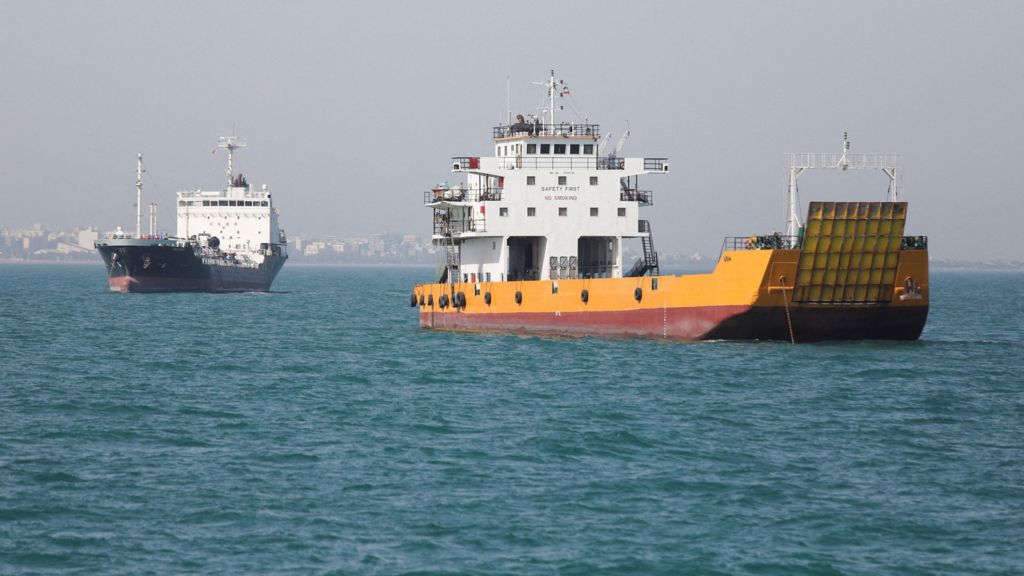
Four weeks after a fragile ceasefire took hold across the Persian Gulf, the truce is rapidly crumbling, with escalating tensions between the United States and Iran pushing the region to the brink of renewed full-scale conflict. At the heart of the standoff is control over the Strait of Hormuz, the world’s most critical energy chokepoint that has become an existential strategic and economic flashpoint for both global powers.
When the ceasefire was first announced, it opened a narrow window for diplomatic de-escalation. Negotiators from Washington and Tehran met face-to-face in Islamabad, the capital of Pakistan, which stepped in as a neutral mediator. But the talks concluded without any breakthrough, leaving the fragile truce hanging by a thread. Pakistani officials have continued efforts to restart dialogue, but so far their outreach has failed to bridge the deep divides between the two sides.
Both Washington and Tehran have publicly expressed willingness to reach a negotiated settlement, but their competing demands and non-negotiable red lines have blocked any path to compromise. Neither side has shown willingness to make the concessions needed to break the impasse, leaving the region just one miscalculated incident away from a return to all-out war. This standoff has created an exceptionally high risk of misperceiving each other’s intentions, a common trigger that has historically pushed unintended crises into full-blown armed conflict.
The strategic significance of the Strait of Hormusz cannot be overstated. Before the U.S.-Israeli strike on Iran in February 2025, the waterway remained open to unrestricted, toll-free navigation for all commercial vessels. Since the attack, Iran has effectively demonstrated its ability to restrict access to the strait, using control over the chokepoint as a leverage tool: it acts as an offensive weapon, a source of potential revenue through tolls, and a deterrent against further attacks. In remarks to Iranian lawmakers this week, Iranian Foreign Minister Abbas Araghchi made clear Tehran’s position that the pre-war status quo will not be restored.
For the United States, allowing Iran to exert full control over the Strait of Hormuz and charge commercial shippers millions in passage tolls would amount to an unacceptable strategic defeat. But any escalation to enforce free navigation carries enormous risks, not just for the region but for the entire global economy.
The economic ripple effects of even partial closure of the strait are already being felt far beyond the Gulf. Already, global supplies of oil, natural gas, helium critical to advanced technology manufacturing, and fertilizer feedstocks are facing growing disruptions. The fertilizer shortage in particular has sparked urgent fears of widespread hunger in low-income nations that lack robust food security systems, putting millions of vulnerable people at risk the longer the closure persists.
U.S. President Donald Trump’s approach to the crisis has been marked by inconsistency and conflicting priorities, rooted in a rash initial decision to go to war that has left the U.S. trapped in a strategic bind. Trump, who has long framed himself as a champion of low energy prices for American consumers, has taken to social media to pressure oil traders against raising gasoline prices for U.S. motorists. But he remains frustrated by the resilience of the Iranian regime, which has refused to buckle under pressure from U.S. and Israeli military strikes and economic sanctions. The Islamic Republic’s security apparatus, which cracked down violently on domestic anti-government protests in January, has shown it is willing to prioritize holding onto power over the well-being of its citizens, giving it little incentive to back down under pressure.
Trump’s recent order for the U.S. Navy to escort two commercial vessels through the strait was intended as a show of force to defend freedom of navigation, but the move did little to restore pre-war traffic levels. Before the outbreak of war, 40 to 60 vessels transited the strait daily; that flow remains severely restricted, and the provocative escort mission was always guaranteed to draw a harsh response from Tehran.
Tehran’s new leadership, which has replaced the former supreme leader and multiple senior officials killed in U.S.-Israeli strikes, has signaled it is willing to escalate to set the terms of the conflict. For the regime, the gamble of renewed war is seen as a calculated risk worth taking to secure its strategic goals.
Regional tensions have spread beyond the U.S.-Iran standoff, with the United Arab Emirates emerging as a key Iranian target among Gulf Arab states. The UAE has deepened its security alliances with the U.S. and Israel in response, receiving an Iron Dome anti-missile defense system from Israel along with Israeli Defense Forces personnel to operate it – a step Israel refused to take for Ukraine amid its ongoing war with Russia.
Iran’s targeting of the UAE’s key Port of Fujairah carries particular strategic weight. Located on the UAE’s Gulf of Oman coastline, outside the boundaries of the Strait of Hormuz, Fujairah is the terminus of a major oil pipeline that allows the UAE to export crude without passing through Hormuz, and it hosts one of the region’s largest commercial oil storage facilities. While the UAE has issued public warnings to Tehran and maintains capable armed forces, it has sought to avoid direct conflict with Iran. That policy could become unsustainable if the ceasefire collapses entirely, and the UAE has already committed billions of additional dollars to purchasing advanced U.S. military hardware to bolster its defenses.
Looking ahead, Trump continues to bet that increasing pressure will force the Iranian regime to collapse and accept a deal on U.S. terms. However, he has refused to accept any agreement that would be seen as weaker than the 2015 Joint Comprehensive Plan of Action (JCPOA), the landmark nuclear deal brokered by former President Barack Obama that Trump withdrew from during his first term in office, at the strong urging of Israeli Prime Minister Benjamin Netanyahu. Trump replaced the JCPOA with a policy of “maximum pressure” that failed to halt Iran’s uranium enrichment program, and ultimately set the U.S. and Iran on the current path to a war with no clear off-ramp.