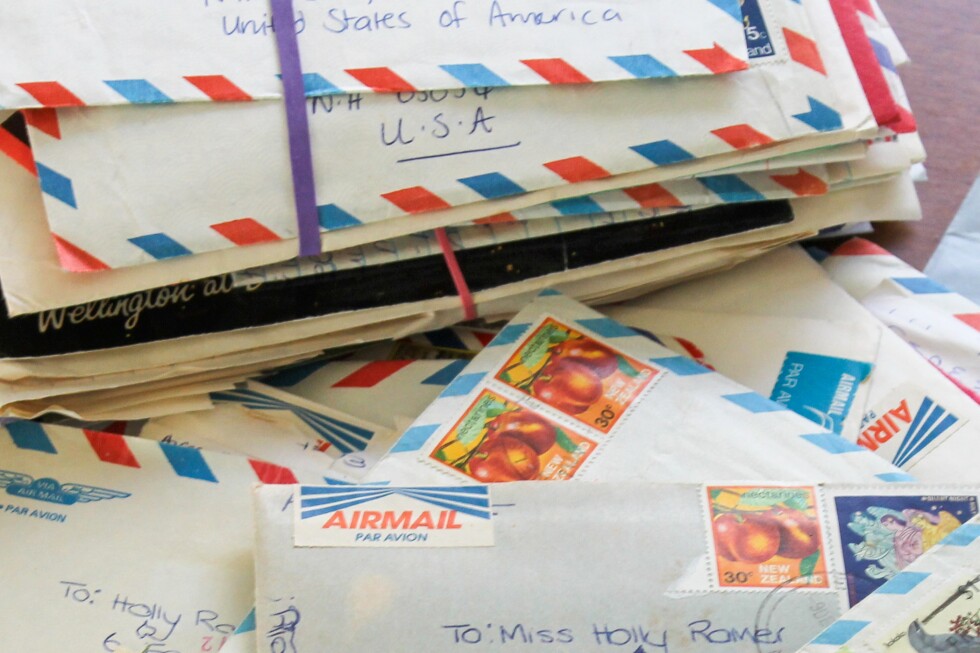
Four decades ago, a 13-year-old girl in New Zealand named Molly Nunns mentioned a pair of coveted purple lip-shaped sunglasses she saw in a magazine to her American pen pal, Holly, who lived 9,000 miles away in Concord, New Hampshire. This past March, Holly finally fulfilled the decades-old wish, traveling across the world to hand-deliver the sunglasses to Nunns — closing a 40-year chapter of a friendship built entirely on handwritten letters that has outlasted shifting communication trends and the rise of the digital age.
The international youth pen pal matching service that first connected Holly and Molly in 1985 shut down long ago, but the tradition of pen pal correspondence is far from dead. Even as postal services across the globe cut back on home delivery — Denmark has stopped residential letter delivery entirely, with Canada following suit and New Zealand reducing delivery days — observers are tracking a steady resurgence of interest in intentional, handwritten letter writing, even among generations raised on constant digital connectivity.
Rachel Syme, a New Yorker writer who launched a grassroots pen pal initiative called Penpalooza at the height of the COVID-19 pandemic and later published *Syme’s Letter Writer – A Guide to Modern Correspondence*, says public appetite for analog correspondence is stronger than ever. More than 15,000 people joined Penpalooza in 2020, and hundreds new participants still sign up for every new round of matchmaking Syme organizes every few months. At book signings, she constantly receives requests for pen pal connections, and the New York City stationery shops she visits regularly draw large crowds of eager shoppers.
Syme notes that for younger people who have grown up constantly glued to smartphones, handwritten letter writing offers a rare chance to step away from the digital noise. “People are very interested in physical, analog things right now,” she explained. “It has an appeal especially to a younger generation who grew up with a phone glued to their hand, to do something that’s more tactile, slower, more intentional, more mindful, but also just disconnected from the internet in every way.”
Longtime pen pal advocates echo Syme’s observations. Julie Delbridge, a 65-year-old Australian who joined International Pen Friends (IPF) as a teenager in 1979, later became the organization’s president in 2001. Delbridge says letter writing gave her a critical positive outlet during her parents’ bitter divorce, offering non-judgmental connection across borders that shaped her life. “It was a pastime that I totally immersed myself into in a positive way and gained a lot of enjoyment from,” she said. “There was an abundance of non-judgmental friendship, fun and different perspectives.”
Over its 59-year history, IPF has connected more than 2 million people aged 8 to over 80 from across the globe. While membership peaked in the late 1990s just before mainstream internet adoption, it surged again during the COVID-19 pandemic, and 2024 has already seen a sharp rise in new members between the ages of 21 and 26.
This growing interest extends to educational spaces, too. In 2021, the U.S. Postal Service launched a national pen pal initiative that distributed materials to 25,000 U.S. elementary school classrooms, but pen pal programs have also taken root at the college level. A group of medical students in Texas created an anonymous pen pal scheme to build peer support and encourage emotional reflection amid the high stress of medical training. At Villanova University, professor Kamran Javadizadeh requires students in his literature course “Letters, Texts, Twitter” to exchange handwritten letters with classmates, even when they could easily pass a note to each other in person.
Javadizadeh argues that instantaneous digital communication erodes a specific type of meaningful connection that only asynchronous letter writing can create. “Something is lost when you have instantaneous communication,” he explained. “So I’m interested in the relationship between synchronous kinds of intimacy and asynchronous forms of intimacy.”
Gordon Alley-Young, dean of communications at Kingsborough Community College in New York, compares the resurgence of letter writing to the renewed popularity of vinyl records: young audiences are increasingly drawn to tangible, physical media from an earlier era as a counterpoint to digital overload. He has used letter writing as a tool to teach empathy to his communication students, finding that when students respond to case studies of interpersonal conflict presented as personal letters, they offer far more vulnerable, thoughtful advice than when they analyze impersonal case studies.
“We really want students to connect to what they’re looking at,” he said. “And letter writing encourages that.”
Even digital platforms are leaning into the pen pal trend, though with a twist. The app Slowly combines modern mobile technology with the slow, anticipatory energy of traditional snail mail pen pal relationships: users send digital messages, but delivery is delayed between one hour and several days to replicate the waiting period that comes with traditional mail. Cofounder JoJo Chan explains that this delay encourages more thoughtful, substantial communication, rather than the quick, superficial greetings common to instant messaging.
Since launching in 2017, Slowly has amassed 10 million users across more than 160 countries, most between their 20s and 30s. Many users, Chan says, first heard about pen pal relationships from their grandparents and are curious to try the experience for themselves. “Slowly offers a convenient way and a modern way for them to try that experience,” she noted.
For advocates like Syme, however, the magic of pen pal correspondence lies in its tangible, physical nature. Her guide includes tips for choosing stationery and pens, and ideas for small mementos to tuck into envelopes, but she emphasizes that the content of the letter matters far more than the frills. “There is joy to be had once you fully embrace the medium’s outdated extravagance,” she writes. But, she added in an interview, the core of letter writing is honest connection: “That’s where I think it can get very real, very quickly.”
For Holly and Molly, that real, lasting connection has shaped 40 years of their lives. The pair exchanged handwritten letters for 15 years before meeting in person for the first time during a 2000 trip to New York, and they have crossed paths multiple times since, including a 2018 visit to New Hampshire from Nunns and her family. When Holly delivered the long-awaited sunglasses on her recent trip, she also brought a printed bound volume of 200 pages of Nunns’ teenage letters, scanned and preserved decades after they were written. While modern technology makes it possible to search and summarize those decades-old scribblings in seconds, it is the depth of the human connection that continues to amaze Holly. After an emotional goodbye at the airport, the pair already plans to meet again — and their correspondence, started 40 years ago, continues.